Soundcore Sleep Earbuds 4 vs 4 Pro (2026)
Soundcore Sleep Earbuds 4 ($229.99) vs 4 Pro ($349.99): snore masking, in-ear heart-rate tracking, AMOLED case and battery compared — which is worth it?
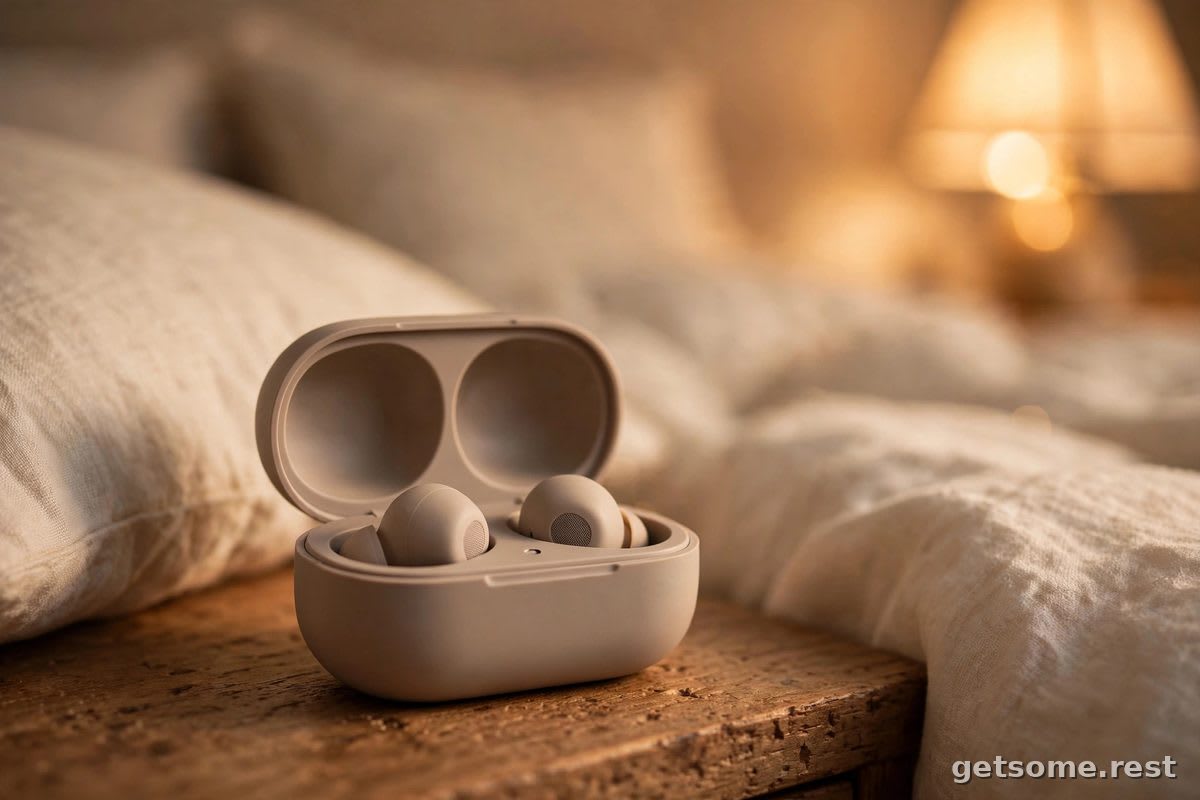
Anker's soundcore announced two new sleep earbuds at IFA 2026 on September 3: the Sleep Earbuds 4 for $229.99, arriving in October, and the Sleep Earbuds 4 Pro for $349.99, arriving in November. They sit above the Sleep A30 ($199.99) and the Sleep A20 ($179.99) in the lineup, and both bring something the older models never had: adaptive snore masking that listens to the room and reshapes its masking audio as snoring changes. The Pro goes further, adding a 100 Hz in-ear heart-rate sensor and a touchscreen charging case that runs bedtime without your phone. Neither model is a medical device, and neither charges a subscription for its sleep features. This comparison lays out exactly what the extra $120 buys, what it does not, and which model fits which sleeper.
Contents
The Two Models at a Glance
The two models share a platform and a launch story, then split on one question: do you want your earbuds to measure you while you sleep? Everything else — the masking, the slim body, the no-subscription promise — is common to both.
| Feature | Sleep Earbuds 4 | Sleep Earbuds 4 Pro |
|---|---|---|
| Price | $229.99 | $349.99 |
| Launch | October 2026 | November 2026 |
| Adaptive snore masking | Yes, AI-generated audio | Yes, AI-generated audio |
| Noise reduction | Passive + sleep-focused ANC (no dB figure) | Passive + 30 dB ANC |
| Heart-rate tracking | No | Yes, 100 Hz in-ear PPG |
| Sleep stages and HRV | No | Yes, with morning report |
| BioSync adaptive audio | No | Yes (experimental lab feature) |
| Charging case | Smart Sensing Case (noise analysis, baby-cry and fire-alarm detection) | AMOLED touchscreen case with its own chip and local storage |
| Bluetooth streaming | Up to 8 h with ANC, 11 h without* | Up to 8 h with ANC, 11 h without* |
| Stored soundscapes | About 9.5 h with ANC, 14.5 h without* | About 9.5 h with ANC, 14.5 h without* |
| Weight | About 3 g per bud | About 3 g per bud |
| Subscription | None for sleep features | None for sleep features |
*Manufacturer estimates. No independent battery testing existed as of November 12, 2026.
The $120 gap buys exactly two things: the in-ear heart-rate sensor with its sleep-stage reporting, and the touchscreen case. Everything about blocking and masking noise is shared. That makes the decision simpler than most $120 upsells: if you do not care about overnight heart-rate data or a phone-free case, the standard model is the whole product. If you do, the Pro is the only way to get them from Soundcore.
Both models replace the Sleep A30 at the top of the range rather than the A20 at the bottom. The A30 ($199.99) stays on sale as the proven, well-reviewed option, and the A20 ($179.99, often discounted) remains the budget pick for passive isolation plus masking. Our Soundcore A20 vs Loop Quiet comparison covers that end of the range in detail.
What Is New in the Sleep Earbuds 4
The standard Sleep Earbuds 4 are the direct successor to the Sleep A30, and the changes are mostly about fit and about what the case can hear. Soundcore built the body from ear data gathered from more than 10,000 people, and says it is about 20 percent slimmer than the A30, with a low-profile layered design and a contact area about 20 percent smaller. For side sleepers that is the spec that matters most: a bud that presses less into the ear when your head is on the pillow is a bud you can actually fall asleep in.
The headline feature on both models is adaptive snore masking. Older sleep earbuds looped a fixed masking sound all night. The new models use a microphone in the charging case to listen for snoring nearby, then reshape the masking audio as the snore shifts in pitch and rhythm. Soundcore calls the masking audio AI-generated, and the system adjusts it in real time rather than playing one track on repeat. Be clear about what masking does: it reduces the intrusion of sounds like snoring, traffic, appliances and conversation. It does not eliminate them, and no earbud can promise silence next to a loud snorer.
The standard model's case is the surprise. It is called the Smart Sensing Case, and it does bedroom noise analysis plus AI sound detection for events like a baby crying or a fire alarm — when it hears one, it ducks the masking audio into transparency so you can hear what is happening. That is a genuinely useful safety feature for parents and light sleepers, and it is worth noting that the Pro, for all its extra hardware, does not do this. Early coverage of the launch flagged the split as odd, and it is worth confirming on the product page before you buy if it matters to you.
Under the hood, both models run on Soundcore's in-house THUS AI audio chip and use Bluetooth 6.0. They also carry the usual sleep-earbud toolkit: soft tips for passive isolation, stored soundscapes that play from the buds themselves, and alarms that play only in your ears so a partner is not woken. Colors for the standard model are Moonlit White and Haze Blue, with Bare Pink following later.
One thing the standard model does not publish is a decibel figure for its noise reduction. The Pro is specified at 30 dB of ANC on top of passive isolation; the standard model's noise reduction is described without a number. That does not mean it is weak — passive isolation does most of the work in a sleep earbud — but it does mean you cannot compare the two on paper for noise blocking alone.
The Pro's Big Upgrades: PPG Tracking and the AMOLED Case
The 4 Pro's case for its $120 premium rests on two pieces of hardware the standard model does not have. The first sits inside the earbud: a 100 Hz optical PPG sensor that reads your pulse from inside the ear canal all night. Soundcore says it tracks heart rate, changes in heart-rate variability, sleep stages, sleep quality and breathing-related patterns, then turns them into a morning report with a Sleep Score, a stage breakdown and a metric called Body Battery. That is smart-ring territory — the Oura Ring 4 costs the same $349 — delivered from inside your ear instead of on your finger, and without Oura's $5.99-a-month membership.
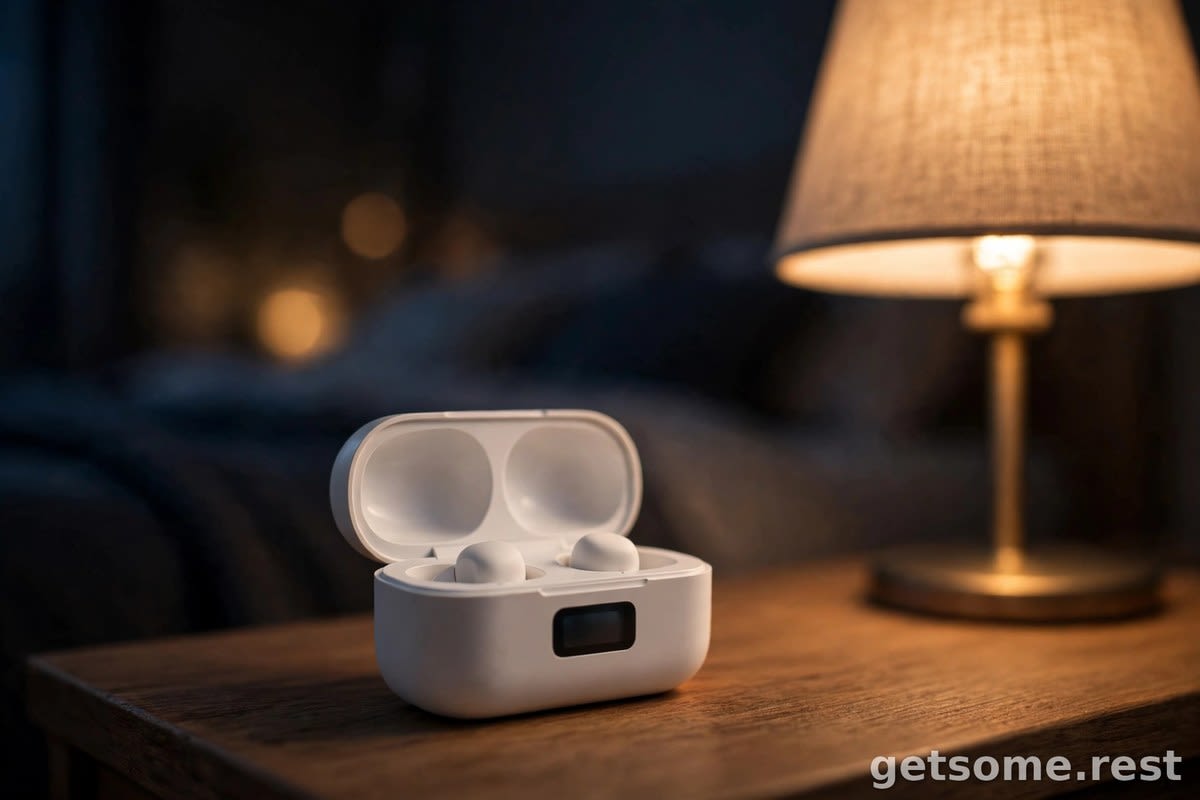
The second piece is the case. The Pro's charging case has an AMOLED touchscreen, its own processing chip and local storage, plus wireless charging. You can adjust audio and volume, set an alarm, play stored sounds, check status and view the morning report without opening the Soundcore app — bedtime without your phone anywhere near the pillow. The case is, as one launch report put it, the computer, and the buds are the sensors you happen to wear. Colors are Lunar White and Mist Blue.
The most experimental feature is BioSync. Instead of using physiological measurements only for a report the following morning, Soundcore says BioSync uses PPG feedback to monitor relaxation and alter the audio while you are trying to fall asleep, reassessing roughly every five minutes and nudging tempo, soundscape and binaural beats. Soundcore labels BioSync a lab feature and says its performance may vary; the company also warns that experimental features can be changed or removed through future updates. Treat it as a bonus, not a reason to buy: the tracking and the case are the durable upgrades, and BioSync may or may not still be there in a year.
A note on accuracy: no independent measurement of the Pro's sensor existed as of November 12, 2026. The product was announced September 3, 2026, and nobody outside Anker had lived with it before launch. In-ear PPG is a proven approach in principle — the ear canal is a good place to read a pulse — but how well Soundcore's staging matches a ring or a watch is untested. If sleep-stage accuracy is the reason you are buying, wait for independent testing before you spend $349.99.
Battery, Comfort and Noise Blocking
Battery is where sleep earbuds live or die: a bud that dies at 3 a.m. is worse than no bud at all. Soundcore rates Bluetooth streaming at up to eight hours with ANC enabled or 11 hours without it. Playing locally stored soundscapes extends the claimed figures to about 9.5 hours with ANC and 14.5 hours without it. Those are manufacturer estimates, and real-world endurance still needs testing — but the stored-sounds figures are the ones that matter, because most people will play a stored soundscape rather than stream from a phone all night. Both models share the same battery figures, so battery is not a reason to pick one over the other.
Comfort is the shared strength. At about 3 grams per bud, with a 20 percent smaller contact area than the A30 and a body shaped from data on more than 10,000 ears, both models are built for side sleepers first. That matters because the most common complaint about sleeping in earbuds is not sound quality, it is pressure. The A20 earned its reputation the same way, with soft twin-seal tips and ear wings that spread pressure; the new models continue that approach in a slimmer body.
Noise blocking works in three layers: passive isolation from the tips and fit, active noise reduction, and masking audio. The A20 relied on passive isolation and masking only, with no ANC, and still earned strong reviews for light sleepers. The new models add sleep-focused ANC on top — 30 dB on the Pro, unspecified on the standard model — plus adaptive masking that responds to snoring in real time. The combination should be meaningfully better than the A20 for a snoring partner, but set expectations honestly: masking reduces snoring, it does not remove it, and a very loud snorer will still come through.
One practical detail: alarms play in the buds only, so you can wake without waking a partner, and the Pro's case lets you set that alarm from the touchscreen without touching your phone. If you keep your phone out of the bedroom at night, that is a small but real quality-of-life win.
Which One Should You Buy?
Buy the Sleep Earbuds 4 ($229.99) if: a snoring partner or bedroom noise is the problem you are solving, you want the baby-cry and fire-alarm detection in the Smart Sensing Case, or you simply do not want another health tracker. It has the full masking system, the same battery, the same slim body and the same no-subscription promise as the Pro. For most buyers, this is the right pick.
Buy the Sleep Earbuds 4 Pro ($349.99) if: you want overnight heart-rate, HRV and sleep-stage data without wearing a ring or watch, and you like the idea of a phone-free bedtime with the AMOLED case. The morning report, the Sleep Score and the Body Battery metric are the Pro's real product; BioSync is a bonus. Just know that the $120 buys a heart-rate graph and a screen, not the safety alerts — the Pro does not do the baby-cry or fire-alarm detection that the standard model's case does.
Consider the A30 or A20 instead if: you want something available and proven today. The Sleep A20 ($179.99) is the budget pick and is regularly discounted, and the A30 ($199.99) adds adaptive ANC and snore-masking detection from the case. If you can sleep tonight with the A20's passive isolation and masking, there is no reason to wait for a November launch. If you need a comparison with non-earbud options, our sleep headphone headband guide covers headband speakers for side sleepers, and Loop Quiet 2 vs Mack's Pillow Soft covers earplugs.
Where to buy: both models sell through soundcore.com and Amazon. The standard model launched in October 2026 and the Pro in November 2026, so check current stock before ordering. You can find the Sleep Earbuds 4 on Amazon and the Sleep Earbuds 4 Pro on Amazon, plus the Sleep A30 and Sleep A20 if you want the proven, cheaper options. Prices change often, especially on Amazon, so verify the price on the listing before you buy.
How We Reported This Story
We have not tested the Sleep Earbuds 4 or 4 Pro, and as of November 12, 2026 no independent reviewer had either — both models were announced at IFA 2026 on September 3 and reached shelves in October and November. Everything in this article comes from Soundcore's own announcement and spec pages, plus launch coverage from Digital Trends, The Gadgeteer, Android Headlines and Gizmodo, and a detailed independent read of the Pro's spec sheet. Where sources disagreed — for example on whether the Pro uses radar — we followed Soundcore's own spec comparison: the 60 GHz radar belongs to the separate SleepLab Pro bedside speaker, not to these earbuds.
- Prices: US list prices as announced at IFA 2026 and checked November 12, 2026: Sleep Earbuds 4 $229.99, 4 Pro $349.99, A30 $199.99, A20 $179.99. UK pricing differs ($229.99 is £199.99 for the standard model, £299.99 for the Pro).
- Battery and ANC figures: manufacturer estimates from Soundcore's spec pages and launch coverage. The Pro's 30 dB ANC figure is published; the standard model's noise reduction has no published decibel figure.
- BioSync: Soundcore's own description, including the company's warning that it is an experimental lab feature that may change or be removed.
- Medical framing: both models are general wellness products, not medical devices, and are not intended to diagnose, treat or prevent conditions including insomnia, sleep apnea or tinnitus.
Frequently asked questions
When do the Sleep Earbuds 4 and 4 Pro ship?
The Sleep Earbuds 4 arrived in October 2026 and the 4 Pro in November 2026, both announced at IFA 2026 on September 3. Soundcore ran a pre-launch offer of a $1 deposit locking in $30 off at launch. Check soundcore.com or Amazon for current stock and pricing, which can change after launch.
Do the Sleep Earbuds 4 or 4 Pro need a subscription?
No. Soundcore has confirmed that all of the sleep features on both models work out of the box with no monthly fee — including the Pro's heart-rate tracking, morning report and BioSync audio. That is a real difference from smart rings and watches, where the full sleep picture usually sits behind a membership.
Are they comfortable for side sleepers?
That is what they are designed for. Each bud weighs about 3 grams, and Soundcore says the body is about 20 percent slimmer than the A30, based on ear data from more than 10,000 people, with a low-profile layered design meant to avoid pressure points when your ear is on the pillow. Comfort still varies by ear shape, so buy from a seller with a decent return window and try them for a few nights.
Can the 4 Pro replace a smart ring or watch for sleep tracking?
Only partly. The Pro tracks heart rate, heart-rate variability, sleep stages and breathing-related patterns while you wear it in bed, and turns them into a morning report. A ring or watch tracks all day and night, so it sees daytime recovery, workouts and naps too. The Pro is a good fit if you hate wearing anything on your wrist but still want staged sleep data; it is not a full replacement for 24/7 tracking.
Is BioSync a medical feature?
No. BioSync is an experimental lab feature, in Soundcore's own words, and the company reserves the right to change or remove it in future updates. It is not medical-grade, and neither model is intended to diagnose, treat or prevent conditions including insomnia, sleep apnea or tinnitus. Treat the tracking as a wellness picture of your nights, not a diagnosis.
Key Takeaways
- Two models, one masking system: the Sleep Earbuds 4 ($229.99, October 2026) and 4 Pro ($349.99, November 2026) share adaptive snore masking, a slimmer 3-gram body and no subscription.
- The $120 buys tracking and a screen: the Pro adds a 100 Hz in-ear PPG sensor (heart rate, HRV, sleep stages), a morning report and an AMOLED touchscreen case with its own chip and storage.
- The standard model has the safety alerts: its Smart Sensing Case detects a baby crying or a fire alarm and ducks the masking audio — the Pro does not do this.
- Battery is shared: up to 8 hours of Bluetooth streaming with ANC (11 without), or about 9.5 hours of stored soundscapes with ANC (14.5 without), per manufacturer estimates.
- BioSync is experimental: the Pro's adaptive audio is a lab feature Soundcore may change or remove; do not buy the Pro for BioSync alone.
- Neither is a medical device: both are wellness products, not for diagnosing insomnia, sleep apnea or tinnitus.