Scientists pinpoint the ideal bedroom temperature for sleep: new research
Harvard researchers measured nearly 11,000 nights of real bedroom sleep and found the sweet spot: 68–77°F, peaking around 70–74°F. Warmer than the old advice — here is why.
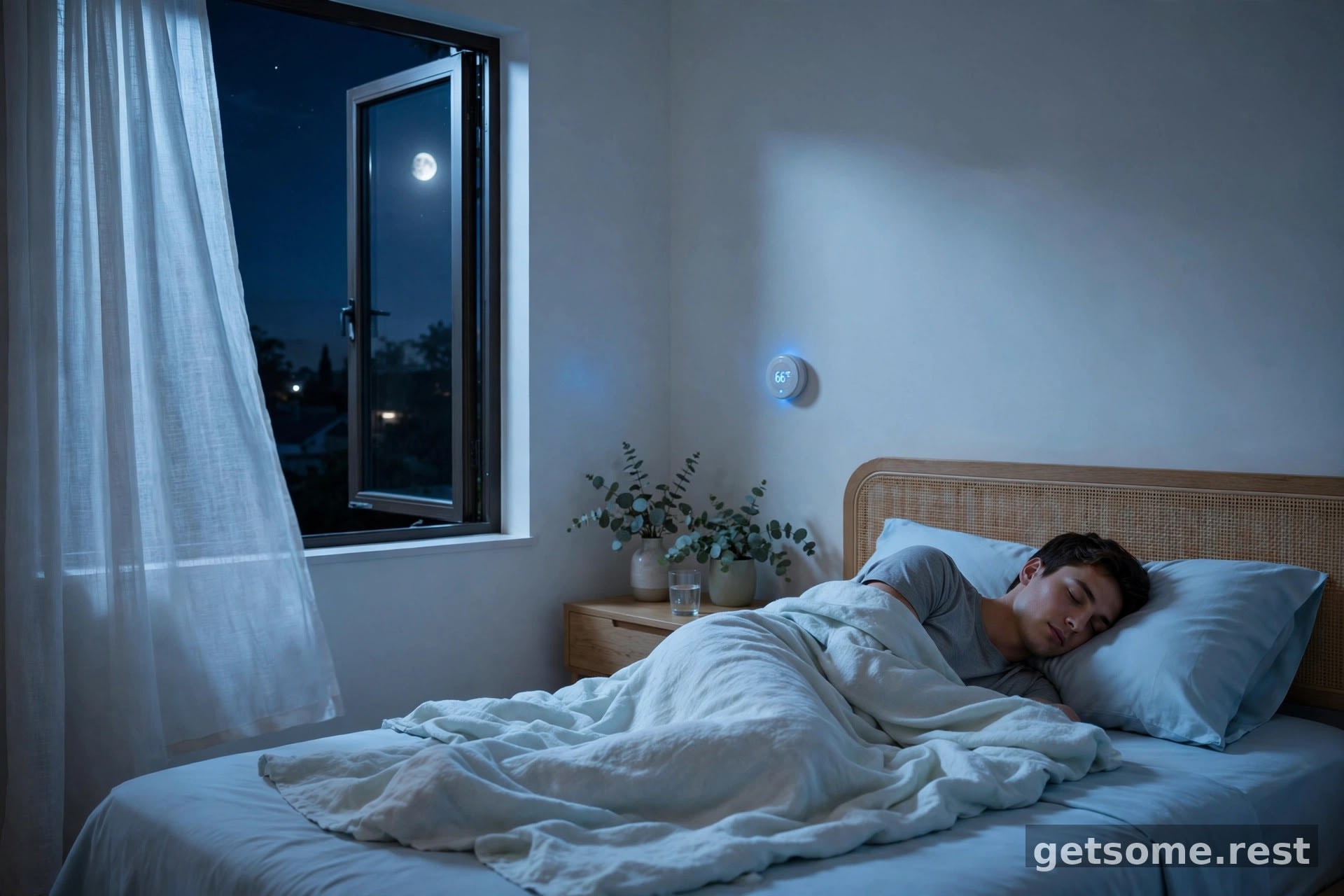
For years the standard advice was a chilly 65°F. Now a team at Harvard Medical School has measured real bedrooms over nearly 11,000 nights — and found the most restful sleep happens warmer than the old guidance suggested.
Contents
The headline study: 11,000 nights of data
The study, published in Science of the Total Environment, was led by Amir Baniassadi, a researcher at the Hinda and Arthur Marcus Institute for Aging Research at Hebrew SeniorLife and Harvard Medical School. From 2021 to 2023, the team followed 50 community-dwelling adults aged 65 and older in Boston, placing environmental sensors in their bedrooms and having each person wear a sleep-tracking ring. The monitors recorded nightly temperatures alongside sleep duration, efficiency, restlessness, respiration, heart rate, and body temperature.
The dataset is what makes the study unusual: nearly 11,000 person-nights of objective data from real bedrooms, not a lab. Most temperature-and-sleep research is either lab-based — precise but artificial — or survey-based, which is notoriously unreliable. This study sits between the two, with sensors in real homes over a long enough window to see patterns through night-to-night noise.
The central finding: sleep was "most efficient and restful" at 68 to 77°F (20 to 25°C), with Baniassadi telling the Washington Post that the real peak was narrower — 70 to 74°F. On either side of the band, efficiency slipped. As rooms warmed from 77°F toward 86°F, sleep efficiency dropped by 5 to 10 percent — a decline large enough to matter, since earlier research has linked a 10-percent efficiency drop to impaired next-day brain performance, higher stress and fatigue, and worse blood-sugar control.
Two nuances deserve attention. First, the relationship was nonlinear — not "cooler is always better." Sleep efficiency also declined below 68°F, just less steeply than in the heat. Second, the researchers found substantial between-individual differences: some participants slept best near the cool end, others near the warm end. Any single number is an average, not a prescription, and the authors stressed personalized temperature adjustments.
For a deeper look at how specific sleep stages respond to conditions like this, our coverage of the deep sleep and memory study is a useful companion read — temperature is only one lever among several that shape the night.
Why temperature matters for sleep at all
To understand why the thermostat matters, it helps to know what the body is doing as you fall asleep. Initiating sleep requires your core body temperature to drop by roughly one to two degrees Fahrenheit. This is not incidental — the temperature drop is part of the machinery of sleep onset, closely timed with the evening rise of melatonin. Anything that fights the cooling fights sleep.
The body cools itself mainly by dumping heat through the skin, and the most effective radiators are the hands and feet. Research on thermoregulation — notably by Kurt Kräuchi and colleagues — has shown that warm extremities paired with a cooling core predict how quickly someone falls asleep. This is the physiological logic behind wearing socks to bed: warm socks in a cool room is not a contradiction, it is the mechanism working as designed.
A hot bedroom breaks the mechanism in two ways. First, it slows the core-temperature drop, which stretches out the time it takes to fall asleep. Second, it fragments the sleep you do get: heat increases restlessness and wakefulness, particularly in the second half of the night when the body's temperature is at its lowest and most vulnerable to disturbance. Cold rooms cause less damage, but they are not free either — being cold enough to shiver or tense up keeps the nervous system alert, which is presumably why the Harvard data showed efficiency dipping below 68°F as well.
Humidity rides along with temperature. High humidity slows sweat evaporation, making a warm room feel warmer and bedding feel clammy. If your room is in the right band but sleep still feels restless, humidity may be the unmeasured variable — a simple hygrometer removes the guesswork.
Sleep was most efficient and restful when nighttime bedroom temperature ranged from 68 to 77°F — and the real peak, the researchers said, sat at 70 to 74°F.
Source: Baniassadi et al., Science of the Total Environment (2023)
The old advice vs. the new findings
If you have read any sleep guide in the last decade, you have seen the number 65°F. It is the figure most commonly cited by sleep experts — cool, borderline chilly — and it is worth asking why the new study lands several degrees warmer.
The honest answer is that the two numbers describe different things. The classic 65-to-68°F guidance is a general recommendation for all adults, shaped partly by lab research and partly by expert consensus. The new 68-to-77°F band is an empirical finding from one specific group: adults aged 65 and older, sleeping in their own Boston homes. Older adults regulate body temperature differently — they tend to feel cold more easily and have less physiological flexibility in responding to heat — so it is entirely plausible that their optimal range skews warmer than a 30-year-old's.
There is also a measurement difference. Lab studies isolate temperature by holding everything else constant; field studies capture it as it actually varies alongside bedding, clothing, and heating habits. Neither is wrong — the lab shows what temperature does to the body, the field shows what it does to a person in their own bed on a Tuesday.
The practical reading is not "65 was wrong" but "the band is wider than the old advice suggested, and your optimum depends on age, bedding, and how you sleep." A younger adult under a heavy duvet may do best near 65°F; an older adult under light blankets may do best near 72°F. Both are inside the science — and the right temperature is the one you stop noticing.
One more consideration for couples: the study's individual-variation finding is the scientific basis for the two-temperature bedroom. If one partner runs hot and the other runs cold, no single thermostat setting is optimal for both — which is why dual-zone bedding, separate blankets, or a mattress with per-side climate control can be worth more than a degree or two on the thermostat. Our comparison of memory foam vs. hybrid mattresses for hot sleepers gets into how the mattress itself changes the equation.
The climate-change connection
The study's authors did not frame their work as pure sleep science — they framed it as a climate paper. Nighttime temperatures are rising in cities across the world, and the finding that sleep efficiency drops 5 to 10 percent as rooms warm from 77°F toward 86°F has a direct implication: hotter nights mean measurably worse sleep, and the effect lands hardest on the people least able to adapt.
Older adults are the vulnerable group twice over. Physiologically, they are more sensitive to heat stress, day and night. Economically, they are more likely to live in housing without effective cooling and less able to afford running air conditioning all night. The authors explicitly call out lower-socioeconomic-status older adults and argue for "increasing their adaptive capacity" — a careful phrase that covers everything from better-insulated housing to community cooling strategies to simply making sure people know that a fan and an open window can help.
The scale is not small: broader research estimates that by century's end, rising nighttime temperatures could erode roughly 50 hours of sleep per person per year — a population average, with the elderly and the poor bearing more than their share. When nights get hotter, the losses show up in mood, stress, blood-sugar control, and next-day cognition — exactly the outcomes the Harvard team flagged.
None of this is a reason for fatalism. The study's core message is empowering: the bedroom is an environment you can change, and small changes land inside the range where sleep is most sensitive. Which brings us to the practical part.
What you can do tonight
Start with the thermostat. If you have one, set it to land in the 68–77°F band and give it three or four nights before judging — one night is not enough data, because sleep varies for a dozen reasons. If you wake up sweating, nudge it down; if you wake up cold, nudge it up. The study's peak of 70–74°F is a reasonable starting point for most people, and younger adults who run hot can reasonably start at the cool end.
If you do not have air conditioning, work with airflow. Cross-ventilation — windows open on opposite sides of the room — moves more air than a single open window, and a fan pointed at the bed accelerates the evaporation that cools your skin. This is genuinely effective: moving air lowers the perceived temperature by several degrees even when the thermometer does not budge. Night-shift workers sleeping through hot daytime hours face the same problem; our night-shift sleep schedule guide covers daytime cooling too.
Next, audit your bedding. Heavy synthetic comforters trap heat against the body; cotton, linen, and bamboo breathe better. If you consistently wake up overheated, a cooling mattress topper can lower the sleep-surface temperature without replacing the mattress, and mattresses with open coil structures sleep cooler than dense all-foam — see our latex vs. memory foam comparison for the details.
Two smaller tricks round out the list. A lukewarm shower an hour or so before bed warms the skin, which accelerates the body's heat-dumping afterward and helps the core temperature drop — the same mechanism as the warm-socks trick. And keep the bedroom door open if the hallway is cooler than the room; bedrooms can run several degrees warmer than the rest of the house once the door is closed and two bodies are radiating heat into a small space.
Finally, track what you change: a note of the thermostat setting plus a morning rating of your sleep, kept a week per setting, is enough to find your own optimum. The study's numbers are averages; yours is the one you discover yourself.

How we test
We never accept payment for rankings. For research coverage like this article, every finding is judged against the same five checks:
- Sources
- We cite the original study or an official summary of it, not a headline about a headline. Where a finding comes from a single study, we say so.
- Study quality
- We note the design behind a claim — lab experiment, observational study, or survey — because each supports a different strength of conclusion.
- Claim scope
- We check that a study's population matches the advice. Findings from older adults are reported as findings from older adults, not universal rules.
- Expert guidance
- We compare new findings against existing consensus and explain disagreements instead of picking a winner.
- Updates
- We revisit research coverage when major new studies appear, and we date every claim so you can see how fresh the evidence is.
Frequently asked questions
What is the ideal bedroom temperature for sleep?
Recent research on older adults found sleep was most efficient and restful when the bedroom stayed between 68 and 77°F, with a peak around 70 to 74°F. The classic expert guidance for the general population remains roughly 65 to 68°F. Both point in the same direction — cool, not cold — and both studies emphasize that the ideal varies between individuals, so treat these as starting points to fine-tune.
Is 70 degrees too warm to sleep?
No — 70°F sits inside the range where the newest study found sleep most restful. In the study of 50 older adults, the real peak of restfulness was 70 to 74°F. Problems appeared mainly above 77°F, where sleep efficiency dropped 5 to 10 percent as rooms warmed toward 86°F. If you sleep well at 70, the research says that is a perfectly reasonable setting.
Why do scientists recommend different temperatures than the classic 65°F advice?
The numbers come from different populations and methods. The classic 65 to 68°F guidance is a general recommendation for all adults, while the newer 68 to 77°F finding comes from measuring real bedrooms of adults aged 65 and older over nearly 11,000 nights. Older adults regulate body temperature differently and often feel cold more easily, so their optimal range skews warmer. The takeaway is not that one number is wrong, but that age and personal comfort shift the ideal.
Does bedroom temperature affect deep sleep?
Yes. Falling asleep requires your core body temperature to drop by roughly one to two degrees, and a hot room fights that process. Research consistently shows that heat increases wakefulness and restlessness and reduces sleep efficiency, while a cool room supports the body's natural nighttime cooling. Warm hands and feet — which help the body shed heat — are associated with falling asleep faster, which is why warm socks in a cool room is a surprisingly effective combination.
How can I keep my bedroom cool without air conditioning?
Cross-ventilation is the cheapest fix: open windows on opposite sides of the room to create airflow. A fan pointed at the bed helps sweat evaporate and cools the skin, and breathable bedding — cotton, linen, or bamboo — traps less heat than heavy synthetics. A cooling mattress topper or a mattress with airflow-friendly construction can lower the sleep surface temperature, and a lukewarm shower before bed helps the body dump heat afterward.
Key takeaways
- A Harvard-led study of nearly 11,000 nights found sleep most restful at 68–77°F, peaking at 70–74°F — warmer than the classic 65°F advice.
- The finding comes from adults 65 and older in real homes; younger adults may still do best at the cooler end, and individual variation is large.
- Heat is the real enemy: sleep efficiency fell 5–10% as rooms warmed from 77°F toward 86°F.
- Falling asleep requires your core temperature to drop — a cool room plus warm hands and feet is the mechanism working as designed.
- Start in the band, adjust over several nights, and treat your own comfort — not any single number — as the final answer.