BedJet 3 vs ChiliSleep Dock Pro: Air or Water — Which Active Cooling System Fits Your Bed?
BedJet 3 (from ~$417) vs ChiliSleep Dock Pro (from $999): forced-air vs water bed cooling compared on cooling power, noise, heating and value. October 2026.
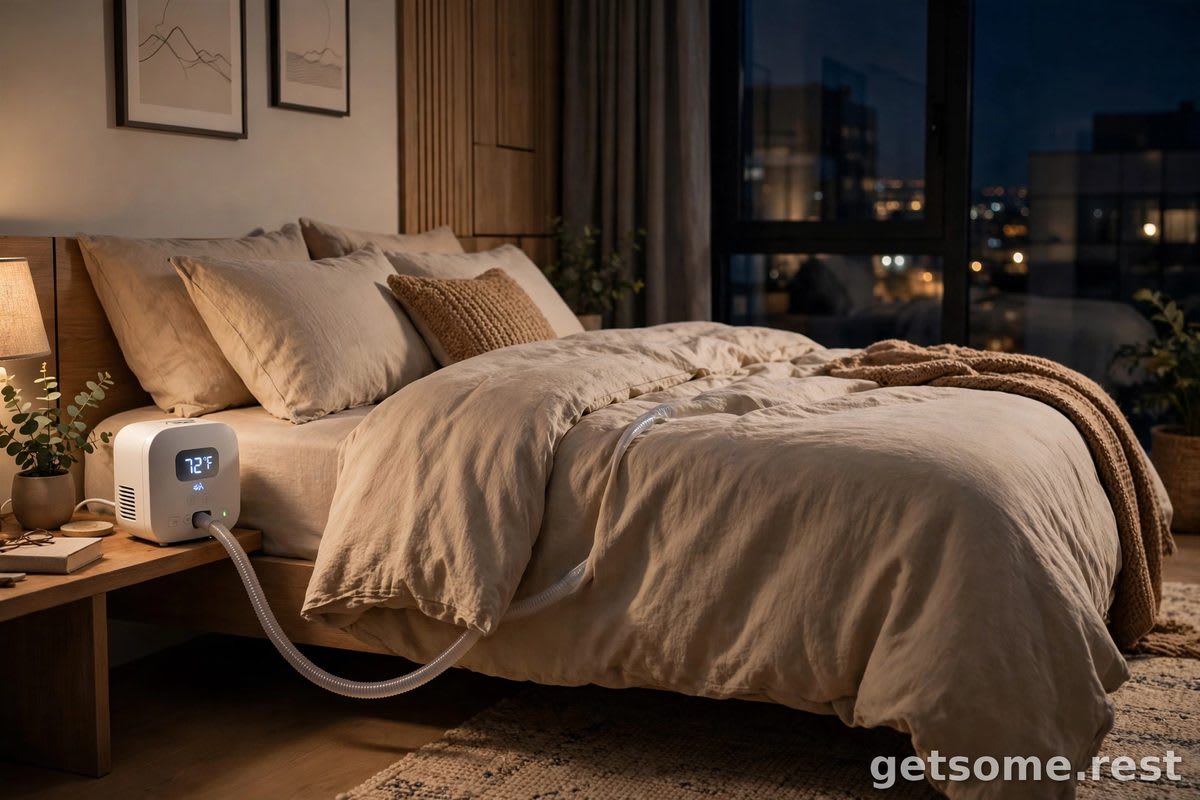
Passive cooling — breathable sheets, cooling toppers — only goes so far. The BedJet 3 and ChiliSleep's Dock Pro are active systems: they mechanically move heat out of your bed all night. But they do it in completely different ways. The BedJet 3 blows temperature-controlled air under your sheets, like a personal ventilation system. The Dock Pro circulates chilled water through a mattress pad, like a radiator in reverse. Here's how forced air stacks up against water.
Contents
BedJet 3 vs Dock Pro at a glance
One blows air, the other pumps water — and that single difference decides almost everything. This is the short version; the physics, the specs table and the full verdict are further down.
| Pick | Winner | Why |
|---|---|---|
| Best budget active cooling | BedJet 3 | From ~$417 — less than half the Dock Pro's entry price |
| Deepest cooling | ChiliSleep Dock Pro | Actively chills the mattress surface to 55°F; BedJet can't beat room temperature |
| Best heating | BedJet 3 | Warm air under the covers in seconds; noticeably faster than water heating |
| Simplest setup | BedJet 3 | ~15 minutes, no water, no priming — just the unit, the hose and your bedding |
| Best for couples | Tie | BedJet dual-zone bundle ($1,279) vs Dock Pro dual-side control (WE size) — both work |
Prices last checked October 2026. BedJet range covers app-only single-zone through the dual-zone bundle.
Air vs water: the physics that matters
The BedJet 3 is a ventilation system. Its unit pulls in room air, adjusts the temperature of that air, and pushes it under your sheets through a soft hose. Moving air strips heat and moisture away from your body — the same reason a fan feels cooler than still air. It's excellent at drying out night sweats and at taking the stuffy edge off warm bedding. But it is fundamentally bounded by the room: it cannot make your bed colder than the air it pulls in.
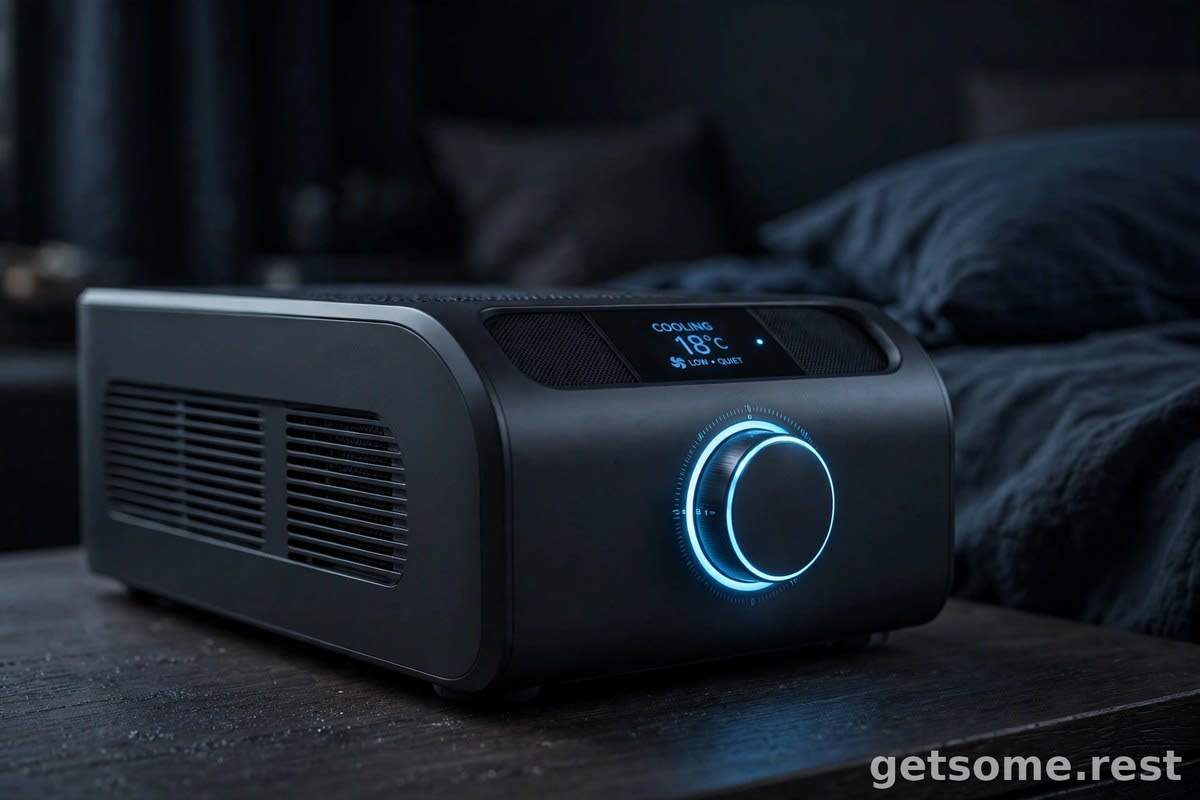
The Dock Pro is a conduction system. Its control unit actively chills (or heats) water, then circulates it through a tubeless hydro-membrane mattress pad you sleep on. Water in direct contact with the mattress surface transfers heat far more efficiently than air, so the pad can genuinely drop to 55°F even when the room is warm. It's the difference between a breeze and an ice pack.
- Cooling power. The Dock Pro's 95 watts of cooling power (roughly double the older Ooler) holds its temperature even in warm rooms. The BedJet's airflow cools you below your skin temperature through evaporation and convection, but never below room temperature.
- Heating. The BedJet's warm air mode is its secret weapon — it warms the bed in seconds, faster than any water system can heat its thermal mass. The Dock Pro heats to 115°F too, but more gradually.
- Noise. The BedJet runs 30-46 dB(A) depending on fan speed — a soft whoosh at the top end. The Dock Pro's pump is quieter, a low hum plus faint pad crinkling. Both are white-noise-adjacent; neither is silent.
- Maintenance. The BedJet asks for nothing — no water, no filters. The Dock Pro needs distilled water refills and periodic cleaning of the hydro system. If "appliance that just works" matters, BedJet wins.
- Feel in bed. The BedJet needs no mattress pad — air flows under your normal sheets. The Dock Pro's pad sits between you and the mattress; the tubeless hydro-membrane is thinner and softer than older tube designs, but it's still an extra layer.
The airflow is different from water in a way some people genuinely prefer. You feel it more like a warm or cool breeze than direct cold or heat against your body.
Source: breakingeighty (hands-on Eight Sleep vs BedJet 3 comparison, 2026)
Why the BedJet can't beat a warm room
This is the single most important buying fact in the article. If your bedroom sits at 78°F with no AC, the BedJet cannot give you a 65°F bed — it can only give you moving 78°F air, which feels better than still 78°F air but is still 78°F. In a moderately cool room (68-72°F), the BedJet is genuinely excellent. In a hot apartment with no cooling, the Dock Pro's chilled water is the only one of the two that actually solves the problem. Our guide to sleeping cool without AC covers the low-tech side of the same battle.
Why water wins for deep cooling
Water conducts heat roughly 25 times better than air, and the Dock Pro exploits that fully: the tubeless ChiliPad Pro membrane spreads water across five times the surface area of older tube designs, with no tubes to feel under you. Set it to 60°F and the mattress surface actually gets to 60°F. That's why hot sleepers who tried fans and breathable toppers and still woke up sweating tend to land on water systems — they're the first thing that changes the temperature of the surface itself rather than just the air above it.
The no-subscription angle
Both systems are buy-it-once products: every feature, every schedule, every temperature works with no monthly fee. That sounds unremarkable until you look at the smart-cooling market — Eight Sleep's Autopilot is mandatory for the first year at $199, and most of the intelligence disappears if you cancel. If the idea of a sleep subscription bothers you, the BedJet and Dock Pro are the two serious systems that never ask for one.
Full specs compared
The raw numbers behind the verdict. Prices from brand and retailer pages; specs from the manufacturers.
| Feature | BedJet 3 | ChiliSleep Dock Pro |
|---|---|---|
| Cooling method | Forced air under the sheets | Chilled water through a mattress pad |
| Temperature range | Limited by room temperature | 55°F to 115°F at the pad surface |
| Heating | Yes — warms the bed in seconds | Yes — up to 115°F, more gradual |
| Noise | 30-46 dB(A), fan whoosh | Very quiet pump + faint pad crinkle |
| Setup time | ~15 minutes | ~30 minutes + priming |
| Maintenance | None | Distilled water refills; periodic cleaning |
| Controls | Remote + app (Biorhythm sleep programming) | Buttons on unit + free Sleepme app (Wi-Fi); optional $249 sleep tracker |
| Subscription | None | None |
| Dual-zone option | Yes — dual-zone bundle ($1,279) | Yes — WE size covers full bed with independent sides |
| Price | ~$417-$569 single-zone; $1,279 dual-zone bundle | From $999 (ME half-bed); ~$1,299+ (WE full-bed) |
Prices last checked October 2026 and may change with promotions. Specs from BedJet and Sleepme product pages.
Our verdict: air or water?
Buy the BedJet 3 if you want the most affordable entry into active sleep cooling, you love the feeling of airflow, you deal with night sweats (the BedJet's moisture removal is genuinely excellent), or you want serious heating power too — its warm-air mode is the fastest bed-warmer in the category. It's also the right pick if you refuse all maintenance: no water, no filters, no priming. Just know its hard limit: in a hot room with no AC, it can't give you a cold bed.
Buy the ChiliSleep Dock Pro if you need the deepest cooling available without a subscription — real, sub-room-temperature chilling that holds even when the room is warm. It's the pick for hot sleepers who've exhausted passive options (breathable sheets, cooling toppers) and still wake up warm, and for anyone who wants heating and cooling in one tubeless pad. The price is the obvious trade-off — roughly double the BedJet — plus the water refills. But for raw cooling performance per dollar with no monthly fee, it's the strongest system in its class.
The two systems in detail
One-line verdicts, current prices and the main pros and cons from our research. Links are plain — no affiliate tags attached yet.
Best budget active cooling
BedJet 3 Climate Comfort System
The affordable active cooler: forced air that dries night sweats, warms the bed in seconds, and runs with zero maintenance — bounded only by room temperature.
~$417-$1,279 at time of writing, depending on configuration
Pros
- Fastest bed heating in the category — warm air in seconds
- Excellent moisture and sweat removal via airflow
- No water, no filters, ~15-minute setup; no subscription
Cons
- Cannot cool below room temperature — useless in a hot uncooled room
- Some sleepers dislike feeling air move under the bedding
- Best performance needs the optional Cloud Sheet ($139+)
Deepest cooling
ChiliSleep Dock Pro
The strongest subscription-free cooler: chilled water down to 55°F through a tubeless pad, with real heating too — at roughly double the BedJet's price.
from $999 at time of writing (ME half-bed size)
Pros
- Genuine sub-room-temperature cooling (55-115°F range)
- Tubeless hydro-membrane pad — no tubes to feel
- No subscription; free Sleepme app with schedules and automation
Cons
- Roughly double the BedJet's entry price
- Needs distilled water refills and periodic cleaning
- Extra pad layer between you and the mattress
How we researched this comparison
Comfort and environment only — this is a buying guide, not medical advice, and we never diagnose or treat sleep disorders.
- Engineering differences
- Cooling method, temperature ranges, noise levels and maintenance needs come from the brands' own specifications and manuals.
- Hands-on reviewer consensus
- We cross-checked owner and reviewer patterns across sleep publications and independent testers — cooling performance in warm rooms, noise, and the water-maintenance reality.
- Price checks
- Prices were verified October 2026 across brand and retailer pages. Both brands discount regularly.
- Subscription audit
- We verified that every feature on both systems works with no monthly fee — and noted where competitors differ.
- Independence
- We never accept payment for rankings. Product links in this article are plain — no affiliate tags attached.
Frequently asked questions
Are heated mattress pads safe to leave on all night?
Yes, with a modern pad that has an auto shut-off timer and overheat protection, such as the ETL- or UL-certified models we compare here. Set the auto-off timer for the time you actually need — most sleepers use one or two hours after falling asleep rather than the full 12-hour window — and never use a pad that is damp or folded over itself.
Heated mattress pad vs electric blanket: which is better for sleep?
A heated mattress pad usually wins for sleep. It warms the bed from underneath so heat rises around you, it never slides off, and it can preheat the bed before you get in. Electric blankets trap heat on top and often make sleepers overheat; a pad plus your normal blanket lets you fine-tune warmth on each side.
How much does it cost to run a heated mattress pad?
Very little. A pad like the Bwarm HeatSync draws about 65 watts per side — roughly the same as an incandescent light bulb. Running one side for eight hours costs only a few cents of electricity, far less than running a 1,500-watt space heater to warm the whole bedroom.
Will a heated mattress pad fit my mattress?
Most fit mattresses up to 18 inches deep, which covers the majority of pillow-top and hybrid mattresses. If your mattress is thicker than 18 inches, pick a deep-pocket model — the Beautyrest Cotton pad here fits up to 21 inches, and all three pads use all-around elastic skirts so they stay put.
Can I wash a heated mattress pad?
Yes — all three pads we compare are machine washable. Detach the controller and cords first, wash on a gentle cycle, and make sure the pad is completely dry before plugging it back in. Never dry clean or bleach it, and never operate a pad that is still damp.
Key takeaways
- The BedJet 3 (from ~$417) blows temperature-controlled air under your sheets: great for airflow lovers, night sweats and fast heating — but it can't cool below room temperature.
- The ChiliSleep Dock Pro (from $999) circulates chilled water for genuine sub-room-temperature cooling down to 55°F — the strongest subscription-free cooler in its class.
- BedJet setup takes ~15 minutes with zero maintenance; the Dock Pro needs distilled water refills and occasional cleaning.
- Both are subscription-free — a real advantage over systems that put features behind a monthly fee.
- In a hot room with no AC, only the Dock Pro can actually deliver a cold bed.