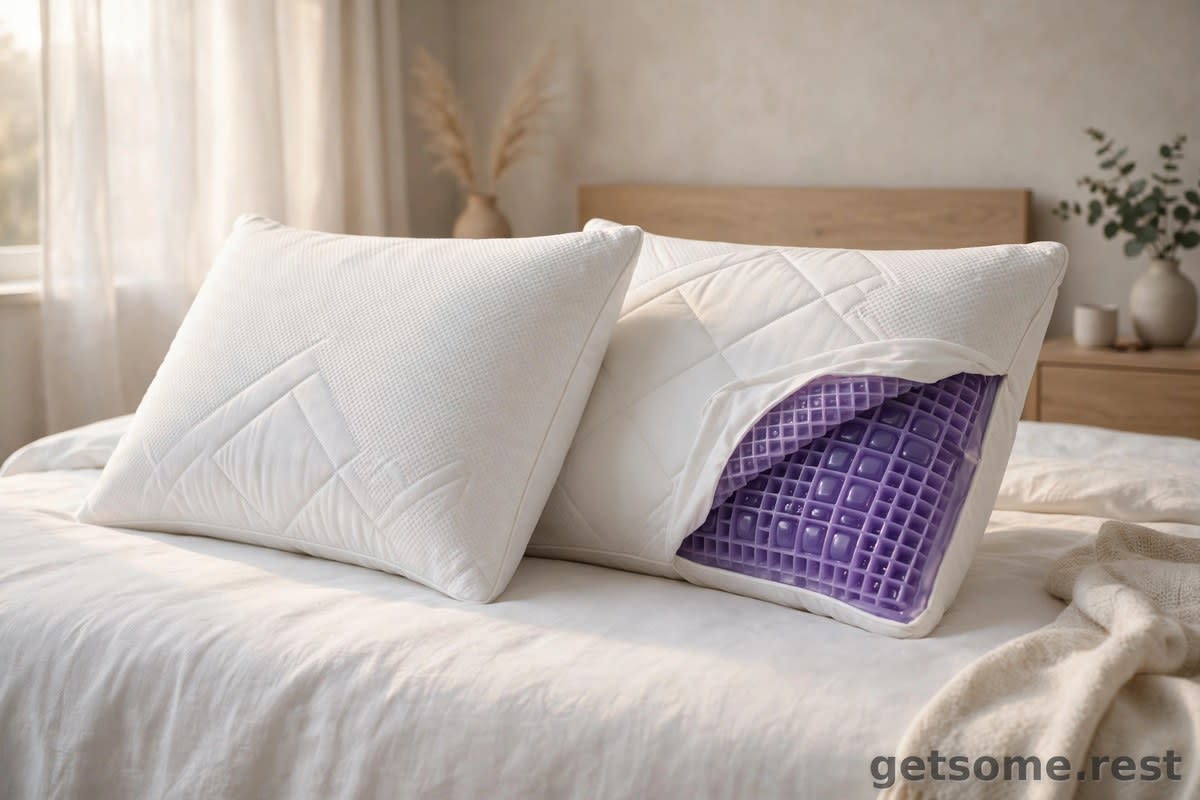
Best Pillows for Sleeping in 2026: Top Picks by Sleep Position
Best pillows for sleeping in 2026, picked by sleep position: Coop Eden, Purple Harmony, Tempur-Pedic, Bluewave, EPABO and Beckham compared on loft, cooling and price.
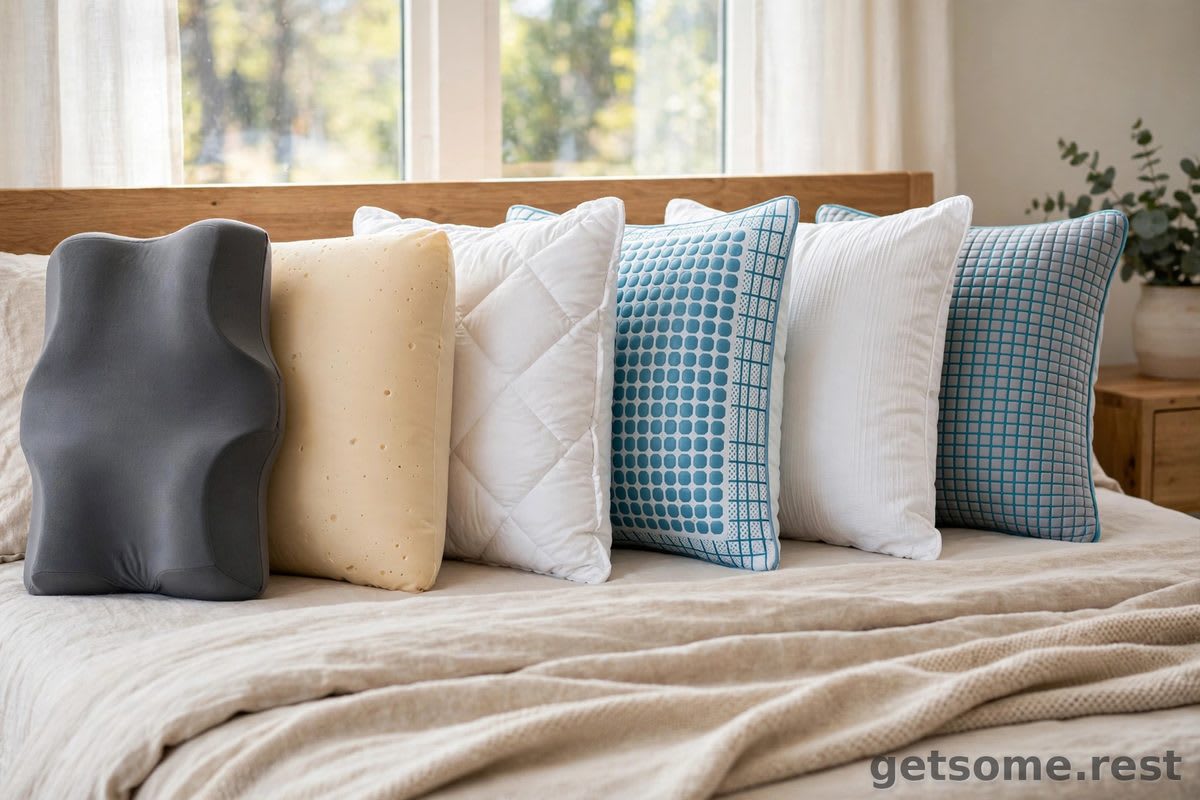
The wrong pillow is the most common fixable sleep problem — and the fix is cheaper than any mattress upgrade. The right pick depends almost entirely on how you sleep: side sleepers need loft, stomach sleepers need flatness, and hot sleepers need airflow. These six real pillows cover every position in 2026, with real prices and the honest trade-offs of each.
Contents
Our top picks at a glance
Six pillows, six lanes, zero overlap. This is the short version — the buying guide, the specs table and the full reviews are below.
| Pick | Winner | Price | Why |
|---|---|---|---|
| Best overall | Coop Home Goods Eden | ~$96 | Adjustable shredded fill: the right loft for any position, plus real cooling |
| Best for side sleepers | Tempur-Pedic TEMPUR-Adapt ProHi 2.0 | ~$175 | High, firm loft that holds the shoulder-ear gap all night |
| Best for back sleepers | EPABO Contoured Memory Foam | ~$65 | Ergonomic contour cradles the neck’s curve at a budget price |
| Best for stomach sleepers | Bluewave Bedding Ultra Slim | ~$50 | True 2.75-inch profile keeps the neck from arching backward |
| Best cooling | Purple Harmony | ~$229 | Open polymer grid over latex — the most breathable pillow here |
| Best budget | Beckham Hotel Collection (2-pack) | ~$45 | Hotel-plush, washable, and two pillows for the price of one premium single |
Prices last checked October 2026. Pillow prices move less than mattress prices, but holiday sales still cut 15–30% off most of these.
How to choose a pillow by sleep position
A pillow has one job: keep your neck aligned with your spine in the position you actually sleep in. Everything else — cooling, adjustability, material — is secondary to getting the loft right.
- Side sleepers: high loft, firm support. Your shoulder creates a 4–6 inch gap between the mattress and your ear. Too thin and your neck cranes down; too soft and it collapses by 2 a.m. Dense memory foam or a fully-stuffed adjustable pillow is the answer — our best pillows for side sleepers guide goes deeper on fill types and shoulder widths.
- Back sleepers: medium loft, neck contour. You need enough lift to support the neck’s natural curve without pushing your chin to your chest. Contoured memory foam pillows (EPABO) are purpose-built for this; a medium-fill adjustable (Coop Eden) works too.
- Stomach sleepers: low loft, soft-to-medium. Anything thick forces your neck into extension — the morning-stiffness classic. Under 3 inches is the rule; some stomach sleepers do best with no pillow at all under the head.
- Hot sleepers: airflow over marketing. Solid memory foam is the worst offender for heat. Open structures — shredded fill, polymer grids, ventilated foam — let heat escape instead of pooling under your cheek. Our Purple Harmony vs Coop Eden comparison tests the two most credible cooling designs head to head.
- Combo sleepers: adjustability wins. If you rotate positions through the night, a pillow you can add fill to (side) or remove fill from (back, stomach) beats buying three fixed pillows.
A pillow has one job: keep your neck aligned with your spine in the position you actually sleep in. Loft is the decision; everything else is a tiebreaker.
Source: our synthesis of 2026 pillow testing and ergonomic guidance
Material cheat sheet
Shredded memory foam (Coop Eden) is adjustable, breathable and mid-priced. Solid memory foam (Tempur-Pedic, EPABO, Bluewave) holds a precise shape and lasts, but traps more heat. Latex (Purple Harmony’s core) is bouncy, durable and naturally cooler. Down alternative (Beckham) is cheap, washable and plush, but flattens fastest. Gel infusions and phase-change covers help modestly — structure matters more than additives.
When the pillow is not the problem
If you have tried three good pillows and still wake up uncomfortable, look at the mattress: a too-soft bed lets the whole torso sink and no pillow can compensate. Our best mattresses for back pain under $500 guide covers supportive budget beds. And if discomfort is persistent, that is a clinician conversation — pillows are comfort gear, not treatment.

Head-to-head specs
The raw numbers behind the verdict. Prices last checked October 2026.
| Feature | Coop Eden | Tempur-Pedic ProHi | EPABO Contour | Bluewave Ultra Slim | Purple Harmony | Beckham Hotel (2-pack) |
|---|---|---|---|---|---|---|
| Fill | Gel-infused shredded memory foam | Shredded TEMPUR material | Solid memory foam, contoured | Solid gel memory foam, 2.75 in | Polymer grid + Talalay latex | Gel fiber (down alternative) |
| Loft | Adjustable | High, adjustable | Medium, contoured | Low (2.75 in) | 3 heights available | Medium-plush |
| Best for | All positions | Side sleepers | Back sleepers | Stomach sleepers | Hot sleepers | Budget buyers |
| Cooling | Good | Average | Average | Good | Excellent | Average |
| Washable | Cover only | Cover only | Cover only | Cover only | Cover only | Whole pillow |
| Trial | 100 nights | 90 nights | 30 days | 60 nights | 100 nights | 30 days (Amazon) |
| Price | ~$96 | ~$175 | ~$65 | ~$50 | ~$229 | ~$45 (2-pack) |
Trial terms from brand pages, October 2026. Trial lengths on Amazon-purchased pillows follow the retailer’s return policy.
Our verdict: the best pillow for sleeping in 2026
Buy the Coop Home Goods Eden if you want one pillow that just works. The adjustable shredded fill is the cheat code: stuff it full for side sleeping, remove half for back sleeping, and fluff it back to life for years instead of replacing it. Gel-infused foam plus a breathable, phase-change cover keeps it genuinely cooler than solid foam. Around $96 (often $70–$80 on sale), it is the rare product that is both the best overall and a fair price.
Buy the Tempur-Pedic TEMPUR-Adapt ProHi if you are a committed side sleeper. High, firm, dense — it holds the shoulder-ear gap all night without collapsing, and the shredded TEMPUR fill is the most durable here. At ~$175 it is an investment, but it outlasts two cheap pillows.
Buy the EPABO contoured pillow if you sleep on your back. The ergonomic contour cradles the neck’s curve instead of pushing the chin forward, at a ~$65 price that makes it the cheapest specialist pick on this list.
Buy the Bluewave Ultra Slim if you sleep on your stomach. A true 2.75-inch profile keeps the neck from arching backward — the single most important spec for stomach sleepers — with gel-infused foam that stays cooler than expected at ~$50.
Buy the Purple Harmony if you sleep hot. The open polymer grid over Talalay latex is the most breathable pillow construction we have seen, and published thermal testing backs it up. At ~$229 it is the premium pick, but hot sleepers feel the difference on night one — our Harmony vs Eden deep dive has the full thermal comparison.
Buy the Beckham Hotel Collection if you want the cheapest good pillow. Around $45 for two gel-fiber pillows that feel like a hotel bed and wash easily. Back and combo sleepers on a budget should start here — see our side-sleeper guide if you need more support than these offer.
In-depth reviews: the six pillows
One-line verdicts, current prices and the main pros and cons from our research. Prices are at the time of writing. Links are plain — no affiliate tags attached yet.
Best overallCoop Home Goods Eden
The do-everything pillow: adjustable gel-infused shredded fill with a cooling cover, tunable for any position.
~$96 list; often $70–$80 on sale
Pros
- Add or remove fill to dial in loft for your position
- Gel-infused fill plus phase-change cover runs cool
- Fluffs back to life — outlasts fixed-fill pillows
- Machine-washable cover
Cons
- Adjusting fill is a little messy the first time
- Needs periodic fluffing to keep its shape
- Not as contour-precise as solid foam for back sleepers
Best for side sleepersTempur-Pedic TEMPUR-Adapt ProHi 2.0
The side-sleeper specialist: high, firm shredded TEMPUR fill that holds the shoulder-ear gap all night.
~$175 at time of writing
Pros
- High, firm loft built for side sleeping
- Dense TEMPUR material holds shape for years
- Adjustable shredded fill — remove some for back sleeping
- Cooling cover upgrade available
Cons
- Premium price
- Too tall for most stomach sleepers
- Heavier than down-alternative pillows
Best for back sleepersEPABO Contoured Memory Foam Pillow
The back-sleeper bargain: an ergonomic neck contour in supportive memory foam at a budget price.
~$65 at time of writing
Pros
- Contoured shape supports the neck’s natural curve
- Supportive memory foam at a low price
- Breathable removable cover
- Good for back sleepers with broader shoulders
Cons
- Fixed shape — not for side or stomach sleepers
- Short 30-day trial, no real warranty
- Firmer than expected for some
Best for stomach sleepersBluewave Bedding Ultra Slim
The stomach-sleeper fix: a true 2.75-inch gel memory foam profile that keeps the neck from arching.
~$50 at time of writing
Pros
- Precise low loft (2.75 in) — ideal for stomach sleepers
- Gel-infused ventilated foam sleeps cooler than expected
- Solid foam stays put, compresses minimally
- CertiPUR-US certified foam
Cons
- Too thin for side sleeping
- Single height — not adjustable
- Solid-foam feel is not plush or cloud-like
Best coolingPurple Harmony
The cooling champion: an open polymer grid over Talalay latex that moves air all night.
~$229 at time of writing; price varies by height
Pros
- Best-in-class airflow from the open grid structure
- Responsive latex core — no stuck feeling
- Three heights to match your sleep position
- Moisture-wicking stretch cover
Cons
- Premium price
- Heavier than average (grid + latex)
- Unique feel takes a few nights to get used to
Best budgetBeckham Hotel Collection Gel Pillows
The cheapest good pillow: two plush gel-fiber pillows for the price of one premium single.
~$45 for a 2-pack, at time of writing
Pros
- Excellent value — two pillows for ~$45
- Hotel-plush feel, good for back and combo sleepers
- Machine washable and dryer safe
- Hypoallergenic down-alternative fill
Cons
- Flattens faster than foam or latex
- Not enough loft for broad-shouldered side sleepers
- Only average for hot sleepers
How we test
We do not run a sleep lab — and this guide is about bedroom comfort, not medical advice. Our method is to compare documented specs, real pricing and the patterns across hands-on reviewer testing, weighted by sleep position. Here is what went into these picks.
- Spec sources
- Fill type, loft, dimensions, cover materials and trial terms come from the brands’ own product pages, cross-checked against reviewer measurements.
- Performance patterns
- Support, cooling, durability and washability are summarized from hands-on testing across multiple publications — we weight agreement across reviewers over single opinions.
- Price checks
- Prices were verified October 2026. Pillow prices move less than mattress prices, but sale events still knock 15–30% off most of these.
- Position lens
- Each pick is judged for its lane: side-sleeper pillows for loft and firmness, stomach-sleeper pillows for thinness, cooling pillows for published thermal results.
- Independence
- We never accept payment for rankings. Product links in this article are plain — no affiliate tags attached.
Frequently asked questions
How do I know what pillow loft I need?
Match loft to your sleep position and shoulder width. Side sleepers usually need high loft (4–6 inches) to fill the gap between shoulder and ear; back sleepers do best with medium loft (3–4 inches); stomach sleepers need low loft (under 3 inches) to keep the neck from arching. An adjustable pillow like the Coop Eden removes the guessing — add or remove fill until your neck feels neutral.
Are expensive pillows worth it?
Sometimes, for the right reason. A $175 Tempur-Pedic earns its price with dense, durable foam that holds loft for years; a $96 adjustable Coop earns it with versatility. But a $45 two-pack of Beckham Hotel Collection pillows sleeps perfectly well for back and combo sleepers. Pay for the feature you need — loft, cooling, adjustability — not the brand name. Our best pillows for side sleepers guide compares more options by position.
How often should you replace a pillow?
Most pillows lose meaningful support within 1–2 years; memory foam and latex tend to last longer than down alternative. The fold test still works: fold the pillow in half — if it stays folded instead of springing back, the fill is spent. Washable covers and fluffing extend the life of shredded-fill pillows like the Coop Eden.
Do cooling pillows actually work?
The honest ones do, modestly. Open structures that move air — the Purple Harmony’s polymer grid, the Coop Eden’s breathable shredded fill and phase-change cover — keep the surface measurably cooler than solid memory foam, according to published thermal testing. What they cannot do is cool the room; pair a cooling pillow with a breathable mattress setup, like the beds in our latex vs memory foam cooling comparison, for the full effect.
Can a pillow help with snoring?
A pillow can change your sleeping position, which changes how you breathe at night — back sleeping tends to be noisier than side sleeping, so a supportive side-sleeper pillow can make a difference for some people. That is a comfort and environment fix, not a medical one. If snoring is loud or persistent, that is a conversation for a clinician; our Nora Gen 2 review covers a tech approach to position-based snoring.
Key takeaways
- The Coop Home Goods Eden (~$96) is the best overall pillow of 2026 — adjustable fill makes it the right loft for side, back and combo sleepers, and the cooling cover beats solid foam.
- Match loft to position: high and firm for side sleepers (Tempur-Pedic ProHi, ~$175), contoured medium for back sleepers (EPABO, ~$65), and low — under 3 inches — for stomach sleepers (Bluewave Ultra Slim, ~$50).
- Hot sleepers get the most from open structures: the Purple Harmony’s polymer grid (~$229) over the Coop Eden’s breathable shredded fill. See our Harmony vs Eden thermal comparison for the numbers.
- The Beckham Hotel Collection (~$45 for two) proves you do not need to spend $150 for a good night’s sleep if you are a back or combo sleeper.
- If a good pillow does not fix morning discomfort, check the mattress next — our under-$500 mattress guide covers supportive budget beds.