Gentle Rocking Beds Improve Sleep (2026 Study)
Whole-night gentle rocking cut time awake by 34% in poor sleepers, a 2026 study found. What it did, what it didn't, and whether you can buy one.
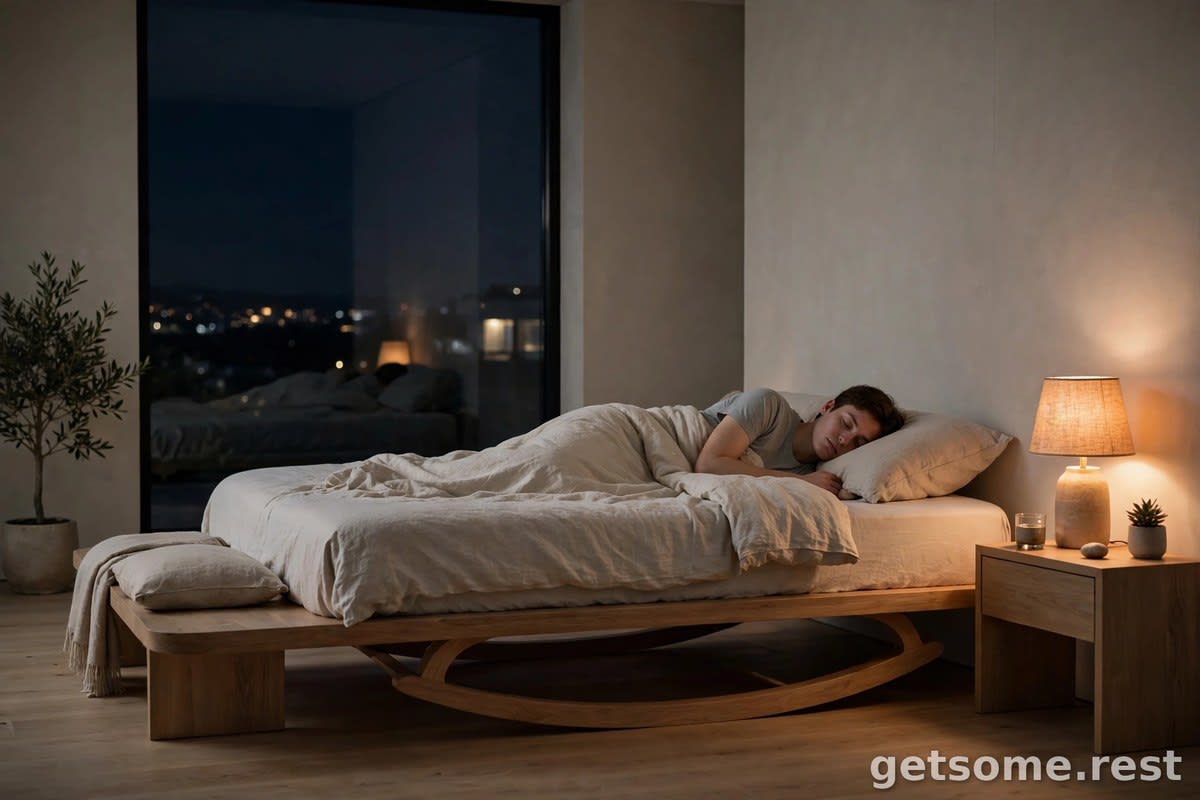
If you have ever been rocked to sleep as a child — or drifted off in a hammock on a warm afternoon — you already know the feeling this study tried to measure. A team at the University of Geneva put 16 young adults with mild-to-moderate insomnia complaints on a bed that rocked gently from side to side all night, then compared it with the same bed standing still. The result, published in the Journal of Sleep Research in October 2026, was striking in one direction and humbling in another: the rockers spent about a third less time awake during the night and rated their sleep a quarter better, but they did not fall asleep any faster, and their memory scores did not improve.
Contents
The headline numbers are strong — and they are worth quoting precisely, because the study reports them as percentages, not minutes. On the rocking night, compared with the stationary night in the same people, time spent awake fell by 34%, light N1 sleep fell by 15.5%, sleep efficiency rose by 4.5% (a relative increase, not 4.5 percentage points), the sleep fragmentation index dropped, and the participants rated their sleep quality 25% better the next morning. Every one of those changes was statistically significant. The one number that did not move is the one most people would guess first: how long it took to fall asleep.
Who were these people? Sixteen young adults, aged 19 to 32 with a mean age of 24.3, were analysed out of 153 screened. All had mild-to-moderate insomnia complaints — a mean Insomnia Severity Index of 14.8 — and their poor sleep was objectively confirmed: screening required sleep efficiency of 85% or less, and their three-week actigraphy average was 80.4%. Half complained mainly of staying asleep, a quarter mainly of falling asleep, and a quarter of both. People with sleep apnoea, periodic limb movements, cardiac arrhythmia, moderate-to-severe anxiety or depression, or shift work were excluded. The participants also liked the experience, rating the rocking 7.8 out of 10 for pleasantness.
The pattern is a study about staying asleep, not falling asleep. Rocking consolidated the night — less waking, less of the lightest sleep, fewer fragments — without adding minutes of total sleep or shortening the wait at the start. That distinction matters, because most popular coverage of rocking beds talks about drifting off faster. In poor sleepers, at least on a single night, that is not what happened.
The design is the strongest part of this paper, and it is why the results are worth taking seriously despite the small sample. It was a within-subject crossover trial run in a sleep laboratory at the University of Geneva, with polysomnography — the full wired-up sleep recording — on every experimental night. Each participant served as their own control: the same person, the same bed, the same lab, one night rocking and one night still.
Getting in took work. Volunteers went through three weeks of wrist actigraphy and a sleep diary, then a screening polysomnography night and a habituation night to get used to sleeping wired up in a lab. Only then came the two experimental nights, in randomised and counterbalanced order, at least seven days apart, each preceded by five days of actigraphy and diary-keeping so the researchers knew the participants arrived in a comparable state. On the rocking night, the bed moved laterally at 0.25 Hz — one full sway every four seconds — with a 10.5 cm excursion, all night. On the stationary night, the same bed was used with the motor switched on but not connected, a sham control that kept the sound and setup identical. Each night the participants took a word-pair declarative memory test in the evening and again in the morning, and rated their sleep the next morning on the St Mary's Hospital Sleep Questionnaire.
That sham control deserves a note. A bed that rocks makes a sound and a feeling, so participants could not be blinded to the motion, and the researchers acknowledge that placebo effects cannot be fully excluded for the subjective ratings. What argues against a pure placebo is the objective brain data: the rocking entrained the participants' sleep brain waves to the bed's turning points, an effect that cannot be willed into existence.
One honest limit is that each person had only one rocking night. The study can tell us what a single night of rocking does; it cannot tell us whether the benefit persists over a week or fades as the novelty wears off. Any claim about rocking as a long-term sleep solution is, for now, an extrapolation.
The leading explanation starts in the inner ear. The vestibular system — the balance organ — senses the gentle acceleration of the bed, and its otolithic organ sends signals through the thalamus, the brain's relay station, into the circuits that generate sleep. The idea is that rhythmic vestibular stimulation nudges the brain toward the slow, synchronised activity of deep sleep. A companion mouse study published alongside the 2019 human trial supported exactly this pathway: when the vestibular signal was disrupted, the rocking benefit disappeared.
The 2026 paper adds striking evidence for that mechanism. During the rocking nights, the participants' fast sleep spindles in deep N3 sleep became denser, and both spindles and slow oscillations clustered around the bed's turning points — the moments when the bed reversed direction. Slow-oscillation to fast-spindle coupling in N3 also rose by 11%. Spindles and slow oscillations are the brain waves most closely tied to stable, restorative deep sleep, so entrainment to the bed's rhythm is a plausible reason the night held together better. What did not change is also informative: slow-oscillation density, count and amplitude were unchanged, and arousal density did not change at all.
This is not the first time rocking has been tested. In 2011, Bayer and colleagues had 12 healthy volunteers take two 45-minute afternoon naps on a rocking bed at 0.25 Hz; every participant fell asleep faster, spent longer in N2 sleep, and showed more slow oscillations and sleep spindles. In 2019, Perrault's team ran 18 healthy young adults through whole-night rocking at the same frequency and found faster sleep onset, longer deep N3 sleep, fewer micro-wakes, and better overnight memory. A 2023 systematic review of eight studies concluded that vestibular stimulation speeds sleep onset, increases N2 in naps and N3 at night, boosts spindles and improves memory, with an optimal intensity around 25 cm/s².
But not every study agrees. Omlin and colleagues, in a 2018 study of 18 healthy men over three nights, found no shortening of sleep onset and no boost in slow oscillations, though N2 and spindle counts rose during two hours of stimulation. The 2026 authors' reading is that the effect depends on the exact parameters — frequency, direction and amplitude — and that 0.25 Hz lateral motion is the candidate sweet spot. Change the motion and you may lose the effect, which matters for anyone shopping for a rocking bed: most products on the market do not rock the way the study bed did.
The honest version of this study includes its nulls. Sleep-onset latency did not change: only 7 of the 16 participants fell asleep faster on the rocking night. Total sleep time did not change either, and time in N2, N3 and REM individually did not change significantly — the response was strikingly heterogeneous. Five participants increased N3 only, six increased N2 only, and five increased both. The authors suggest differences in sensory-processing sensitivity may explain who responds: people highly sensitive to sensory input may find the motion distracting rather than relaxing.
Memory did not improve, the clearest break from the 2019 healthy-sleeper study, where whole-night rocking improved overnight word-pair memory. The 2026 authors do not over-explain this, but the contrast is a reminder that a result in good sleepers does not automatically transfer to poor sleepers. Arousal density, the rate of brief awakenings on the EEG, did not change either, even though the broader fragmentation index did: rocking smoothed the night without eliminating the micro-arousals.
Then there is the sample: 16 people, all young adults, all with mild-to-moderate complaints, all screened to exclude other sleep disorders and significant anxiety or depression. That is a narrow slice of the people who struggle with sleep. The findings do not apply to severe insomnia, older adults, children, or anyone whose sleep problem comes with apnoea, restless legs or a medical condition. The authors call their findings preliminary, and that is the right word: a single night in a lab, in 16 young adults, is a promising signal, not a verdict. Larger, multi-night randomised trials are the stated next step.
That framing matters for how to read this study alongside the rest of the bedroom-environment research. A warm bedroom, for example, measurably worsens next-day productivity — our coverage of that 2026 study found about half a point of sleep-score loss per degree above a person's average. Rocking belongs in the same category: a physical property of the sleep environment that the brain responds to, worth trying if it is accessible, not a substitute for care when sleep is seriously disrupted.
Here is where the story gets awkward. There is no widely available consumer bed that reproduces the study's exact setup: whole-night, lateral, 0.25 Hz rocking with a 10.5 cm excursion. The only adult rocking bed we could verify as currently sold is the Rock and Sleep Bed, from Rock to Sleep Bed LLC in San Diego: $2,999 for Twin or Twin XL and $3,499 for Full, Queen or King, plus tax, mattress not included. It is sold in San Diego only; everywhere else is a waitlist, with shipping to other cities expected from July 2026.
More importantly, it is not the study bed. The Rock and Sleep Bed tilts head-to-foot rather than sliding side to side, has five speed settings, and its timer runs for 15 minutes to 2 hours, after which it stops — it does not rock all night. Its own website states: 'No formal sleep studies have been conducted specifically with this bed yet.' Buying it on the strength of the Geneva study would be a mistake; the motion is different, the duration is different, and the evidence does not transfer. An older $3,450 rocking bed was shown at CES 2018 and reviewed by the Washington Post in 2019, but we could not verify any current listing for it, so treat it as history.
What about cheaper analogues? A hammock is the closest low-cost option, but no study has tested whether it produces the same brain effects as the lab bed — that is an inference, not an equivalence. The Somnox, at $599 to $600, sometimes appears in rocking-bed roundups, but it is a breathing-simulation cushion, not a rocking bed. For now, the study bed is a laboratory device, and the consumer market has not caught up.
That gap between lab and market is common in sleep research — the same pattern shows up with cooling mattresses, where a 2024 study found a high-heat-capacity mattress added about 7.5 minutes of deep sleep a night, but the specific mattress used is not the one on store shelves. The study still tells you something useful: gentle, rhythmic, whole-night motion helps some poor sleepers stay asleep. The practical takeaway is to test the principle cheaply — a hammock, a rocking chair before bed — before spending anything, and to keep expectations modest.
How We Reported This Story
We have not tested a rocking bed ourselves, and no honest guide can claim to have replicated a sleep-lab study in a bedroom. This article is built from the published paper and its public summaries, and we flag where the evidence ends.
- The study: Perrault et al., 'Whole-Night Gentle Rocking Improves Sleep in Poor Sleepers With Insomnia Complaints', Journal of Sleep Research, 2026 Oct; 35(5): e70392. DOI 10.1111/jsr.70392, PMID 42268039. Open access via PubMed Central (PMC13619013). All percentages and p-values come from the paper, cross-checked against the PsyPost summary.
- What we did not invent: the paper reports results as percentages — 34% less time awake, 15.5% less N1, 4.5% higher sleep efficiency — so this article states no absolute minutes of wake time. The 4.5% sleep-efficiency figure is a relative increase, not 4.5 percentage points.
- Earlier studies: Bayer et al. 2011 (Current Biology, 12 healthy volunteers, 45-minute naps); Perrault et al. 2019 (Current Biology, 18 healthy young adults, whole-night rocking) with the Kompotis et al. 2019 mouse study; Omlin et al. 2018 (Scientific Reports, 18 healthy men); Subramaniam et al. 2023 systematic review (8 studies).
- Products: Rock and Sleep Bed prices ($2,999/$3,499) and availability from rockandsleepbed.com, checked November 16, 2026. Somnox price ($599–$600) from its product page. The 2018-era $3,450 rocking bed has no verified current listing and is mentioned as history only.
- What this article is not: medical advice. It reports a research finding about a sleep-environment idea. It does not diagnose or treat insomnia, and it does not suggest that a rocking bed replaces care. Chronic insomnia's first-line treatment remains CBT-I, per the paper itself.
Frequently asked questions
Does a rocking bed help you fall asleep faster?
Not in this study. Sleep-onset latency did not change significantly on the rocking night (p = 0.67); only 7 of the 16 participants fell asleep faster. The benefit was in sleep maintenance — less time awake during the night and less light sleep — not a faster start. Earlier studies in healthy sleepers did find faster sleep onset, so the effect may depend on who is in the bed.
How fast does a rocking bed rock?
The study bed moved at 0.25 Hz — one full back-and-forth sway every four seconds — with a lateral excursion of 10.5 cm. That frequency keeps showing up in the research: the 2011 nap study and the 2019 whole-night study both used 0.25 Hz, and a 2023 systematic review put the optimal stimulation intensity at around 25 cm/s². Faster or slower motion has not shown the same effect.
Can I buy a bed like the one in the study?
Not yet. No widely available consumer bed reproduces the study's exact whole-night 0.25 Hz lateral rocking. The Rock and Sleep Bed ($2,999 for Twin/Twin XL, $3,499 for Full/Queen/King, mattress not included) tilts head-to-foot instead of sliding side to side, has five speed settings, and stops after 15 minutes to 2 hours. Its own site says no formal sleep studies have been conducted with that bed. A hammock is the closest low-cost analogue, but that equivalence has never been tested.
Is rocking safe for everyone?
The study only tested young adults aged 19 to 32 with mild-to-moderate insomnia complaints, no other sleep disorders, and no moderate-to-severe anxiety or depression. It says nothing about severe insomnia, older adults, children, sleep apnoea, restless legs, or people with medical or psychiatric conditions. The paper positions rocking only as a possible complementary approach, and CBT-I remains the first-line treatment for chronic insomnia. If your sleep problems are persistent, talk to a doctor rather than buying a bed.
Does rocking improve your memory overnight?
Not in this study. The 16 participants took a word-pair memory test in the evening and again in the morning, and the overnight change did not differ between the rocking and stationary nights. That contrasts with the 2019 study in healthy sleepers, where whole-night rocking did improve overnight memory consolidation. The 2026 authors suggest the difference may come down to the population: poor sleepers may respond differently from good sleepers, and the deep-sleep response in this study varied widely from person to person.
Key Takeaways
- The headline result: one night of gentle whole-night rocking cut time awake by 34%, light N1 sleep by 15.5%, and improved subjective sleep quality by 25% in 16 young adults with mild-to-moderate insomnia complaints.
- The catch: they did not fall asleep faster, total sleep time did not change, and memory scores did not improve. Rocking helped them stay asleep, not drift off.
- The recipe matters: 0.25 Hz lateral motion — one sway every four seconds, 10.5 cm — all night. Other frequencies, directions and amplitudes have not shown the same effect.
- The mechanism is real but narrow: brain waves entrained to the bed's turning points, and fast-spindle density in deep sleep rose. The vestibular system is the likely pathway.
- You cannot buy the study bed: no consumer bed reproduces the exact setup. The Rock and Sleep Bed ($2,999–$3,499) tilts rather than slides, stops after two hours, and has no sleep studies behind it.
- Keep it in perspective: 16 young adults, one night, in a lab. The authors call the findings preliminary, and CBT-I remains the first-line treatment for chronic insomnia.