Too Bright, Too Hot, Too Noisy: What the 2026 Penn State Study Found About Young Adults' Bedrooms
A Penn State Sleep Health study of 372 young adults found bedrooms too bright, hot, or noisy hurt sleep quality but not duration — over 14 days of self-reports and wrist sensors.
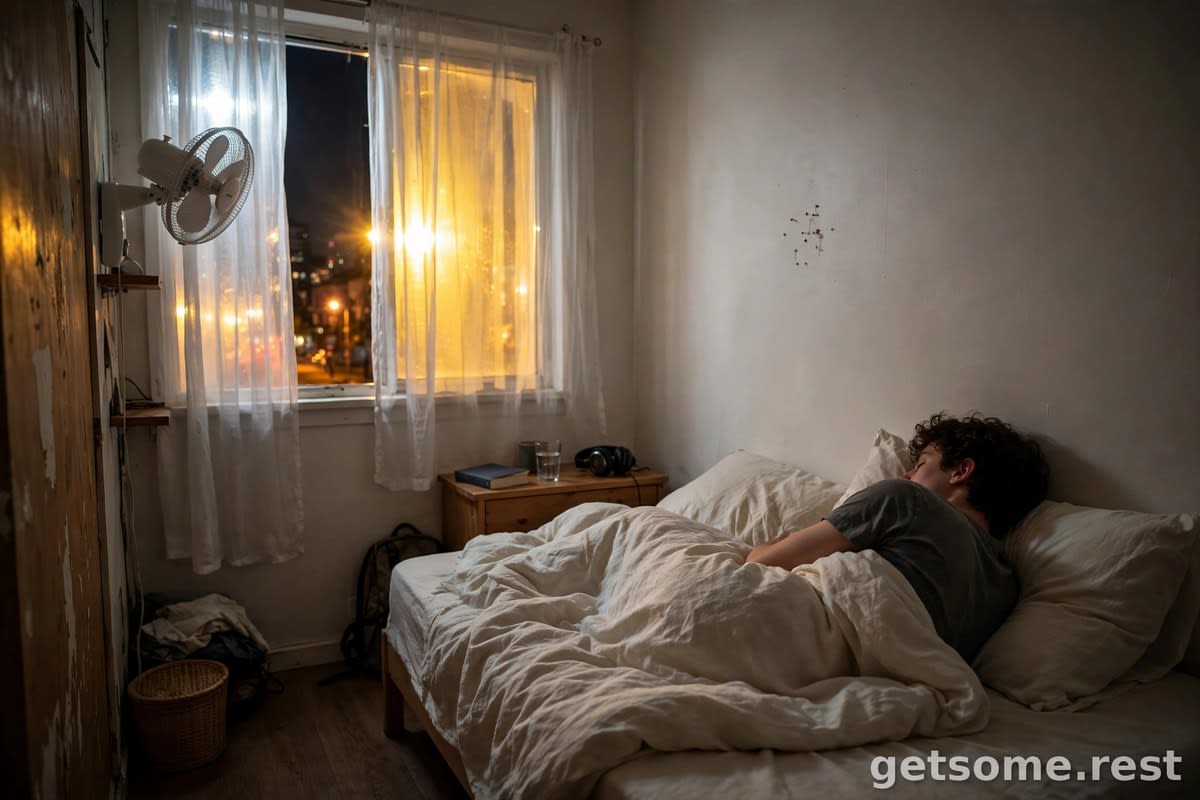
You can sleep for eight hours and still wake up tired. A new Penn State study gives that familiar complaint a number: in 372 young adults tracked for two weeks, bedrooms that were too bright, too hot, or too noisy made sleep measurably worse — while leaving total sleep time untouched. The problem, the researchers say, is not always how long you sleep. It is how well the room lets you sleep.
Contents
At a Glance: What the Study Found
Published in Sleep Health in October 2026 and led by Penn State doctoral candidate Adwoa Dadzie, the study draws on the Future of Families Young Adult Sleep Study — a group rarely at the centre of sleep research, which usually studies older adults.
- The setup: 372 young adults, average age 22, reporting every morning for 14 days on sleep quality and on whether light, noise, or temperature had disrupted them, while a wrist sensor objectively recorded sleep timing and wakefulness.
- The headline split: sleep quality fell on nights the bedroom was too bright, too hot, or too noisy — but sleep duration did not fall with it.
- The brightest-room effect: too much light was the most detailed finding: later sleep onset, poorer quality, and more time awake during the night.
- The surprise: a bedroom that felt too cold did not measurably change objective sleep, a reminder that not every discomfort registers the same way on a sensor.
The study's message for dorm-dwellers and apartment-sharers is encouraging in a practical way: you may not control the building, but the three things that hurt most are also the three cheapest to fix.
How to Read This Study Without Overreading It
This study is unusually strong for sleep-environment research, because it pairs two kinds of evidence every night: what people said the next morning, and what a wrist sensor recorded while they slept. When both point the same way — as they did for heat and noise — the finding is harder to dismiss as mood or expectation. When they diverge, as they did for cold, the sensor data tempers the self-report.
Still, three limits matter. First, the sample is young adults only, average age 22, so the results may not transfer to older adults, children, or shift workers with rigid wake times. Second, the bedroom ratings were perceptions — ‘too bright’ to one person is fine to another — not lux-meter, thermometer, or decibel readings. Third, this is observational: the study watched natural variation across nights rather than randomly assigning people to bright or dark rooms, so it cannot prove that changing the room will change sleep, only that the two move together.
The compensation idea also deserves a sceptical eye. Sleeping in after a bad night sounds plausible for students and young workers with flexible mornings, but it would not hold for anyone with a fixed alarm, a baby, or an early shift — which is exactly why the researchers call for follow-up work in less flexible populations.
The Findings, Side by Side
Every headline result from the study, what it measured, and the limit that applies to it.
| Bedroom condition | Effect on sleep quality | Effect on sleep duration |
|---|---|---|
| Too bright | Worse: later sleep onset, poorer quality, more time awake at night | No measurable change |
| Too hot | Worse by both self-report and wrist sensor | No measurable change |
| Too noisy | Worse by both self-report and wrist sensor | No measurable change |
| Too cold | No measurable effect on objective data | No measurable change |
One more detail from co-author Orfeu Buxton explains why noise may be the hardest of the three to ignore: parts of the brain stay vigilant during sleep, especially for sounds that could signal a threat. That vigilance is useful in the wild and unhelpful in a thin-walled apartment, where a hallway conversation at 2am gets the same alarm treatment as something genuinely dangerous.
Our Verdict: The Honest Takeaway
Here is the most defensible reading of this research — what is supported, what is plausible, and what it does not show.
Supported: for young adults, a bedroom that feels too bright, too hot, or too noisy is associated with worse sleep quality on a given night, by both self-report and wrist-sensor measures, without a matching drop in sleep duration.
Plausible, not proven: that fixing the room — earplugs, blackout curtains, cooler bedding — will improve sleep quality for a given person. The study did not test interventions, but its mechanism (disrupted sleep continuity) points in that direction, and the fixes are cheap and low-risk.
Not shown: that cold rooms do not matter at all (only that ‘too cold’ showed no measurable effect in this sample, by these measures), or that these results apply to older adults, children, or people with fixed wake times.
Practical bottom line: if you sleep long enough but wake up unrefreshed, audit the room before you audit your habits. Start with the cheapest fix for your worst offender: foam earplugs for noise, a contoured sleep mask for light, lighter bedding and a fan for heat. One change at a time, for a week, is how you learn which one actually helped.
What the Coverage Got Right — and Where It Overreached
Penn State's own report, and the better coverage that followed it, got the central split right: quality down, duration unchanged. That distinction is the whole story, and most outlets preserved it. The report also preserved the researchers' own caution — Dadzie's line that ‘young adults often have little control over their sleep environments, but habitual sleep disruptions can affect long-term health and development’ — which keeps the focus on rooms and buildings, not on blaming young people for their sleep.
Where some coverage overreached was in turning an association into a prescription. Headlines that promised a specific temperature or a specific product went beyond what the study measured: it recorded perceived heat, not thermostat settings, and it tested no products. The 18-20°C bedroom figure that appears in some write-ups is general sleep-hygiene guidance, not a finding of this study, and treating it as one muddies an otherwise clean result.
The most useful coverage added context the study itself could not: that young adults are understudied in sleep research, which usually focuses on older adults, and that dorms and shared apartments concentrate all three problems — light, heat, and noise — in one small room. That context is why a study of 372 twenty-two-year-olds matters beyond its sample.
How We Reported This Story
This article is a research roundup, so our method is literature coverage rather than product testing. We started from Penn State's own report on the study — led by doctoral candidate Adwoa Dadzie, with co-author Orfeu Buxton, published in Sleep Health in October 2026 — and checked the key numbers (372 participants, average age 22, 14 days, Future of Families Young Adult Sleep Study) against at least two independent write-ups. Where a secondary source added a claim the Penn State report did not make, we left it out.
We did not re-analyse the raw data or contact the authors. Product mentions are general comfort suggestions drawn from the researchers' own examples (earplugs, blackout curtains), not tested recommendations, and they carry no claim about sleep quality.
Disclosure: GetSome Rest contains affiliate links. If you buy through them, we may earn a commission at no extra cost to you.
Frequently asked questions
What did the Penn State study actually find?
That a bedroom perceived as too bright, too hot, or too noisy was linked to poorer sleep quality — slower sleep onset, more waking, more time awake at night — but not to shorter sleep duration. A bedroom that felt too cold showed no measurable effect on objective sleep data.
Who took part, and how was sleep measured?
372 young adults with an average age of 22, drawn from the Future of Families Young Adult Sleep Study. For 14 days they reported each morning on sleep quality and on whether light, noise, or temperature had disrupted them, while a wrist sensor objectively recorded when they slept, how long it took to fall asleep, and how long they stayed awake.
Why would quality fall but duration stay the same?
The researchers' leading explanation is compensation: young adults with flexible schedules may simply sleep in after a disrupted night, keeping total hours steady while the quality underneath erodes. In their words, eight hours of bad sleep is not the same as eight hours of good sleep.
Does this prove bright, hot, or noisy rooms cause poor sleep?
No, not by itself. This was an observational study linking nightly perceptions to nightly sleep measures, not a controlled experiment that changed one variable at a time. It shows a strong, consistent association across both self-reports and sensor data, which is more persuasive than either alone, but it does not prove causation.
What can you actually do about a bedroom you do not control?
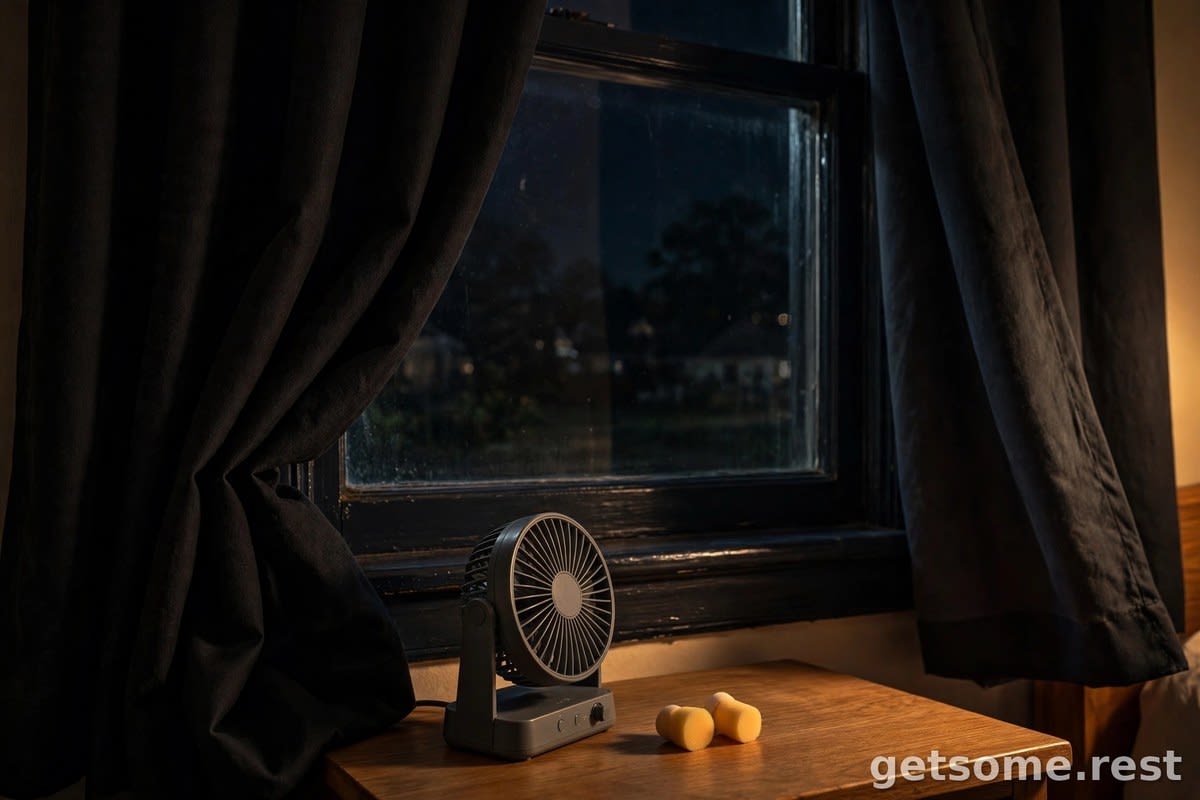
The researchers point to cheap, portable fixes: foam earplugs or a white-noise app for noise, blackout curtains or a contoured sleep mask for light, and lighter bedding plus a fan for heat. Those are especially useful in dorms and shared apartments, where you often cannot change the building, the roommates, or the thermostat.
Key Takeaways
- A Penn State Sleep Health study tracked 372 young adults (average age 22) for 14 days with morning reports and wrist sensors.
- Bedrooms too bright, hot, or noisy were linked to poorer sleep quality, but not to shorter sleep.
- Too bright meant later sleep onset, poorer quality, and more time awake at night; too hot and too noisy hurt quality by both measures.
- Too cold showed no measurable effect on objective sleep data in this sample.
- The researchers suspect young adults compensate by sleeping in, keeping hours steady while quality erodes.
- Cheap, portable fixes — earplugs, blackout curtains or a sleep mask, lighter bedding and a fan — are the researchers' own suggestions.
- This was an observational study, not an intervention trial: it shows association, not proven causation.