How Does a Cooling Pillow Work? (2026)
A cooling pillow doesn't refrigerate your head — gel, phase-change material and airflow move heat away. How each works, and which pillows are worth buying.
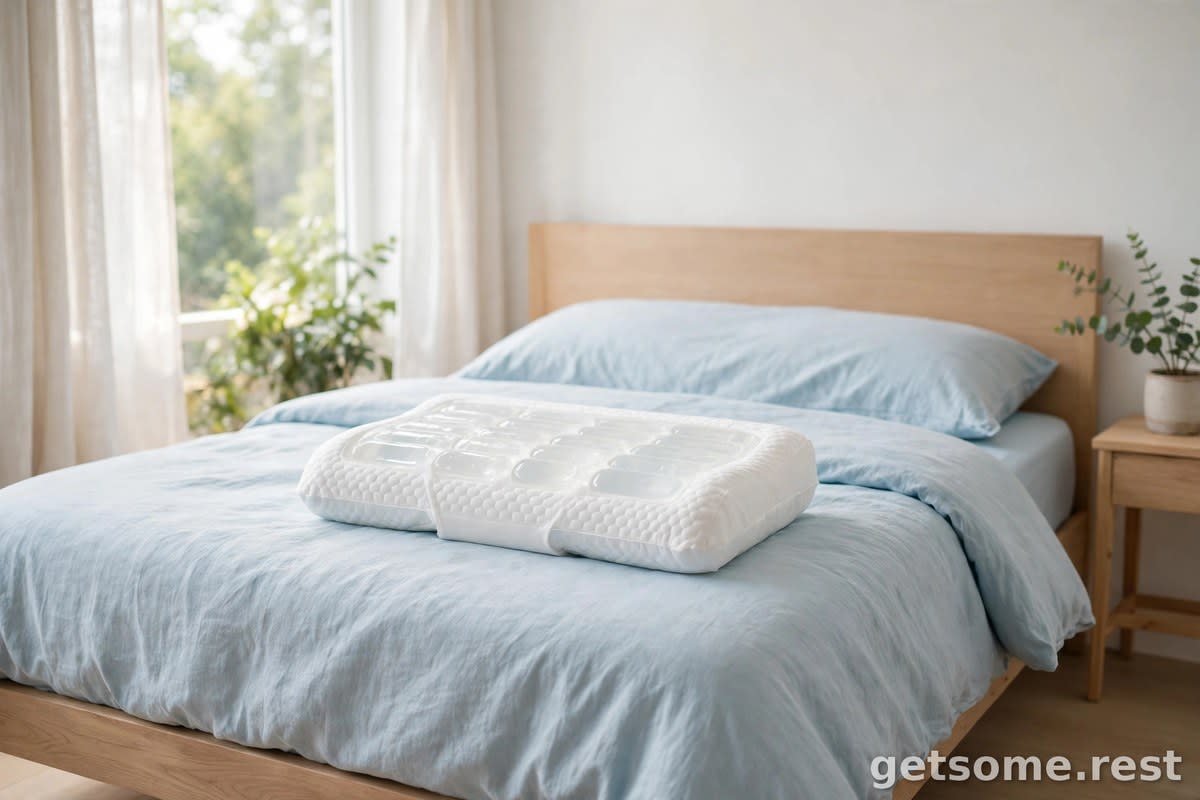
You put your head down, and for a minute the pillow feels deliciously cool. Then, slowly, it doesn't. That first minute is the whole story of how a cooling pillow works — and why so many of them disappoint. A cooling pillow does not refrigerate your head. There is no compressor, no fan, no power. It manages heat passively, in three ways: conducting heat away from your skin, letting warm air escape, and wicking sweat so evaporation can cool the surface. Some methods work for minutes, some work all night — and that difference decides whether the pillow helps or is just a regular pillow with a cool-sounding label. This guide explains each mechanism, how long each one lasts, and which pillows are worth your money — with real prices checked in November 2026.
Contents
The Short Answer: Three Ways a Pillow Cools
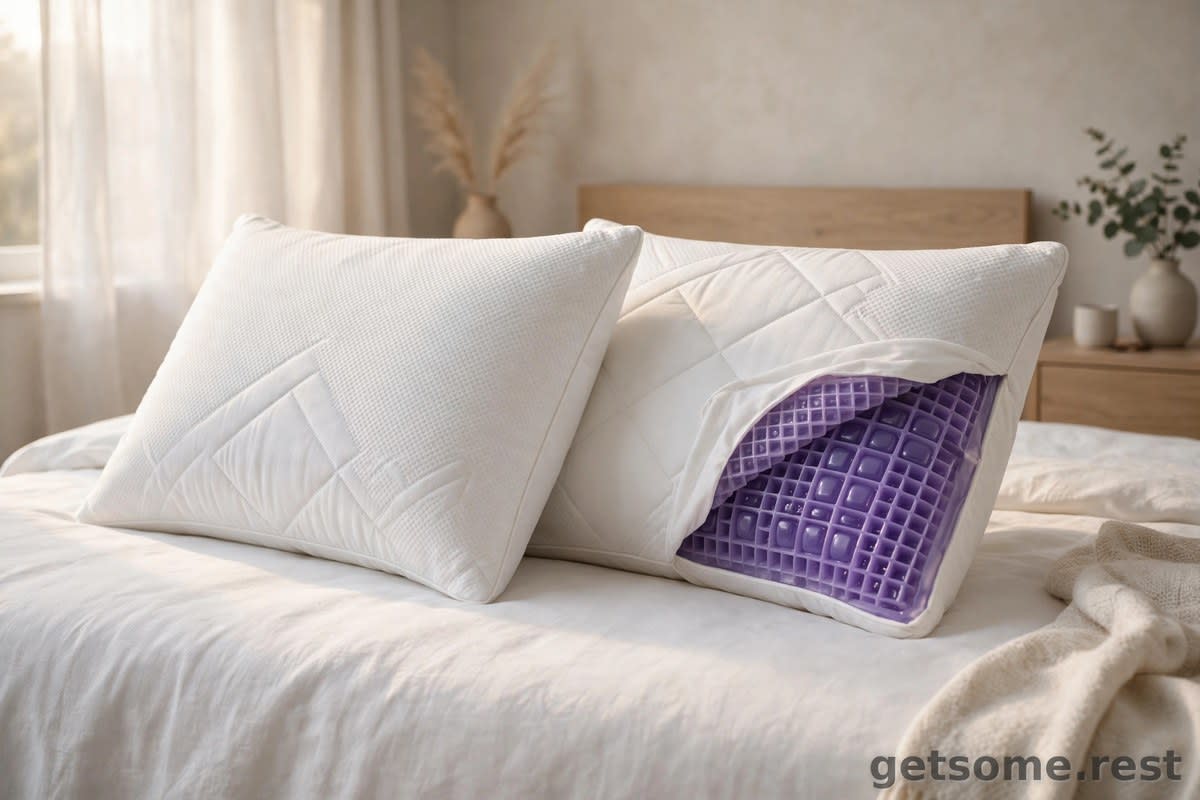
A cooling pillow manages heat in three ways, and every product on the market uses one or more of them. First, conduction: gel and phase-change material pull heat away from your skin and into the pillow, the way a cold pack pulls heat from a sore muscle. This is the strongest effect and the shortest-lived — it feels cold on first contact and fades as the material warms to your temperature. Second, ventilation: open-cell foam, shredded fill, latex and airflow channels let warm air escape instead of pooling under your head. This never feels cold, but it keeps working all night, because it never stores the heat in the first place. Third, evaporation: moisture-wicking covers pull sweat off the skin so it can evaporate and cool the surface. A good cooling pillow usually combines at least two of the three — the Coop Eden pairs gel with airflow and a bamboo-derived cover, the Purple Harmony pairs a ventilated grid with a latex core — and the pillows that disappoint usually rely on only one, and the wrong one.
The most common misunderstanding is about what 'cooling' means here. A pillow cannot be colder than its environment for long, because it has no power source and no way to dump heat anywhere except into the room. What it can do is move heat away from your head faster than an ordinary pillow, and keep it from building up. That is a real effect — the Sleep Foundation's 2026 roundup says cooling pillows 'draw heat away from the body and prevent sleeping hot' — but it is modest, and it is worth knowing which mechanism you are paying for.
The other misunderstanding is about who needs one. People who overheat at the head, wake sweaty, or feel warm the moment their head touches the pillow will notice the difference. People who do not sleep hot will not. The same logic applies to the room: a cooling pillow in a 26°C bedroom is a warm pillow with a fancy label. The pillow is the last piece of the system, not the first.
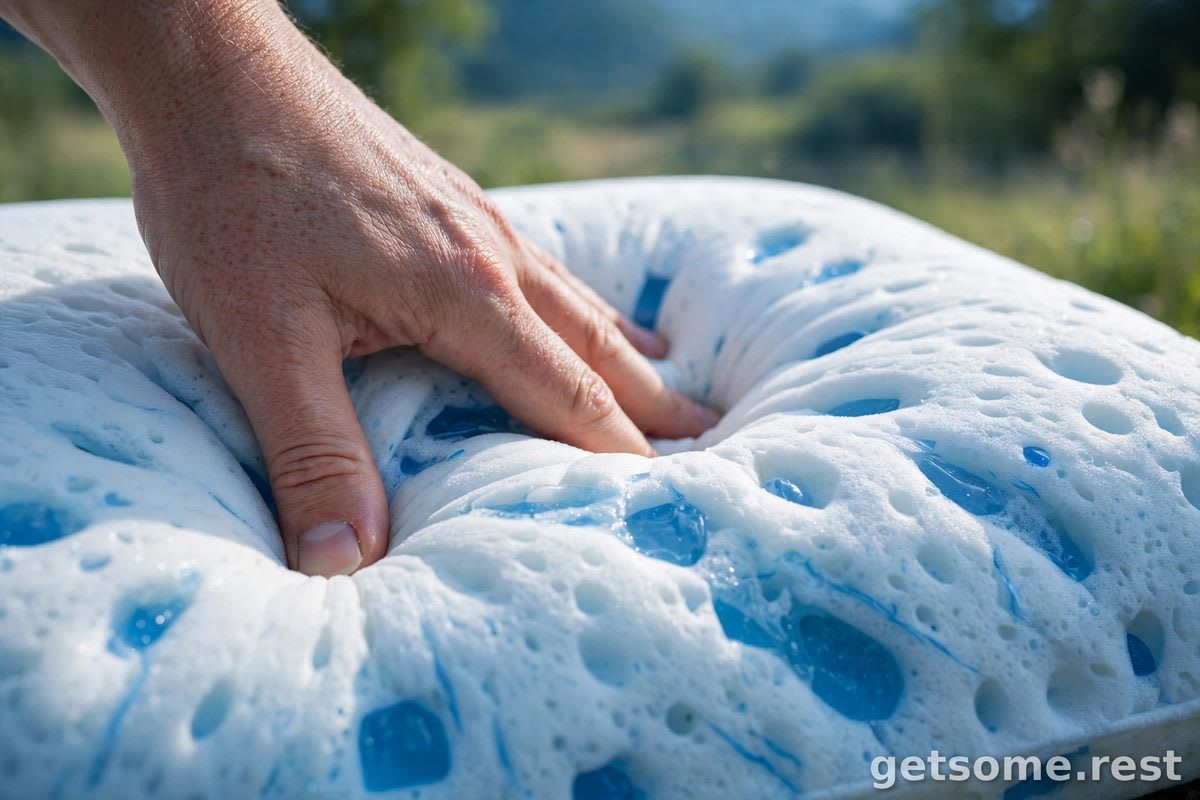
Gel-infused memory foam is the most common cooling trick. Gel conducts heat away from your skin faster than plain foam — like a cold pack that spreads heat into the pillow. There are two versions: infused gel, where gel beads are dispersed through the foam for a mild effect throughout, and a gel layer, a sheet on top that feels stronger at the surface only. The Coop Eden uses gel-infused shredded foam; the Tempur-Pedic TEMPUR-Cloud Dual Cooling puts cooling gel on both sides of its core. The limit is that gel is a finite heat sink: it saturates and reaches equilibrium with your body, typically in 20 to 60 minutes, and then the foam underneath behaves like ordinary memory foam. In a warm bedroom it equalises and stays warm.
Phase-change material, or PCM, is the cleverer version of the same idea. Microcapsules — often paraffin-based — absorb a large amount of heat as they melt from solid to liquid at a set temperature near skin comfort, holding the surface steady while they change phase: the same principle as ice absorbing heat as it melts without getting warmer. The Casper Hybrid Snow uses PCM as part of its 'Snow Technology'. The limit is the same as gel, only slower: PCM is a battery, not a chiller. Once fully melted it stops absorbing until it cools and re-solidifies, and a surface-only PCM cover over an ordinary foam core manages only the surface.
Open-cell foam, shredded fill and airflow channels work on a different principle entirely: they do not store heat, they vent it. Open cells and the gaps between shredded fill pieces form continuous air channels, so warm air escapes instead of pooling under your head. Perforated solid foam does the same thing to a lesser degree. The Coop Eden's shredded fill creates air channels between the pieces, and the Purple Harmony's open GelFlex Grid moves air through the whole pillow, not just the surface. The limit is that there is no active cooling here at all — it only prevents heat from building up. It needs room air circulation to work, and it is useless if the pillow is smothered by a heavy cover or the room is hot and still.
Latex deserves its own paragraph because the word gets used as a synonym for 'cool', and it is not. Natural latex is open-cell and springy, so air moves through it and it does not sink and trap heat the way dense memory foam does. Talalay latex is lighter, airier and bouncier, while Dunlop is denser and firmer, and shredded latex adds extra air gaps. The Saatva Latex Pillow uses a shredded Talalay core, and the Purple Harmony has a ventilated Talalay core under its GelFlex Grid. But dense solid latex can still retain warmth: the benefit comes from ventilated or shredded construction, not from the word 'latex' alone. And latex is not for everyone — people with a latex allergy should avoid it entirely.
Moisture-wicking and cooling-fibre covers are the last layer. Covers made from bamboo-derived rayon, Tencel or lyocell, nylon cooling yarns or PCM-treated fabric pull sweat off the skin so evaporation can cool the surface, and they feel cool to the touch on contact. The Coop Eden's Lulltra cover is bamboo-derived rayon; the Casper Snow has a QuickCool cover; Tempur-Pedic uses its SmartClimate cover. The limit is that cool-to-the-touch is a surface effect only and it fades fast — a good cover cannot rescue a heat-trapping core. Finally, there are water designs: water is an excellent heat conductor, and a water-filled pad absorbs head heat and dumps it to the air. The Chillow is a water-activated cooling foam pad in the $20 to $30 class — fill it once with water, no power, and you can chill it in the fridge for 10 to 15 minutes. Powered micro-tube pillows exist too, but they are expensive, need power and water maintenance, and belong to a different product category. Passive water pads warm up by morning and feel warmer at the edges and centre unevenly.
The table below is the short version: six real pillows, current prices checked in November 2026, the cooling technology each one uses, and who it suits. Prices move with sales, so verify before you buy — the Coop Eden has already moved up since our October article, and the Beckham two-pack swings between $42 and $60.
A note on the Tempur-Pedic price: sources disagree. Wayfair and SleepRanked put the TEMPUR-Cloud Dual Cooling at $154 for a Queen, verified November 15, 2026, while Sleepopolis lists $189 for a Queen and $229 for a King. We use $154 with a check-before-buying note. It is a premium pillow — cooling gel on both sides of a TEMPUR-Material core, medium loft — but the gel effect is finite and the pillow is heavy for what is still passive cooling. The Saatva, at $165, is the better buy for breathability that does not fade. You can find the Purple Harmony on Amazon, the Casper Hybrid Snow on Amazon and the Saatva Latex Pillow on Amazon.
The honest answer depends on what kind of hot sleeper you are, because the mechanisms solve different problems. If your head overheats the moment it touches the pillow and you wake up sweaty, you want the strongest all-night cooling, and that is the Purple Harmony. Its open GelFlex Grid moves air through the whole pillow continuously, so it does not fade the way gel does — and at $229 list, currently $194 on sale, it is the premium pick for a reason. It comes in three heights, Low, Medium and Tall, so side sleepers should take the Tall and back sleepers the Medium. Our full Purple Harmony vs Coop Eden comparison reaches the same conclusion.
If you want the best value, buy the Coop Eden. At $109 for a Queen, it is less than half the price of the Harmony, and its adjustable shredded fill solves a problem the Harmony cannot: loft. You add or remove fill until the height matches your sleep position, which matters more than cooling for neck comfort. Its cooling is mild — gel plus airflow, not PCM — and it fades after the first minutes, but the bamboo-derived cover and the adjustability make it the best all-rounder for most people. Note that our own October article listed it at $96 Queen and $116 King, so the price has moved up. You can find the Coop Eden on Amazon, where it often runs below the Target price.
For phase-change material, the Casper Hybrid Snow is the only pick here with a genuine PCM layer, at $161.10 on sale against a $179 list. For latex lovers, the Saatva at $165 is the best breathable pick with no gel or PCM to saturate, and latex lasts years — but its high loft suits side and back sleepers, not most stomach sleepers. And for the budget, the Beckham Hotel Collection 2-pack at roughly $40 to $60 is hotel-plush and machine-washable, but 'gel fibre' is a soft down-alternative, not a gel layer or PCM, so its cooling is modest. You can find the Beckham pillows on Amazon — check the price at checkout, because it moves between $42 and $60.
One more consideration before you buy: loft matters as much as cooling. Side sleepers need higher loft — the Purple Harmony Tall, the Saatva High, or a Coop Eden with fill added. Back sleepers need medium loft. Stomach sleepers need low and soft — the Coop Eden is Coop's own stomach-sleeper recommendation, and a high-loft latex pillow is usually wrong for them. A cold pillow at the wrong height is still a bad pillow, and it will hurt your neck long after the cooling has faded.
This is the question that decides whether a cooling pillow is worth the money. Gel lasts 15 to 90 minutes before reaching equilibrium with your body. Phase-change material lasts longer than gel, but it is still finite: once fully melted it stops absorbing heat until it cools and re-solidifies. Airflow and moisture-wicking covers are the only mechanisms that keep working all night, because they vent heat continuously rather than storing it. The mechanisms that feel coldest at first contact are the ones that fade fastest; the ones that never feel cold are the ones that work all night.
And then there is the case where a cooling pillow is simply not the fix. If the room is too hot, no passive pillow can stay colder than the room it is in. If the mattress sleeps hot, a cool pillow will not save the night. If the overheating is whole-body, or night sweats come from medication or hormones, a pillow is the wrong tool. The fix is the room first — a cooler bedroom, breathable bedding, a fan for air movement — and then the pillow. Our guide to sleeping cool without AC and our cooling sheets comparison cover the rest of the system. The research backs the mechanism, within limits: Herberger et al. 2024 found a high-heat-capacity cooling mattress added about 7.5 minutes of deep sleep a night — but that was a mattress, not a pillow.
How We Reported This Story
This guide is built from the Sleep Foundation's 2026 cooling-pillow roundup, the manufacturers' own specifications and current prices, and the published research on temperature and sleep. Where a claim could not be verified, it is flagged rather than stated.
- Prices: Purple Harmony ($229 Standard / $269 King, $194 on sale) from purple.com; Coop Eden ($109 Queen / $119 King) from Target's product pages, crawled November 2026 — the brand site may show a different sale price; Casper Hybrid Snow ($161.10 Standard on sale, list $179) from casper.com; Tempur-Pedic TEMPUR-Cloud Dual Cooling ($154 Queen) from Wayfair listings and SleepRanked, verified November 15, 2026 — Sleepopolis lists $189 Queen, so $154 carries a check-before-buying note; Saatva Latex Pillow ($165 Standard / $185 King) from Sleepopolis 2026 and MattressNut; Beckham Hotel Collection 2-pack ($40–$60, volatile) from Amazon listings. All prices checked November 16, 2026.
- The science: Herberger et al. 2024, Scientific Reports 14:4669 — 72 people, three centres, polysomnography; a high-heat-capacity cooling mattress increased deep N3 sleep by about 7.5 minutes a night and lowered heart rate by about 2.36 bpm. That was a mattress, not a pillow: it supports the mechanism, not a pillow-specific claim. Hamanishi et al. 2019, PLoS ONE — a small pilot of head cooling in female university students. Okamoto-Mizuno and Mizuno 2012, Journal of Physiological Anthropology — a review of core temperature and sleep onset.
- What we did not use: the '22 extra minutes of deep sleep' figures circulating on Medium (untraceable to any named study); the 'PCM lasts 4.8 hours' figure from a single brand blog; Casper's '12+ hours of cooler sleep' (brand marketing); and a 1996 eight-person cooling-pillow study we could not verify from the primary paper.
- What this guide is not: medical advice. It covers a sleep-environment product — how pillows manage heat — not the diagnosis or treatment of night sweats, which can have medical causes worth discussing with a doctor.
Frequently asked questions
Do cooling pillows actually work?
Yes, modestly — and briefly, for most of them. Gel and phase-change material genuinely move heat away from your head, but only until they warm to your temperature, usually within 15 to 90 minutes. Airflow designs — open-cell foam, shredded fill, latex, ventilated grids — work differently: they vent warm air continuously, so they keep working all night as long as room air can circulate. No passive pillow refrigerates your head, and none can stay colder than the room it is in.
How long does a cooling pillow stay cool?
It depends on the mechanism. Gel typically lasts 15 to 90 minutes before reaching equilibrium with your body. Phase-change material lasts longer than gel but is still finite — once fully melted it stops absorbing heat until it cools and re-solidifies. Airflow and moisture-wicking covers are the only mechanisms that keep working all night, because they vent heat continuously rather than storing it.
Which cooling pillow is best for hot sleepers?
For outright cooling, the Purple Harmony at $229 ($194 on sale) is the one to beat — its open GelFlex Grid moves air through the whole pillow all night, not just at first touch. For value, the Coop Eden at $109 is the best adjustable cooling pillow, with gel-infused shredded fill and a bamboo-derived cover. For phase-change material, the Casper Hybrid Snow at $161.10 on sale is the only pick here with a genuine PCM layer.
Can you wash a cooling pillow?
Usually not the core. Most foam and latex cores must never be machine-washed — spot-clean them with mild detergent and air-dry. The removable cover usually can be machine-washed on cold and gentle. Down-alternative fibre pillows like the Beckham Hotel Collection are the exception and are generally machine-washable — check the label. Gel and PCM performance also fades over two to three years as the gel degrades and the foam flattens, while latex lasts three to four years.
Why does my cooling pillow stop feeling cool?
Because gel and phase-change material are heat sinks with a finite capacity, not chillers. They absorb heat until they reach your body temperature, then they stop — and in a warm bedroom they equalise and stay warm. If your pillow stops feeling cool after the first hour, that is normal for gel and PCM, not a defect. Airflow designs avoid this because they never store the heat. And if the room itself is hot, no passive pillow can help: fix the room first, then the pillow.
Key Takeaways
- A cooling pillow is not a fridge: it manages heat passively — conducting it away with gel or PCM, venting it with airflow, and wicking sweat so evaporation cools the surface.
- The coldest feeling fades fastest: gel lasts 15 to 90 minutes and PCM is finite too. Airflow and wicking covers are the only mechanisms that keep working all night.
- Best outright cooling: the Purple Harmony at $229 ($194 on sale) — its open grid moves air through the whole pillow, not just the surface.
- Best value: the Coop Eden at $109, adjustable for any sleep position, with mild gel-plus-airflow cooling. Best PCM: the Casper Hybrid Snow at $161.10 on sale. Best latex: the Saatva at $165.
- Loft matters as much as cooling: side sleepers need high loft, back sleepers medium, stomach sleepers low and soft. A cold pillow at the wrong height is still a bad pillow.
- Fix the room first: no passive pillow can stay colder than a hot room. Cooler bedroom, breathable bedding, air movement — then the pillow. And foam or latex cores must never be machine-washed.