Best AI-Powered Sleep Apps in 2026 Compared
Tired of generic sleep tips? These five apps use real AI — sleep-debt modeling, adaptive soundscapes and smart alarms — to personalize your nights.
Every sleep app now claims to be powered by AI, but the label covers wildly different things: one models your sleep debt, another generates an endless soundscape that never repeats, and a third just bolts a chatbot onto the same old tips. We sorted the genuinely intelligent tools from the marketing and found five apps that earn the label — each using AI in a specific, useful way. This guide compares what each does, what it costs per year in 2026 pricing, and who it suits, so you can skip straight to the app that fits your nights.
Contents
Our top picks at a glance
Here is how our five picks compare. Prices are the real 2026 annual subscriptions — the number that matters for an app you will pay for every year. Each name links to its full write-up further down the page.
| Product | Best for | Price | Rating |
|---|---|---|---|
| Rise: Science of Sleep | AI sleep-debt and energy coaching | $69.99/yr | 4.6 out of 5 |
| Sleep Cycle | Waking up in light sleep | $39.99/yr | 4.5 out of 5 |
| Endel | Generative sleep audio | $49.99/yr | 4.3 out of 5 |
| Loóna | Interactive bedtime stories | about $39.99/yr | 4.2 out of 5 |
| Calm | Sleep stories and meditations | $69.99/yr | 4.3 out of 5 |
Prices last checked October 13, 2026 and may change. Buying through the App Store or Google Play can cost more than subscribing directly on the developer’s website. Ratings reflect our own testing and research.
How to choose an AI sleep app
An AI sleep app is only as good as the model underneath the marketing. A chatbot that rephrases generic tips is not doing anything your notes app could not do. The apps in this guide earned their place because their AI does specific work: estimating sleep debt, generating audio, or timing alarms. Before you compare prices, run through the checks below — they are where most buyers go wrong.
- Price: compare the real annual price, not the monthly headline. A $9.99-a-month plan bills $120 a year, and Endel’s annual plan costs far less bought direct than through Apple’s in-app purchase. Do the multi-year math too: at $69.99 a year, three years of Rise costs more than most dedicated sleep trackers.
- What the AI actually does: ask what the AI produces that a static app could not. Rise outputs a personal sleep need and debt number; Endel generates audio that never repeats. If the app’s “AI” only summarizes your data in nicer sentences, it is a reporting tool, not an intelligent one.
- Free tier vs. paywall: most of these apps are free to download and nearly useless without paying. Sleep Cycle is the exception, with a genuinely functional free tier. Know exactly which features sit behind the paywall before you invest weeks of data in an app.
- Data and privacy: sleep AI needs data — phone usage, health-app history, sometimes audio of your snoring. Read what is stored, where, and whether it is sold or used for advertising — and check whether you can export or delete your history.
- Trial and cancellation: every app here offers a trial, typically 7 days, and trials convert to paid plans automatically. Set a reminder to cancel before the trial ends if you are unsure. An app that makes cancelling hard is telling you something.
57% of U.S. adults say they would feel better if they got more sleep.
Source: Gallup
Pair the app with the bedroom
An app can tell you that you are short on sleep; it cannot darken your room or cool your bed. The biggest wins we see come from pairing a good app with the basics: a dark, cool, quiet bedroom. If your app keeps flagging restless nights, our guide to the best blackout curtains for shift workers solves the light problem for everyone, not just night-shift workers, and the best white noise machine for light sleepers covers the noise side. For the hour before bed, our 30-minute evening routine pairs well with any of these apps — run the routine, then let the app track whether it worked.
Price and value
The cheapest app here costs less than a pizza per year; the priciest as much as a budget fitness tracker. Price does not track quality in a straight line: Sleep Cycle at $39.99 a year does the core job — tracking plus a smart alarm — better than some apps costing twice as much. Where the money goes is specialization: Rise charges $69.99 a year because its sleep-debt model is hard to replicate; Endel charges for an audio engine that never repeats. Pick the specialization that matches your problem. If you lie awake with a racing mind, our guide on how to fall asleep fast when your mind is racing is worth reading alongside any app trial. And if you want coaching from a human-like AI rather than an app dashboard, see our separate test of AI sleep coaches.
What the AI in these apps actually does
Strip away the marketing and there are really four kinds of AI at work in sleep apps. Understanding which kind you are buying is the fastest way to pick the right one.
The first kind is predictive modeling. Rise is the purest example: it ingests your sleep history, phone usage and health data, then estimates two personal numbers — how much sleep you need and how much debt you carry. From those it predicts your circadian rhythm for the day ahead, including your afternoon dip and melatonin window. This is the kind of AI that can change behavior, because it tells you what to do today, not just what happened last night.
The second kind is generative audio. Endel composes soundscapes in real time, responding to inputs like time of day, weather and heart rate. No two sessions sound the same — and that matters, because the brain habituates to repeated loops. Loóna sits nearby: its wind-down “escapes” combine storytelling, activity and sound into guided sessions aimed at shifting your mood before bed.
The third kind is signal analysis. Sleep Cycle listens to your breathing and movement through the phone’s microphone and accelerometer, then uses machine learning to estimate sleep stages and to wake you during light sleep inside a window you set. It is the oldest AI trick in this category and still one of the most useful — a gentler wake-up is the one feature users say they would never give up.
The fourth kind is recommendation. Calm’s library is curated rather than generated, but its recommendations and sleep-story matching increasingly lean on machine learning. Be honest about which of these four you need: falling asleep calls for generative audio; inconsistent energy calls for a debt model. Match the AI to the problem and you will stop paying for intelligence you never use.
How to get real value from a sleep app
An app does not improve your sleep; acting on what it tells you does. The owners who get real value follow a simple process. First, run the app for a full week without changing anything. Sleep varies night to night, and one anxious night of data is noise, not signal. A week gives the model enough history to make its estimates honest.
Second, change one thing at a time and watch for two weeks. The interesting metrics are the boring ones: bedtime consistency, time to fall asleep, wake-ups after sleep onset. If the app says your energy dip lands at 2 p.m. daily, test it — schedule demanding work for the morning peak it predicts. Small, deliberate experiments beat passive score-watching.
Third, treat the numbers as estimates, not measurements. Phone-based tracking infers sleep from stillness and silence; it can mistake reading in bed for light sleep. If a morning score looks wrong, check the timeline before you believe it. And keep perspective: none of these apps is a medical device. If you snore loudly, gasp awake, or feel exhausted despite full nights in bed, that is a conversation for a doctor, not an app — no AI model here diagnoses sleep disorders.
Finally, audit the subscription twice a year. App subscriptions are designed to be forgotten. If you have not opened the app in a month, cancel it — you can always resubscribe. The best AI sleep app is the one you actually use, and an unused $70-a-year subscription is the most expensive kind of all.
Our picks in detail
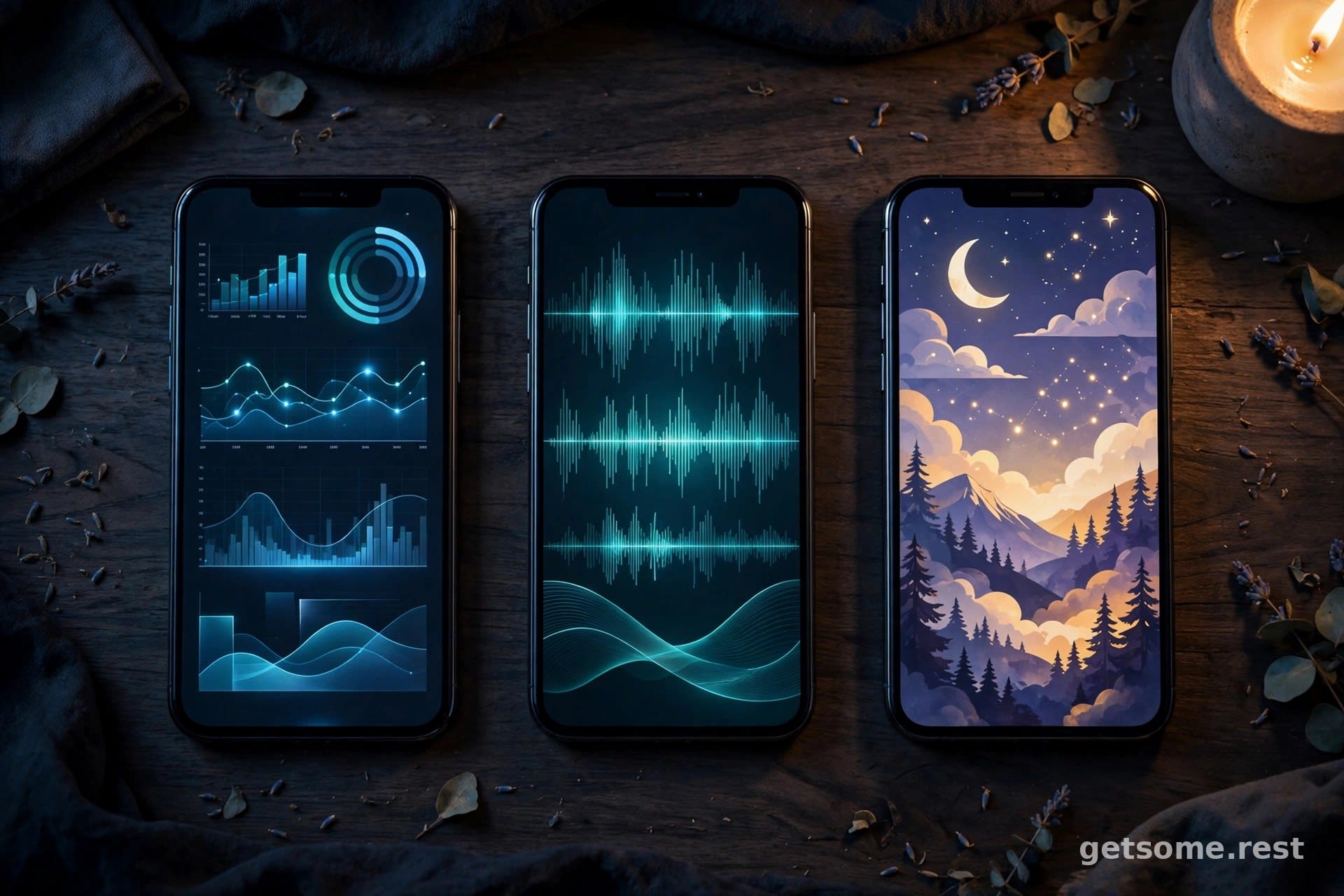
Each pick below includes a one-line verdict, the current price, and the main pros and cons from our testing.
 Best overall
Rise: Science of Sleep
The smartest sleep app you can buy: a personal sleep-debt model that plans your whole day around your circadian rhythm.
$69.99/yr per year, 7-day free trial
Pros
- Personal sleep-need and sleep-debt estimates built from your actual phone and health data — no wearable needed
- Daily energy schedule predicts your peaks, dips and melatonin window so you can plan work, caffeine and bedtime
- Syncs with Apple Health, Sleep Cycle and wearables to keep its model honest
Cons
- Among the priciest apps here, and the free version is barely functional
- Phone-based tracking can mistake stillness for sleep; accuracy depends on the data you feed it
Best smart alarm
Sleep Cycle
The classic done right: AI-powered sleep-stage detection wakes you in light sleep, and the free tier is genuinely useful.
$39.99/yr per year; free basic version available
Pros
- Smart alarm wakes you during light sleep inside a customizable window — users call it the one feature they would never give up
- Snore recording and sleep-stage graphs with no wearable, just your phone on the nightstand
- Best value in this guide: a working free tier and the lowest annual price of any full-featured pick
Cons
- Premium-only features (full statistics, sleep aids, recordings history) sit behind the paywall
- Microphone-based tracking needs the phone close by and charging overnight
Best AI soundscapes
Endel
Generative audio that never repeats: real-time soundscapes tuned to your context, built for sleep, focus and recovery.
$49.99/yr per year via endel.io; app-store prices are higher
Pros
- Adaptive soundscapes respond to time of day, weather and heart rate — no two sessions sound alike
- Works across phone, desktop, watch and smart speaker with offline playback on paid plans
- Backed by published research on functional sound; the sleep mode genuinely fades into the background
Cons
- Confusing price spread between website and app stores — buy direct or you may pay double
- Free tier caps sessions at about 10 minutes, which is not enough to fall asleep to
Best guided wind-down
Loóna
Interactive bedtime “escapes” that blend storytelling, activity and sound to shift a racing mind into sleep mode.
about $39.99/yr per year for Loóna Plus; free trial available
Pros
- Unique escape format: each night pairs a calming activity with story and sound instead of passive listening
- Beautiful, dreamlike visuals make the wind-down feel like an experience rather than a chore
- One of the cheapest full subscriptions here, with mood-based daytime content included
Cons
- Smaller content library than Calm; heavy users may exhaust the escapes
- Annual pricing varies by region and legacy plans — check the exact price at signup
Best meditation library
Calm
The deepest library of sleep stories, meditations and soundscapes — less “AI” than the others, more content than anyone.
$69.99/yr per year; frequent 40%-off promos for new users
Pros
- 500+ Sleep Stories with celebrity narrators, plus guided meditations, music and breathing programs
- Polished, beginner-friendly design with content for anxiety, stress and daytime focus too
- Regular promotions cut the first year to around $42 — never pay full price without checking for a deal
Cons
- Its “AI” is mostly recommendation, not the predictive or generative kind found in Rise and Endel
- The free version is a thin teaser; the real app starts at the paywall
How we test
We never accept payment for rankings. Every product is judged against the same five checks:
- Price
- We record the real price at checkout, note regular discounts, and recheck prices when we update the guide.
- Materials
- We read the fabric, fill and build details, and note anything the brand doesn’t make clear.
- Sleep trials
- We check how long you can try the product at home and whether the trial has conditions.
- Warranty
- We compare warranty length and what it actually covers, in plain language.
- Return policy
- We look at how returns work, who pays for shipping, and how refunds are handled.
Frequently asked questions
Do AI sleep apps actually improve sleep?
They can, but the app is the coach, not the cure. Apps like Rise reveal patterns — a 1 a.m. bedtime building a debt that tanks your afternoons — and nudge you toward consistent habits. An app you open once and ignore does nothing; one whose nudges you follow for a few weeks often does.
Can a sleep app replace a wearable sleep tracker?
For most people, yes — with trade-offs. Apps like Rise and Sleep Cycle infer sleep from phone sensors and health data, which covers timing, debt and consistency well enough to act on. They cannot measure heart rate, HRV or blood oxygen overnight like a ring or watch can. If you want better habits, the app alone is enough.
Which AI sleep app is the cheapest?
Sleep Cycle, at $39.99 a year, is the cheapest full-featured pick in this guide — and its free tier covers the smart alarm and basic tracking at no cost. Loóna Plus is close behind at about $39.99 a year. Endel costs $49.99 a year when you subscribe on its website rather than through the app stores, where the same plan can cost much more.
Do these apps need access to my health data?
They work best with it, but only Rise truly depends on it. Rise builds its sleep-debt model from your phone usage and health-app history; the more data you share, the more accurate its predictions. Sleep Cycle, Endel, Loóna and Calm work fine without health data. Whatever you choose, read the privacy policy, check whether data is sold or used for ads, and confirm you can export or delete your history.
Can a sleep app fix my insomnia?
No — and be wary of any app that claims it can. These apps support better sleep habits: consistent bedtimes, wind-down routines and realistic expectations. They do not diagnose or treat insomnia, sleep apnea or other sleep disorders. If you regularly struggle to fall or stay asleep, snore loudly, or feel exhausted despite a full night in bed, talk to a doctor or sleep specialist. An app is a wellness tool, not medical care.
Key takeaways
- Rise: Science of Sleep is our top pick for most people — its sleep-debt and circadian model is the most genuinely intelligent AI in this category.
- Match the AI to your problem: Sleep Cycle for waking up gently, Endel for falling asleep to sound, Loóna for winding down, Calm for the deepest content library.
- Always check the real annual price and buy direct from the developer’s website — app-store subscriptions for the same plan can cost far more.
- Rankings on GetSome Rest are never for sale, and we update our guides weekly.