Do Blue Light Glasses Help You Sleep? What the Research Actually Says
A 2023 Cochrane review, a 2025 meta-analysis and new 2026 morning-light research: what the science actually says about blue light glasses and sleep.
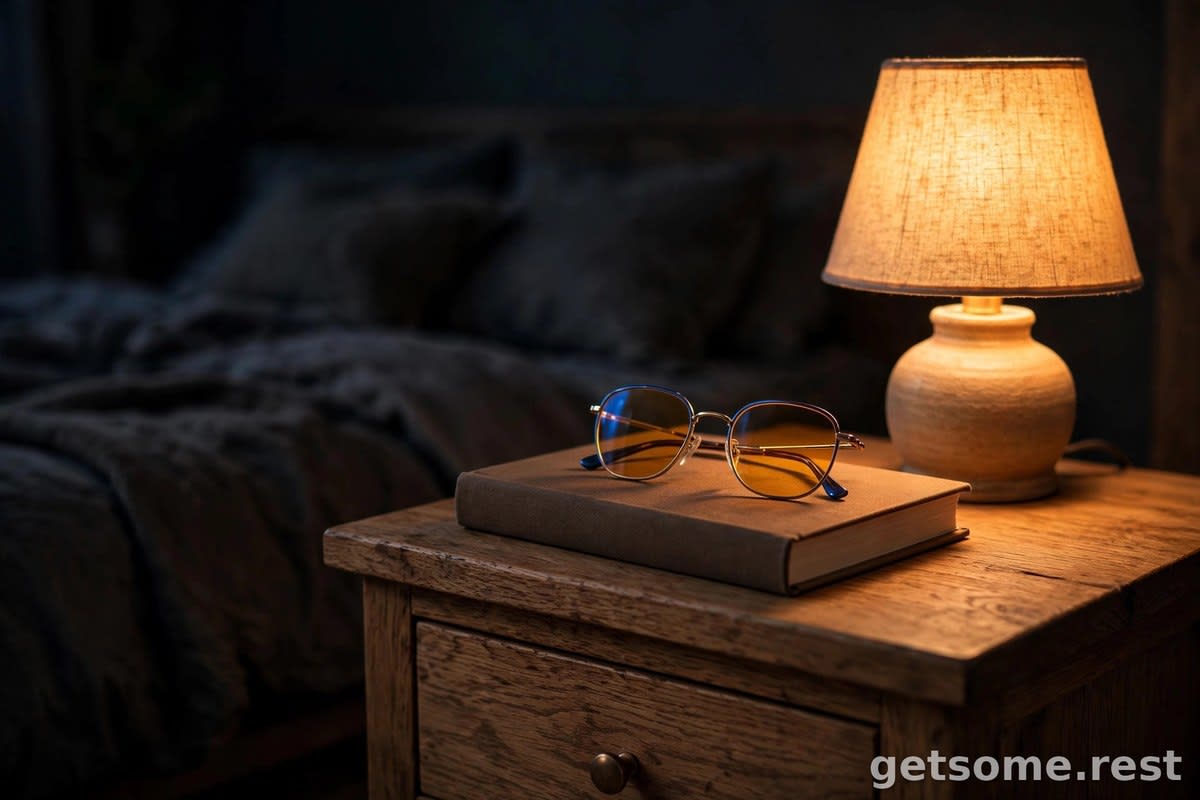
Blue light glasses are marketed as a sleep fix, but the best available evidence — including a Cochrane review of 17 trials — says the sleep benefits are far shakier than the ads suggest. Here is what the research actually found, plus one surprise: morning light glasses may be the real story.
Contents
At a glance: what the research says
Blue light glasses are one of the most marketed sleep products on the internet. The science underneath them is real — evening light really does suppress melatonin — but the glasses themselves have a much thinner evidence base than the ads suggest. Here is where the research actually stands in October 2026.
- The Cochrane review (2023): 17 randomized trials, 619 people. No high-quality evidence that blue-light-filtering lenses improve sleep; the six sleep trials could not even be pooled, and certainty was graded very low.
- The 2025 actigraphy meta-analysis: pooling three crossover trials with wrist-worn trackers found no statistically significant improvement in time to fall asleep, total sleep, efficiency, or nighttime awakenings.
- Subjective vs. objective split: people wearing blockers sometimes say they fell asleep faster, while their trackers show no change — a classic signature of expectation effects.
- Tint matters: amber or orange lenses that truly filter blue wavelengths are the ones studied for sleep; nearly-clear daytime 'computer glasses' block far too little to matter at night.
- The morning twist: a 2026 field experiment with 182 employees found that blue-light-emitting glasses worn for 30 minutes in the morning improved sleep that night and next-day alertness. Morning light, not evening filters, may be the real story.
This is a research roundup, not medical advice. We report what researchers found — we do not prescribe what you should wear or do about your sleep.
How to read a blue-light sleep study
Before the study details, a quick guide to what separates a convincing trial from marketing dressed up as science. Keep these six checks in mind as you read any claim about blue light glasses.
1. Self-report vs. objective measurement. Asking people how they slept is useful but vulnerable to expectation: if you believe the glasses work, you tend to say you slept better. Wrist actigraphy or polysomnography measures what your body actually did. The most trusted trials use both — and the gap between the two is where the truth usually hides.
2. What did the control group wear? A trial that compares amber glasses against wearing nothing at all cannot separate the lens from the placebo ritual of putting something on before bed. Stronger trials compare amber lenses against clear lenses that look identical but filter almost nothing.
3. The tint tells the truth. Melanopsin — the pigment in the eye's clock cells — responds most strongly to blue wavelengths around 446–477 nanometers. Amber and orange lenses block that band; nearly-clear daytime 'blue light' glasses do not. A study on clear lenses tells you nothing about amber ones, and vice versa.
4. Sample size and follow-up. Many trials in this field have 10–30 people and run for days, not months. Small, short studies can miss real effects — or inflate flukes. Treat single small trials as hints, not verdicts.
5. Brightness matters more than color alone. A dim blue screen and a bright white room lamp are not equivalent exposures. Trials that ignore total light dose can miss why their results conflict.
6. Who was studied? Shift workers, people with delayed body clocks, and hospital inpatients bathed in overhead lighting are not the average person with a bedside phone. Effects found in extreme circadian disruption do not automatically transfer to everyone.
The studies, side by side
Seven key publications, from the landmark Cochrane review to the newest 2026 work. Read the finding, then the limitation — that is where the honest picture lives.
| Study | Design | Finding | Limitation |
|---|---|---|---|
| Singh et al., Cochrane Database Syst Rev, 2023 | Systematic review of 17 RCTs, 619 adults, six countries | No high-certainty evidence of benefit for sleep; six sleep trials split 3 improved / 3 null, not poolable (very low certainty) | Follow-up under one day to five weeks; no study had low risk of bias across all domains; no macular-health data |
| Torres-Mancilla et al., Front Neurol, 2025 | Meta-analysis of 3 double-blind crossover RCTs (49 adults) with actigraphy | No significant effects: sleep onset ~5 min shorter (p = 0.54), total sleep ~9 min longer (p = 0.70), efficiency and awakenings flat | Tiny pooled sample (49 people); only evening blockers tested, not morning light |
| Hester et al., Chronobiol Int, 2021 | Systematic review of 24 publications | Substantial evidence of shorter sleep onset in people with sleep disorders, jet lag, or shift-work schedules | Mixed study types, not RCT-only; average-person benefit not established |
| Martin et al., J Sleep Res, 2021 | Randomized trial in healthy adults | Wearers reported falling asleep faster with fewer awakenings — but wrist trackers showed no objective improvement | Subjective–objective split suggests expectation effects; small sample |
| Keeler et al., J Appl Psychol, 2026 | Within-person field experiment, 182 employees, 2 work weeks, 100% vs 1% blue-light glasses worn 30 min each morning | Morning blue light improved that night's sleep, next-day alertness, and work outcomes; strongest in people with existing sleep problems | Workplace field study, not a lab trial; self-reported sleep outcomes |
| Chang et al., PNAS, 2015 | Randomized crossover lab trial, 12 young adults, ~4 h evening reading | E-reader vs paper book: ~26 vs ~16 min to fall asleep, ~55% melatonin suppression, clock shifted more than 1.5 h, ~12 min less REM | Small lab study of screens, not glasses; extreme exposure protocol |
| Front Physiol, 2020 (inpatient trial) | 33 medical inpatients randomized 2:1 — morning bright-light glasses plus evening filter glasses vs standard care | Trend to fewer night awakenings; actigraphy day-mode ~1 h earlier (p = 0.008); lower morning sleepiness | Small, short hospital study; combined intervention, so glasses vs morning light cannot be separated |
Our verdict: the honest takeaway
After weighing the reviews, the meta-analysis, and the newest trials, here is the most defensible reading of the evidence — what is supported, what is plausible but unproven, and what is mostly marketing.
Supported: evening blue light disrupts the body clock. This is the part nobody serious disputes. Lab work shows evening screen light suppresses melatonin, delays the circadian clock, and shortens REM sleep in a dose-dependent way. If your evenings are bright — overhead LEDs, a glowing monitor, a phone in bed — that light is a genuine sleep-relevant exposure. The debate is not whether light matters. It is whether a pair of glasses is an effective way to manage it.
Weak to mixed: evening amber glasses improve sleep. The two most rigorous syntheses — the 2023 Cochrane review and the 2025 actigraphy meta-analysis — both land in the same place: no statistically significant, high-quality evidence that blue-light-filtering lenses improve sleep in the average adult. The most optimistic reading comes from reviews of people with serious circadian disruption (shift workers, delayed sleep phase), where amber lenses worn for one to three hours before bed shortened sleep onset. For everyone else, the effect — if real — looks small and inconsistent.
More promising: bright light in the morning. The strongest new signal in 2026 points the other way on the clock. Morning blue or bright light exposure advances circadian timing and improved nighttime sleep in a 182-person field experiment, and hospital trials combining morning light glasses with evening filters shifted sleep earlier. Decades of light-therapy research for delayed sleep phase point the same direction. Morning light is the intervention with the deeper bench of evidence.
Practically: dimming the room, lowering screen brightness, and using device night modes address the actual exposure — brightness and timing — more directly than any lens. Glasses remain a reasonable backup layer when screens are unavoidable, and amber lenses that truly filter blue are the only kind with any sleep rationale. We report the research; for persistent sleep problems, the consistent recommendation across these papers is to speak with a clinician rather than self-treating with eyewear.
Study by study: the details
The headline numbers above deserve their full context. Here is what each paper actually did and found.
The Cochrane review: 17 trials, one uncomfortable conclusion
Published in the Cochrane Database of Systematic Reviews in 2023, this is the most rigorous synthesis in the field. Researchers led by the University of Melbourne (senior author Laura Downie) hunted down every randomized controlled trial comparing blue-light-filtering spectacle lenses against non-filtering lenses, and found 17 trials across six countries with 619 participants total. Follow-up ranged from under a day to five weeks, and none of the studies had low risk of bias across all seven assessed domains. For eye strain, the evidence was low-certainty for little or no short-term effect. For sleep, six trials with 148 participants were too heterogeneous to pool: three reported improvement, three did not, and the certainty was graded very low. No trial reported on macular health at all, so no conclusions could be drawn there. The authors' message to consumers was blunt: be aware of these findings when deciding whether to buy the lenses.
The 2025 actigraphy meta-analysis: the objective test
If the Cochrane review's weakness was short, mixed trials, a 2025 meta-analysis in Frontiers in Neurology (Torres-Mancilla and colleagues, registered in PROSPERO) asked the cleanest possible question: when sleep is measured by wrist actigraphy instead of questionnaires, do evening blue-blocking glasses help? Only three double-blind crossover RCTs with 49 adults qualified. The pooled numbers: time to fall asleep was about 5 minutes shorter, total sleep about 9 minutes longer — neither statistically significant (p = 0.54 and p = 0.70), with wide confidence intervals that comfortably include zero. Sleep efficiency and wake-after-sleep-onset were flat. Heterogeneity was zero, meaning the three small trials agreed with each other: no significant effect. The authors concluded the glasses may provide small improvements, but current RCT evidence does not support significant effects, and larger well-powered trials are needed.
Hester 2021: where the benefit shows up
A 2021 systematic review in Chronobiology International covering 24 publications found the one corner where the evidence looks genuinely encouraging: people with sleep disorders, jet lag, or shift-work schedules showed substantially reduced sleep onset latency, and the authors called amber lenses a viable intervention for insomnia or delayed sleep phase. This is the review most often cited by supporters of blue-blocking glasses — and its caveats matter. It pooled mixed study types rather than RCTs alone, and its population is people with serious circadian disruption, not the average person scrolling before bed. It supports a narrower claim than the marketing makes.
Martin 2021: the subjective–objective split
A randomized trial in healthy adults published in the Journal of Sleep Research captured the field's central tension in a single study. People wearing blue-blocking glasses reported falling asleep faster and waking up fewer times. Their wrist-worn trackers, however, showed no significant improvement — and total sleep time actually trended slightly shorter in the glasses group. When people feel helped but their trackers disagree, expectation is the leading suspect. This study is why reviews keep asking for objective outcomes.
Keeler 2026: morning light steals the show
The most talked-about new paper flips the question. In the Journal of Applied Psychology (advance online publication, 2026), Keeler, Barnes, Huang, Gunia, and Moy ran a within-person field experiment with 182 full-time employees. Participants wore blue-light-emitting glasses for 30 minutes each morning over two work weeks; the glasses were programmed to emit either 100% (treatment) or 1% (control) blue light intensity, with the order randomized. Morning exposure improved sleep outcomes later that night, which translated into better next-day alertness, reduced depletion, and improved work outcomes. Employees with preexisting sleep problems and younger employees benefited most. The authors frame it as a 24-hour approach: it is not only about blocking light at night, but about giving the clock a strong morning signal.
The mechanism benchmark: Chang 2015
Why does any of this make biological sense? In a landmark 2015 PNAS crossover trial, 12 young adults read for about four hours before bed on a light-emitting e-reader versus a paper book. With the e-reader, falling asleep took about 26 minutes versus 16; evening melatonin was suppressed by about 55%; the body clock shifted more than 1.5 hours later; and REM sleep was about 12 minutes shorter. This is the causal foundation: specialized retinal cells (ipRGCs) carrying the pigment melanopsin are most sensitive to blue wavelengths, and they report light levels straight to the brain's master clock. The glasses debate is about whether filtering is an effective response to this exposure — not whether the exposure matters.
The combo trial: morning glasses plus evening filters
A 2020 Frontiers in Physiology trial in 33 medical inpatients — people exposed to bright hospital lighting around the clock — tested both ends of the day at once: bright-light glasses right after waking plus short-wavelength filter glasses in the evening, randomized 2:1 against standard care. Sleep diaries showed a trend toward fewer night awakenings (1.6 vs 2.4, p = 0.057); actigraphy showed a significantly earlier start to the day (06:39 vs 07:44, p = 0.008); and daytime sleepiness was lower in the hours after light administration. Small and short, and the combined design means the morning light and evening filters cannot be separated — but it is another data point for the same pattern: timing the clock beats filtering the evening.
How we reported this story
This article is a research roundup, so our method is literature coverage rather than product testing. We searched peer-reviewed reviews, meta-analyses, and randomized trials on blue-light eyewear and sleep published through October 2026, prioritizing systematic reviews and studies with objective sleep measurement (actigraphy, melatonin assays) alongside subjective reports. We included the landmark Cochrane review, the 2025 actigraphy meta-analysis, and the newest 2026 morning-light research, and we reported negative and null findings with the same prominence as positive ones.
We excluded animal studies, marketing white papers, and single-arm testimonials, and we flag sample sizes and follow-up periods wherever they limit what a study can prove. We do not prescribe, diagnose, or treat: this is news about research, and persistent sleep problems deserve a clinician's input, not an eyewear purchase. This story contains no product recommendations and no affiliate links — there is nothing here for us to earn a commission on, so there is nothing to disclose beyond that.
Frequently asked questions
Do blue light glasses help you fall asleep?
The evidence is weak and mixed. A 2023 Cochrane review of 17 randomized trials found no high-quality evidence that blue-light-filtering lenses improve sleep, and a 2025 meta-analysis of trials using wrist actigraphy found no statistically significant improvements. Some people with serious circadian disruption (shift workers, delayed sleep phase) may benefit from amber lenses, but for the average adult the effect looks small and inconsistent.
What did the Cochrane review actually find?
Led by University of Melbourne researchers and published in 2023, it reviewed 17 randomized trials with 619 people across six countries. For sleep, six trials with 148 participants were too different to pool — three reported improvement and three did not — so the evidence was graded very low certainty. It also found low-certainty evidence of little or no effect on eye strain, and no trial had measured macular health at all.
Are amber glasses better than clear blue light glasses?
For sleep purposes, the tint is the whole ballgame. The eye's clock cells respond most strongly to blue wavelengths around 446–477 nanometers, and amber or orange lenses filter that band — nearly-clear daytime 'computer glasses' do not. Every trial showing even a hint of sleep benefit used amber or orange lenses worn in the evening, not clear daytime lenses.
What about light therapy glasses in the morning?
This is where the newest evidence looks strongest. A 2026 field experiment with 182 employees found that wearing blue-light-emitting glasses for 30 minutes each morning improved that night's sleep and next-day alertness, especially for people with existing sleep problems. Hospital trials combining morning bright-light glasses with evening filters also shifted sleep earlier. Morning light has a much deeper bench of supporting research than evening filters.
Is blue light itself actually bad for sleep?
Evening bright light — especially blue-rich light — is a genuine problem for the body clock. A landmark 2015 lab trial found four hours of e-reader use before bed suppressed evening melatonin by about 55%, delayed the body clock by more than 1.5 hours, and cut REM sleep. But brightness and timing matter as much as color: a dim screen and a bright room lamp are very different exposures, which is why dimming the room often beats buying glasses.
Key takeaways
- Evening blue light genuinely suppresses melatonin and delays the body clock — that part of the science is measured and causal.
- The glasses marketed to fix it have weak evidence: a 2023 Cochrane review of 17 trials found no high-quality evidence of sleep benefit, and a 2025 meta-analysis of actigraphy trials found no significant effects.
- Amber or orange lenses that truly filter blue wavelengths have a more plausible rationale than nearly-clear daytime 'computer glasses,' which block far too little for nighttime use.
- The strongest new signal is morning light: a 2026 field experiment found 30 minutes of blue-light glasses each morning improved that night's sleep and next-day alertness.
- Dimming rooms, lowering brightness, and night modes address the actual exposure more directly than any lens; glasses are at best a backup layer when screens are unavoidable.
Reporting note: this article summarizes published research through October 2026. It is not medical advice, and it does not recommend any product or treatment.