New research on screen time before bed puts the 1-hour rule to the test
A 2025 study of more than 45,000 students tied an extra hour of in-bed screen time to 59% higher odds of insomnia — but a second 2025 study found the 1-hour cutoff doesn't help everyone. Here's what three published studies actually found, and what they couldn't prove.
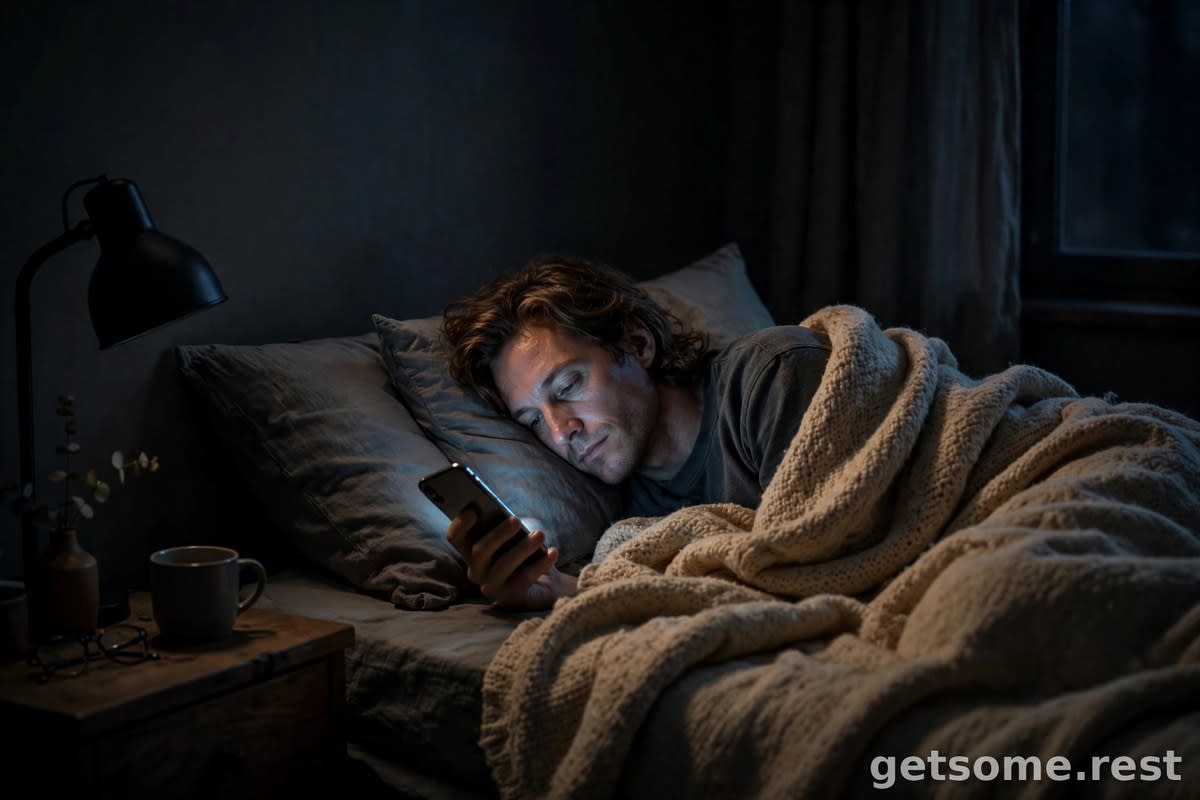
You know the rule: no screens for the hour before bed. It shows up in sleep guides everywhere. But new research from 2025 and 2026 is putting that rule through bigger, more honest tests — and the results are more nuanced than the slogan.
Contents
The 1-hour rule, and why researchers keep testing it
The "no screens an hour before bed" advice rests on three overlapping theories. The first is blue light: screens emit short-wavelength light that researchers have shown can delay the evening rise of melatonin, the hormone that signals your body it's time to sleep. The second is arousal: a heated argument on social media or a gripping video keeps the brain alert. The third is time displacement: an hour on a screen is simply an hour not spent sleeping.
All three sound plausible, and they get repeated as settled science. But over the past two years, published studies have started separating them — asking which mechanism actually shows up in the data, and whether a hard one-hour cutoff is the thing that matters. Three studies are worth knowing about: a large 2025 Norwegian survey of university students, a smaller 2025 experiment on the cutoff itself, and a 2026 study of preschoolers that tested the rule at the youngest ages.
The 59% number: what the big Norwegian study found
The headline study came from Norway, where researchers led by Gunnhild Johnsen Hjetland analyzed data from the 2022 SHoT survey of more than 45,000 university students aged 18 to 28. The participants reported how much time they spent on screens after getting into bed — and the researchers compared that against standard measures of insomnia symptoms and sleep duration.
The headline result: each additional hour of in-bed screen time was associated with 59% higher odds of reporting insomnia symptoms and about 24 fewer minutes of sleep. But the detail that surprised the researchers was about what people were doing. Social media use was not worse than watching video or any other screen activity. Statistically, the type of activity didn't change the outcome — only the total screen time did.
That pattern led the team to a specific conclusion: screens appear to hurt sleep mainly by displacing rest — taking up time that would otherwise be sleep — rather than by making people more wakeful. If the problem were arousal or blue light, you'd expect some activities (say, social media) to be worse than others. They weren't.
The caveats matter as much as the finding. This was a single cross-sectional survey, so it can't determine causality — the authors explicitly note they can't say whether screen use causes insomnia or whether students who already sleep badly simply reach for their phones more. All the data were self-reported, the sample was young Norwegian university students, and the researchers didn't include physiological sleep measurements. A headline of "screens cause insomnia" goes further than this study can reach.
If you struggle with sleep and suspect that screen time may be a factor, try to reduce screen use in bed, ideally stopping at least 30–60 minutes before sleep.
Source: Gunnhild Johnsen Hjetland, lead author, via MedicalXpress (2025)
The twist: when a 1-hour cutoff changed nothing
Later in 2025, a different study — by Lydi-Anne Vézina-Im and colleagues, published in the journal Sleep Health — tested the rule itself. Adults first monitored their sleep for one week with their normal screen habits, then for a second week they stopped using devices at least one hour before bedtime and kept monitoring.
Some participants slept better during the cutoff week. Others didn't notice any difference at all. The researchers concluded that the association between bedtime screen use and sleep health is, in their words, "complex" — and that a blanket one-hour rule overstates what the evidence can support for any given person.
As the study's sleep researcher Colleen Carney put it in coverage of the findings: if you try an earlier device bedtime and you don't feel better, "the device is not the problem we have been led to believe." The study also noted that not all screen content is equal for the mind — some apps promote relaxation while others stir up emotions that interfere with sleep — which complicates any single cutoff rule further.
This is the study that makes the Norwegian findings more interesting rather than less. The Norwegian survey says: in a population of tens of thousands, more in-bed screen time tracks with worse sleep. The cutoff experiment says: for an individual, removing the screen may or may not be the lever that fixes things. Both can be true at once.
What the studies measured — and what they didn't
Comparing the three studies side by side makes the strength of the evidence — and its limits — much clearer.
| Study | Who was studied | Key reported finding | What it didn't measure |
|---|---|---|---|
| Hjetland et al. 2025, Frontiers in Psychiatry | 45,000+ Norwegian university students (SHoT 2022) | +1 hour of in-bed screen time linked to 59% higher odds of insomnia symptoms, 24 min less sleep; no difference between activities | Causality (cross-sectional); physiological sleep; whether participants had insomnia before picking up screens |
| Vézina-Im et al. 2025, Sleep Health | Adults in a two-week monitoring experiment | A 1-hour device cutoff before bed helped some participants' sleep but made no difference for others | Long-term effects; which screen contents help or hurt; why individuals responded differently |
| Ramos et al. 2026, European Journal of Pediatrics | Preschool children (Brazil) | More than 1 hour of daily electronic media use linked to a higher prevalence of sleep disorders (aPR 1.26) | Causality (cross-sectional); specific screen-use patterns, content, or parental supervision |
aPR = adjusted prevalence ratio, a statistical measure of association. All three studies report associations, not proven cause and effect.
Where does the 1-hour rule stand now?
Taken together, the new research neither kills the 1-hour rule nor vindicates it. The Norwegian study gives the rule its strongest recent support: a large, well-analyzed sample where more in-bed screen time tracks with measurably worse sleep. The cutoff experiment is the honest counterweight: the rule's core prediction — remove the screen, fix the sleep — didn't hold for everyone.
What's most defensible from the evidence is narrower than the slogan: screens in bed are associated with less sleep, mostly because they take up time you'd otherwise spend asleep, and the risk rises with the dose. That's a softer claim than "one hour or else," but it's one the data actually support.
None of this is medical advice, and none of it replaces a conversation with a clinician if you have persistent sleep problems. But if you're looking for a low-effort experiment, researchers' own suggestion is worth reporting: try cutting screen use in bed, aim for 30 to 60 minutes screen-free before sleep, and silence notifications so the phone can't wake you after you've put it down. If your sleep improves, you've found a lever. If it doesn't — as the 2025 cutoff study found for some people — the answer may lie elsewhere, in the rest of your evening routine. Our guide to a 30-minute evening routine for better sleep and our explainer on whether reading before bed actually helps you sleep cover the other half of the wind-down picture, and if your mind is what's keeping you up, see how to fall asleep fast when your mind won't stop.
How we reported this research
This is a research news article, not a product review. We don't take payment for coverage. Here's how we handled the science:
- Study selection
- We covered studies published in peer-reviewed journals in 2025 and 2026 — two adult studies and one pediatric study — and report what each found in the authors' own framing.
- What counts as evidence
- We distinguish associations (things that appear together in survey data) from proven causes. The two largest studies here are cross-sectional, which cannot establish which came first.
- Sample sizes
- The Norwegian study drew on 45,000+ participants; the cutoff experiment and the preschooler study were much smaller. Larger samples give more stable population-level patterns; smaller experiments test mechanisms.
- Design limits
- We report each study's stated limitations — single-culture samples, self-reported sleep, no physiological measurement — because the caveats are part of the finding.
- No medical advice
- We don't diagnose, treat, or prescribe. If sleep problems persist, talk to a clinician or sleep specialist.
Frequently asked questions
Does scrolling on my phone before bed really cause insomnia?
Research shows a link, not a proven cause. In a 2025 study of more than 45,000 Norwegian students, each extra hour of screen time after getting into bed was associated with 59% higher odds of insomnia symptoms and 24 fewer minutes of sleep. But the study was a one-time survey, so it cannot prove the screens caused the insomnia — people who already sleep badly may also reach for their phones more.
Is social media worse for sleep than watching TV in bed?
The Norwegian researchers found no meaningful difference between activities: social media, video, and other screen use were all linked to less sleep in roughly the same way. That led them to conclude that screens mostly steal sleep by displacing rest time — an hour spent on a screen is an hour not spent sleeping — rather than because any one type of content is uniquely stimulating.
Will stopping screen use one hour before bed fix my sleep?
Not necessarily for everyone. A 2025 study in the journal Sleep Health had adults try one week of normal screen habits followed by one week of stopping devices at least one hour before bed. Some participants slept better, but others noticed no difference at all. The researchers concluded the link between bedtime screens and sleep is more complex than a single rule can cover.
Does the 1-hour screen rule apply to children too?
The research on young children points in a similar direction. A 2026 study of preschoolers found that more than one hour of daily electronic media use was associated with a higher prevalence of sleep disorders, including trouble falling and staying asleep. The authors said the findings support limiting children's daily screen time and avoiding screens before bedtime — again as an association, not proven cause and effect.
What did researchers suggest instead of a strict 1-hour rule?
The lead author of the Norwegian study suggested reducing screen use in bed and aiming to stop 30 to 60 minutes before sleep — a gentler version of the rule — plus disabling notifications to cut nighttime disruptions. Her own caveat stands: these are suggestions based on survey data, not medical prescriptions, and anyone with persistent sleep problems should talk to a clinician.
Key takeaways
- A 2025 study of 45,000+ Norwegian students linked each extra hour of in-bed screen time to 59% higher odds of insomnia symptoms and 24 minutes less sleep — a large-sample association, not proven causation.
- What people did on screens didn't matter; how long they spent did — suggesting screens displace sleep rather than uniquely overstimulating the brain.
- A 2025 cutoff experiment found a one-hour device ban before bed helped some adults' sleep and changed nothing for others — the rule isn't universal.
- A 2026 preschooler study linked more than one hour of daily screen use to more sleep disorders in young children.
- Researchers' own suggestion: reduce screen use in bed, aim for 30–60 minutes screen-free before sleep, and silence notifications. This is reported research, not medical advice.