Does reading before bed actually help you sleep?
Books are the classic wind-down ritual — but science draws a sharp line between paper pages and glowing screens. Here is what the research actually shows.
Reading before bed is one of the most recommended sleep habits in the world — and one of the least examined. Does a few chapters actually help you fall asleep, or is it just a pleasant habit with no real evidence behind it? The research gives a nuanced answer.
Contents
What the science actually says
There is surprisingly little direct research on whether reading makes people fall asleep faster. Most studies compare reading against something worse — usually scrolling a phone — rather than testing reading on its own, which means much of the "evidence" for bedtime reading is really evidence against bedtime screens.
The most-cited benefit comes from a small 2009 study by the University of Sussex, which found that six minutes of reading reduced stress by up to 68 percent — more than music, tea, walking, or video games. The catch: it measured stress, not sleep. Feeling calmer is plausibly helpful before bed, but lower stress on a questionnaire is not the same as falling asleep faster. Treat that finding as suggestive, not decisive.
There is also indirect evidence from habit research: people who read in bed tend to keep more consistent bedtimes, and consistent bedtimes predict better sleep. But correlation is not causation — the same people who protect a reading ritual usually protect their whole evening. The ritual may deserve only part of the credit.
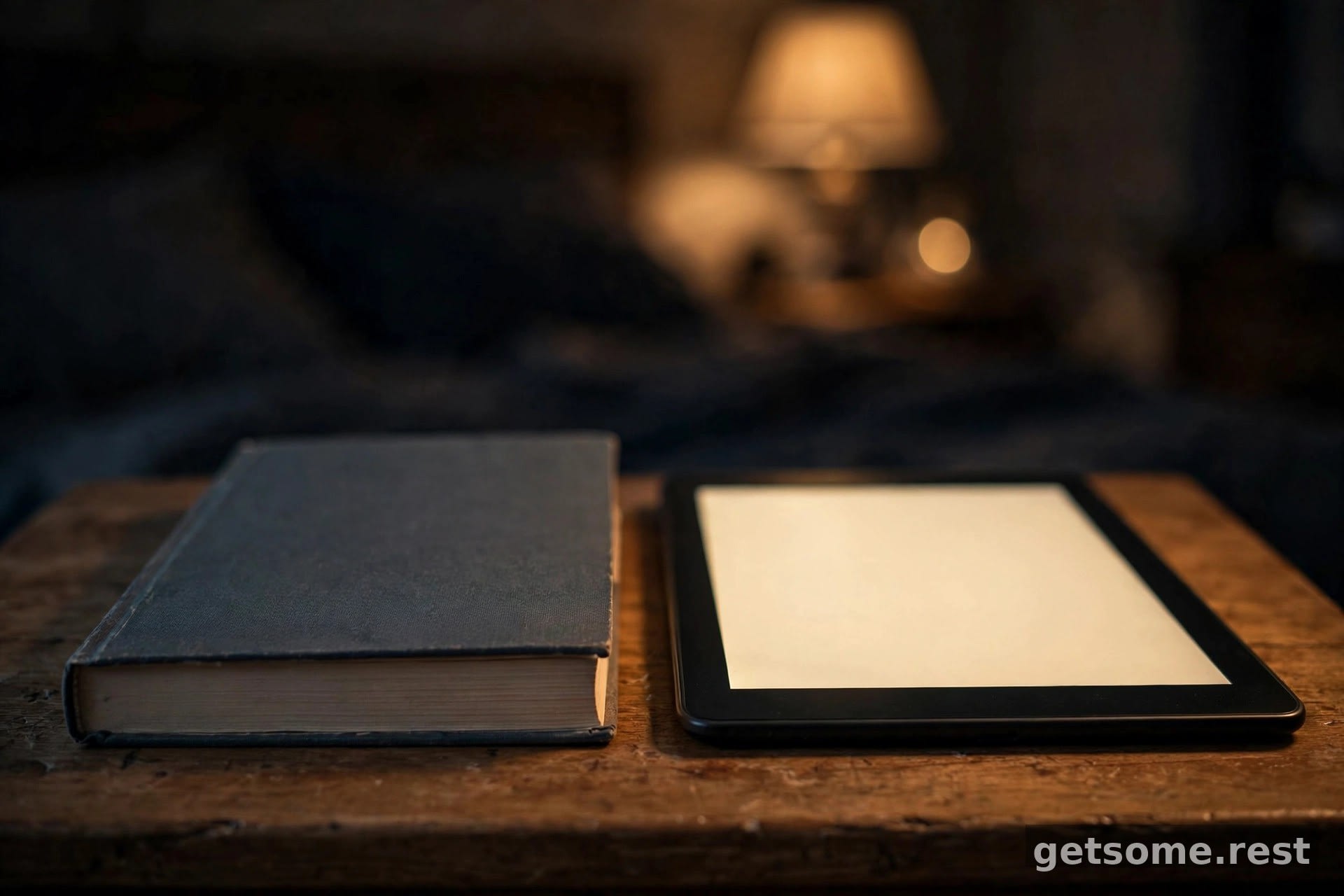
The strongest direct evidence we have is not about reading helping — it is about glowing screens hurting. In a two-week inpatient study published in the Proceedings of the National Academy of Sciences, researchers led by Anne-Marie Chang at Penn State compared reading on an iPad with reading a printed book for four hours before bed. The tablet readers took nearly 10 minutes longer to fall asleep, secreted less of the sleep-facilitating hormone melatonin, spent less time in REM sleep, and — most strikingly — felt more tired and took longer to become alert the next morning. The paper's own conclusion is worth quoting in spirit: light-emitting e-readers before bed prolonged sleep onset, delayed the circadian clock, suppressed melatonin, reduced REM, and cut next-morning alertness.
So the honest summary: reading is a low-stimulation, screen-free activity that does not fight your body's sleep signals. It will not sedate you the way a dark room does, but it will not keep you up the way a phone does — which makes it a genuinely good wind-down, with the medium doing most of the heavy lifting.
Reading vs. screens: the PNAS experiment
The Chang study deserves a closer look because it answers the exact question most people are really asking: is reading on my tablet the same as reading a book? Twelve adults lived in a sleep lab for two weeks, alternating five nights of iPad reading with five nights of printed-book reading, each for four hours before bed. Researchers tracked melatonin hourly from blood samples, monitored brain waves with polysomnography, and measured morning alertness. The results were consistent across every measure.
The mechanism is light. The iPad emitted short-wavelength-enriched blue light peaking around 450 nanometers, which suppresses melatonin and shifts the circadian clock later. Phones, laptops, and LED monitors emit similar blue-enriched light — while a non-backlit e-ink reader reflects ambient light like paper and behaves like a printed book.
A few caveats keep the study honest: four hours of reading at full brightness is more extreme than a typical dim 20-minute chapter, and a lab is not your bedroom. But the direction of the effect is well supported by decades of circadian research — and the "less alert next morning" finding is the one that should make evening scrollers pause.
The practical takeaway is simple. If you read on a dedicated e-ink reader, keep the front light low or off and treat it like a book. If you read on a phone or tablet, you are not "reading before bed" in the way the research supports — you are doing bright-screen time with words on it.
Surveys cited by the PNAS researchers found that 9 out of 10 Americans use some kind of electronic device within an hour of bedtime.
Source: background survey cited in Chang et al., Proceedings of the National Academy of Sciences (2015)
Why reading can help you unwind
Even without a study proving that books knock you out, there are three solid reasons reading works as a wind-down. The first is the mental off-ramp. Racing thoughts — replaying the day, rehearsing tomorrow — are one of the most common barriers to falling asleep, and our guide to falling asleep when your mind is racing covers the problem in depth. Reading gives the mind a single, mildly engaging track to follow. A novel demands just enough attention to displace rumination, but not so much that it revs you up. It is, in effect, a gentle form of the cognitive-shutdown techniques sleep specialists recommend, minus the effort.
The second is the transition ritual. Sleep is a slope, not a switch, and the brain takes cues from repeated sequences. When the same activity — book, lamp, twenty minutes — precedes sleep every night, it becomes a conditioned signal. Reading is an unusually good vehicle for this because it is pleasant enough to keep doing; consistency turns the habit into a cue.
The third is displacement. Every minute spent with a book is a minute not spent on a phone. Social media, news, and messaging are engineered to hold attention with novelty and outrage — the opposite of drowsy. Swapping half an hour of scrolling for reading removes the brightest light, the most stimulating content, and the most open-ended activity from the pre-sleep window in one move.
How to make reading part of your wind-down
Doing it right is mostly about protecting the reading from the rest of the evening. Start by moving the phone out of the bedroom — not face-down on the nightstand, out. A phone in the room is a phone you will check "just once," and one check is never one check. A cheap alarm clock removes the last reason to keep it nearby.
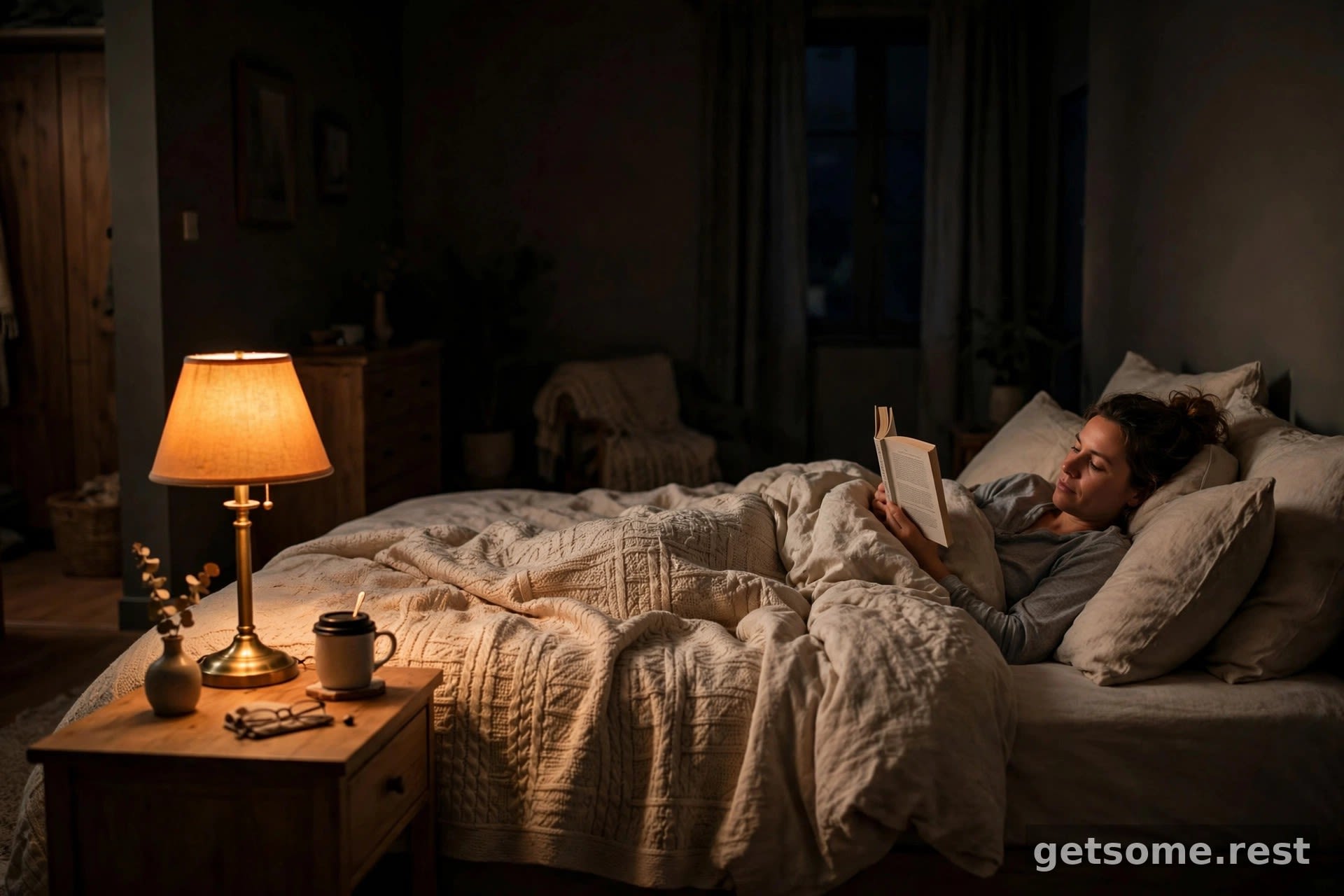
Light matters almost as much as the device. Read under a warm, dim lamp rather than the overhead light, and keep it behind or beside you rather than shining in your eyes. Bright overhead lighting signals "daytime" to the same circadian system the PNAS study measured, quietly undoing the benefit of choosing paper. On an e-ink device, keep the front light as low as comfortable.
Timing is the part people skip. Aim for 20 to 30 minutes and treat the end time as a hard boundary — a chapter count or a timer, whichever you will honor. An unbounded session is a delayed bedtime in a healthy habit's clothes. Many readers fold it into a broader evening routine; our 30-minute evening routine guide shows how a reading block fits alongside dimming the lights and prepping the room.
Finally, keep the habit attached to sleep, not wakefulness. If you are not drowsy when your reading time ends, resist the urge to keep reading to "make" sleep come. Lights out, book down — the routine works by repetition, not force.
What to read — and what to avoid
The ideal bedtime book is absorbing but not activating. Gentle fiction, essay collections, poetry, nature writing, and calm nonfiction all fit the bill. The key quality is a steady narrative pull without spikes: you want your attention held, not your pulse raised. Many readers find that re-reading a favorite book works even better than something new, because there are no cliffhangers left to chase.
Be wary of anything engineered for "just one more." Thrillers with cliffhanger chapters and twist-heavy mysteries can convert a 20-minute wind-down into a 2 a.m. finish. The content does not need to be boring — it needs to be stoppable. If you keep blowing past your timer with a particular book, it is not a bedtime book.
The same goes for material that is not really reading: news apps, social feeds, work email, and comment sections. These deliver novelty and emotional charge — the opposite of a wind-down. If your "reading" happens in a browser with tabs open, it is not the habit this guide is about.
When reading before bed backfires
There are two ways reading can work against sleep, and both are worth knowing. The first is procrastination: reading to delay bedtime. If the book becomes a reason to stay up past the hour you intended to sleep, the lost sleep will cost you far more than the reading gains you. This is the most common failure mode, and the timer rule from the section above is the fix.
The second is subtler. Sleep specialists often advise keeping the bed reserved for sleep, because the brain learns fast: hours spent awake in bed — even pleasantly, even reading — can teach it to associate the bed with alertness rather than sleep. If you regularly read in bed for an hour or more while wide awake, move the reading to a chair and come to bed when you feel genuinely drowsy.
None of this makes reading bad. It makes reading a tool with a job description: a bounded, dim, screen-free bridge from the day to sleep. Use it that way and it is one of the cheapest sleep upgrades there is.
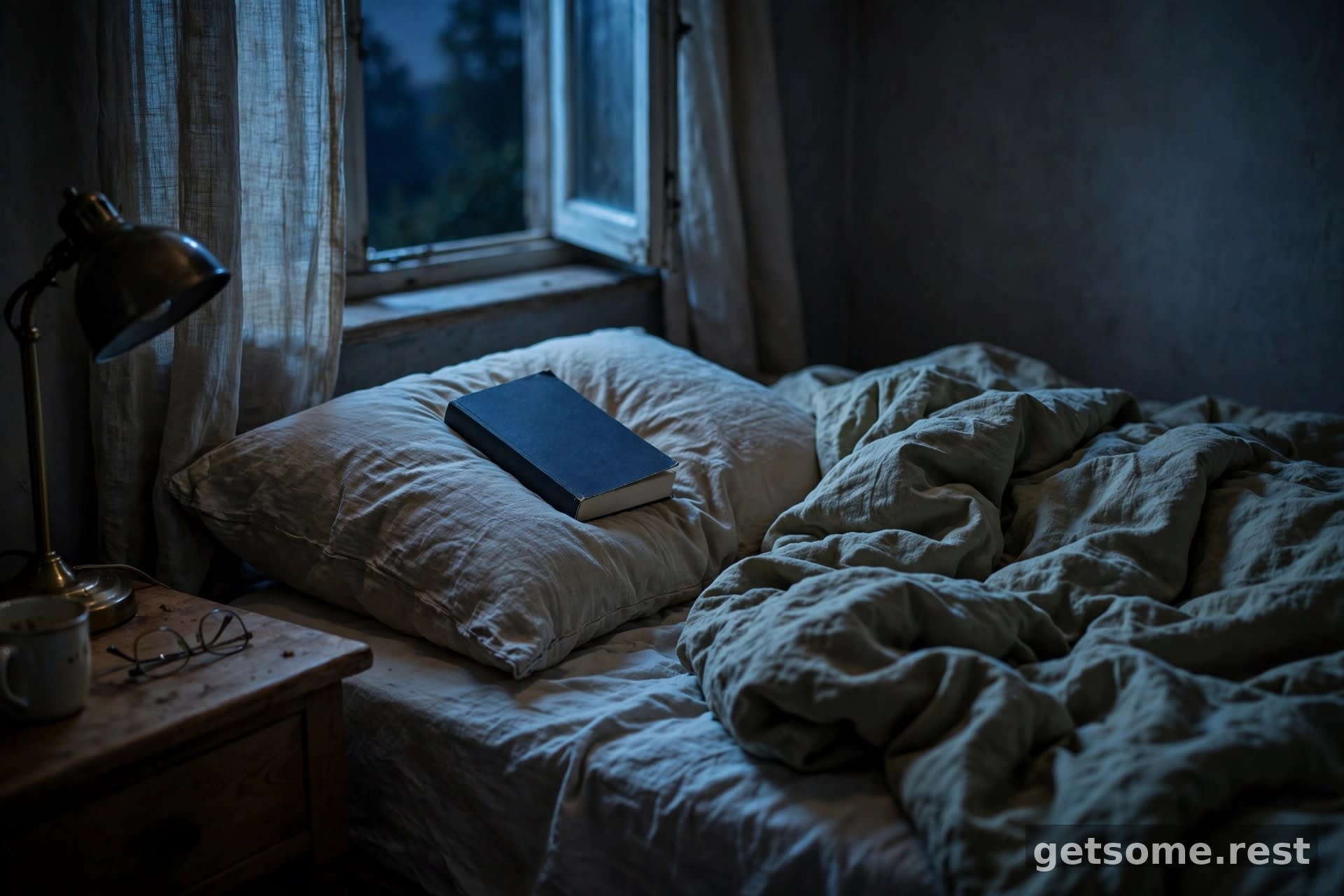
A simple 20-minute reading wind-down
Here is a concrete version you can try tonight. One hour before bed, dim the overhead lights and switch to lamps. Thirty minutes before bed, put the phone on charge outside the bedroom. Pick up your book — paper or e-ink — and read for 20 minutes under a warm lamp. When the timer ends, close the book, turn off the lamp, and get into bed. No checking the phone "one last time." If you want the full version with the room setup, sound, and morning anchor included, see our best 30-minute evening routine for better sleep.
Give it a week before judging. The first night or two your brain may still reach for the phone; that is the old habit, not a verdict on the reading. By night five or six, the book should start to feel like the first step toward sleep — the conditioned cue the ritual is built to create.
How we test
We never accept payment for rankings. For research guides like this one, every claim is judged against the same five checks:
- Sources
- We cite the original study or an official summary of it, not a headline about a headline. Where a finding comes from a single small study, we say so.
- Study quality
- We note the design behind a claim — lab experiment, observational study, or survey — because each supports a different strength of conclusion.
- Claim scope
- We check whether a study measured what the headline claims. Stress reduction is not sleep improvement, and we do not present it as such.
- Expert guidance
- We compare findings against the consensus of sleep-medicine guidance, and flag where a single study diverges from it.
- Updates
- We revisit research guides when major new studies appear, and we date every claim so you can see how fresh the evidence is.
Frequently asked questions
Does reading before bed help you fall asleep faster?
Reading can help you fall asleep faster mainly because it replaces screen time and gives your mind a calm, low-stimulation activity to focus on. Research shows the benefit depends on the medium: printed books and e-ink readers with the backlight off appear neutral or helpful, while backlit tablets can delay sleep onset — in one well-known study by about ten minutes — because their blue-enriched light suppresses melatonin.
Is reading on a phone or tablet as good as a paper book for sleep?
No. A landmark study published in the Proceedings of the National Academy of Sciences compared reading on an iPad with reading a printed book before bed. The tablet readers took longer to fall asleep, showed reduced evening melatonin, got less REM sleep, and felt less alert the next morning. A dedicated e-ink reader with the front light off behaves more like a paper book; a phone or tablet does not.
How long should you read before bed?
About 20 to 30 minutes works well for most people. That is long enough to settle a busy mind and let drowsiness build, but short enough that reading stays a wind-down rather than a reason to delay bedtime. Keep the session bounded: decide on a chapter count or a set number of minutes, and stop when the time is up even if the story is good.
What should you read before bed?
Choose something absorbing but not activating: gentle fiction, essays, poetry, or calm nonfiction. Avoid page-turner thrillers with cliffhanger chapters, stressful news, and anything that makes you argue in your head. The goal is a steady, mildly engaging focus that lets the day's thoughts fade — not content that spikes adrenaline or keeps you turning pages at 1 a.m.
Can reading in bed make insomnia worse?
It can, if reading becomes a way to pass wakeful hours. Sleep specialists often advise keeping the bed reserved for sleep, because lying awake while reading can teach the brain to associate the bed with being alert. If you find yourself reading for an hour or more while wide awake, it is usually better to read in a chair until you feel drowsy, then move to bed. Reading itself is fine; reading through wakefulness is the problem.
Key takeaways
- Reading before bed is a good wind-down mainly because it displaces screen time and gives racing thoughts a calm track to follow.
- The medium matters: paper books and dim e-ink readers are fine; backlit phones and tablets measurably delay sleep and dull the next morning.
- Keep it to 20–30 minutes under a warm, dim lamp, and stop on time — an unbounded session is just a delayed bedtime.
- Choose absorbing-but-calm material, and skip the news, feeds, and thrillers with cliffhanger chapters.
- If you are lying awake reading for an hour, move the reading to a chair — the bed should stay associated with sleep.