Does Sleeping With Socks Help You Fall Asleep Faster?
A small 2018 study found bed socks helped six men fall asleep 7.5 minutes faster and sleep 32 minutes longer. What the research really says — and its limits.
In November 2026, a Saga report on new sleep research put an old bedtime habit back in the spotlight: wearing socks to bed. In one small study, six men fell asleep seven and a half minutes faster, slept 32 minutes longer and woke less often on the nights they wore bed socks. It sounds like the cheapest sleep hack ever invented. The catch is the size of the evidence: six people, one night each way, in a cool laboratory bedroom. This guide covers what the studies found, why warm feet might help, which socks work best, and who should skip it — caveats included, because a promising result from six people is not a guarantee.
Contents
What the Studies Actually Found
The headline comes from a 2018 study by Ko and Lee, published in the Journal of Physiological Anthropology — the only trial that tested bed socks directly. Six healthy young men slept seven hours in a cool 23°C room on two nights, once wearing bed socks and once without. On the sock nights, they fell asleep 7.5 minutes sooner (8.5 versus 16.0 minutes), slept 32 minutes longer, woke about half as often, and had 7.6 points higher sleep efficiency. Their feet stayed warmer while core temperature did not change — the socks improved heat loss rather than overheating the body.
| Measure | Without socks | With bed socks | Difference |
|---|---|---|---|
| Time to fall asleep | 16.0 minutes | 8.5 minutes | 7.5 minutes faster |
| Total sleep | Baseline | 32 minutes longer | +32 minutes |
| Night awakenings | 16.3 | 8.8 | 7.5 fewer (about half as often) |
| Sleep efficiency | 86.2% | 93.8% | +7.6 percentage points |
Those are big effects from a very small study, and the limits matter as much as the numbers. Six participants, all young men, measured on one night in each condition, in a controlled cool room. The authors said women, older adults and colder settings still need testing. The gains also showed up on the equipment, not in how well the men felt they slept.
A second study, covered in Saga's November 9, 2026 report, looked at adults over 50 and asked whether warming the feet — including with socks — shortens the time it takes to fall asleep. It concluded bed socks could help older people fall asleep quicker, provided they had no other sleep difficulties — but again, the group was small.
The idea behind both studies is much older than the sock trial. In 1999, Kräuchi and colleagues in Basel published a paper in Nature titled “Warm feet promote the rapid onset of sleep.” They found that blood-vessel widening in the hands and feet was the single best predictor of how quickly someone fell asleep. The socks trial is a practical test of that older finding.
Not every test of foot warming has worked. In a 2006 study, 11 people dipped their hands and feet in 42°C water for five minutes before a daytime nap, and fell asleep no faster. Timing and context seem to matter.
Sleep expert Dr David Lee, clinical director of Sleep Unlimited, put it plainly to Saga: “But is that true for everyone from a couple of small studies? Probably not. It needs to be repeated with a larger number of participants and studied for a longer period.” It is “not advice we'd give out clinically, yet.”
One note on the numbers: some reports call the awakening result “7.5 times fewer.” The study's figures are 16.3 awakenings without socks versus 8.8 with — 7.5 fewer, roughly half as often, not 7.5 times fewer.
Why Warm Feet Help You Fall Asleep
Falling asleep is partly a cooling process. As bedtime approaches, your core temperature drops by roughly a degree Celsius, and that drop is one of the signals your body uses to switch into sleep mode. The heat leaves through the skin — mostly through your hands and feet, which are rich in blood vessels and act like radiators. The warmer your feet are relative to your core, the more heat can escape, and the faster your core can cool.
That is why the mechanism behind the sock studies makes sense even though the direct evidence is thin. Warming your feet widens the blood vessels in the skin — distal vasodilation — increasing blood flow to the surface and letting core heat escape. It sounds backwards, but it is the same reason a warm bath an hour or two before bed can make you drowsy: the bath warms your skin, your vessels open, and your core temperature falls faster afterwards.
The Kräuchi research from 1999 backs this up. The Basel team found that the gap between the temperature of the hands and feet and the temperature of the trunk — a measure of how much heat the body is shedding — predicted how quickly someone fell asleep better than core temperature, heart rate or self-reported sleepiness. Warm extremities are not a folk remedy; they are one of the most reliable physical signs that sleep is coming.
Room temperature is the other half of the equation. The sock trial was run at 23°C, a cool bedroom — the condition where feet warming should shine, because cold feet mean constricted vessels and inefficient heat loss. In a warm bedroom the same socks could keep you awake. The trick is also individual: people whose feet already run warm gain nothing, while people whose feet go cold in bed are the ones most likely to benefit.
Bed Socks Compared: What Works Best
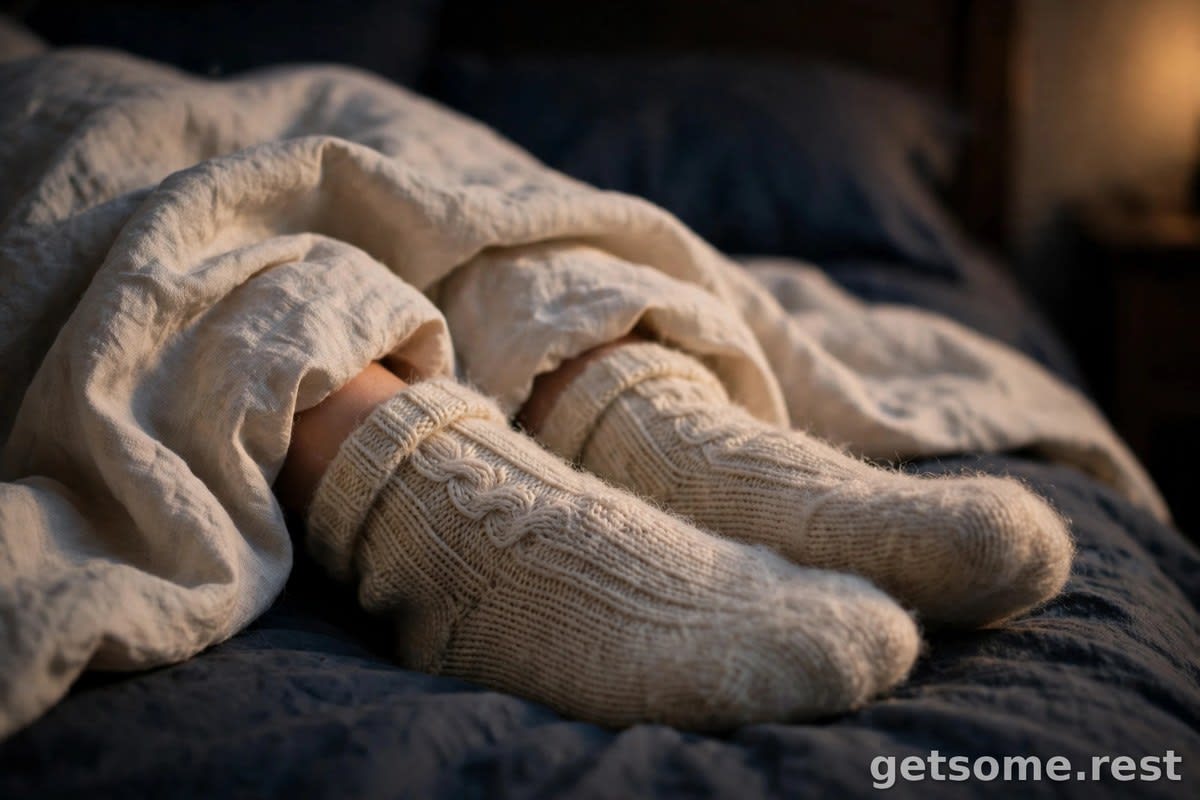
The studies used dedicated bed socks — loose, soft, warm socks worn only for sleeping — not the socks you wore all day. Tight elastic restricts the blood flow you are trying to encourage, and damp or dirty socks trap moisture. Here is how the options compare.
| Option | Best for | Watch out for |
|---|---|---|
| Loose cotton bed socks | Most people; breathable, cheap, easy to wash | Thin cotton may not be warm enough in a very cold room |
| Loose wool bed socks | Cold bedrooms; wool insulates even when slightly damp | Some wool itches; choose soft merino or a wool blend |
| Thick fluffy slipper socks | Very cold feet; maximum warmth | Easy to overheat; grippy soles can feel odd under sheets |
| Tight daytime or compression socks | Not recommended for sleep | Tight elastic can restrict circulation and trap heat |
| Heated or electric socks | People with chronically icy feet | Overheating risk, batteries and wires in bed; overkill for most |
| No socks + extra blanket at the foot of the bed | People who hate wearing socks | Less targeted warmth; blankets slip off during the night |
The practical rules are simple. Pick a pair that is loose around the ankle and toes, with no elastic digging in. Choose a natural fibre — cotton or wool, as Dr Lee recommends — because man-made fibres like polyester make feet sweat more. Keep a dedicated clean pair for bed and change them nightly.
If you want to buy a dedicated pair, search for loose cotton bed socks on Amazon or merino wool bed socks on Amazon — look for listings that describe the socks as loose-fitting or non-binding. You do not need anything expensive.
Who Should Try It — and Who Should Skip It
Most likely to help: people whose feet get cold in bed, people sleeping in a cool bedroom, and light sleepers who wake often — the group the sock trial actually studied. If you regularly lie awake with icy feet while the rest of you is warm, socks are a free experiment with almost no downside. Older adults may also benefit: the over-50s study found foot warming could help them fall asleep quicker, provided they had no other sleep difficulties. Socks also slot neatly into a 30-minute evening routine for better sleep as the last, smallest step.
Worth trying, with modest expectations: anyone who takes a while to drift off and has not found an obvious cause. Socks will not fix a racing mind — if thoughts are what keep you up, our guide on how to fall asleep fast when your mind won't stop is the better starting point.
Probably skip it: if you sleep hot, get night sweats, or wake up kicking the covers off, adding warmth to your feet is likely to work against you. The same goes for anyone whose feet already feel warm in bed. If you have a condition that affects circulation or feeling in your feet, talk to your clinician first; this article is general information about comfort and routine, not medical advice.
A note on safety: there is currently no evidence that sleeping in socks is harmful. The one real downside is moisture — warm, damp feet in tight synthetic socks can encourage fungal infections like athlete's foot. The fix is easy: breathable cotton or wool, a fresh pair each night, and taking them off if your feet get sweaty.
How to Try Sleeping With Socks Tonight
Trying this costs nothing and takes about a minute, but a little method makes the test fair. Here is a simple way to run your own three-night experiment.
1. Pick the right pair. A clean, loose pair of cotton or wool bed socks — not the socks you wore today, and not anything with tight elastic. If you are buying a pair, look for “loosely fitting” or “non-binding” in the description.
2. Keep the room cool. The research was done at 23°C, and the effect depends on it. A cool bedroom with warm feet is the combination that works; warm feet in a hot room just makes you hotter.
3. Put them on at bedtime. The point is warm feet as you are trying to fall asleep. Putting socks on 15 to 30 minutes before bed is fine too, especially if your feet are already cold — a short warm foot bath works the same way.
4. Give it three or four nights. One night tells you almost nothing, because your bedroom, bedding and stress levels vary nightly. Try three or four sock nights, then three or four without, and compare — a note on your phone each morning is enough.
5. Take them off if you overheat. If you wake up hot, sweaty or with the socks half-kicked off, that is your answer: your feet did not need the extra warmth. Socks on to fall asleep, off by morning, counts as a win too.
6. Pair it with the basics. Socks are a finishing touch, not a foundation. They work best alongside a cool, dark room and a regular bedtime. If you wake in the small hours, our guide to why you wake up at 3am every night (non-medical causes) covers the usual suspects. If sleep troubles persist for weeks, the evidence-based first step is cognitive behavioural therapy for insomnia (CBT-I).
How We Reported This Story
We have not run a sleep trial, and this article is a guide to published research, not a product review. Everything here comes from the studies and reporting listed below, checked on November 13, 2026.
- The bed-socks trial: Ko and Lee (2018), Journal of Physiological Anthropology — six healthy young men, 23°C room, crossover design. Sleep-onset latency 16.0 to 8.5 minutes, total sleep +32 minutes, awakenings 16.3 to 8.8, sleep efficiency 86.2% to 93.8%.
- The 2026 coverage: Saga, November 9, 2026 (Rebecca Frew) — the six-man study, the over-50s foot-warming study, and interviews with Dr David Lee of Sleep Unlimited. Saga's wording of the awakening result (“seven-and-a-half times smaller”) does not match the study's figures; we use the study's own numbers (16.3 versus 8.8).
- The mechanism: Kräuchi et al. (1999), “Warm feet promote the rapid onset of sleep,” Nature, and the group's 2000 follow-up in the American Journal of Physiology.
- The null result: Ebben and Spielman (2006), International Journal of Behavioral Medicine — warming hands and feet in 42°C water before a daytime nap did not shorten time to fall asleep in 11 people.
- Expert view: Dr David Lee, clinical director of Sleep Unlimited, as quoted by Saga — the evidence needs larger, longer replication and is not yet advice given clinically.
This article is general information about sleep comfort and routine, not medical advice. If you regularly struggle to fall asleep or stay asleep, speak to your doctor.
Frequently asked questions
Does sleeping with socks help you fall asleep faster?
It might. In the most direct test, six young men in a cool room fell asleep 7.5 minutes faster wearing bed socks, and slept 32 minutes longer. The sock evidence is one small trial, so the result is promising rather than proven.
What kind of socks should I wear to bed?
Loose, clean bed socks in a breathable natural fibre — cotton or wool. They should feel roomy around the ankle and toes, with no tight elastic digging in. Avoid the socks you wore all day, and avoid tight compression or thick sports socks. If your feet feel hot or sweaty during the night, take them off.
Is it safe to sleep with socks on?
There is currently no evidence that sleeping in socks is harmful. The main downside is trapped moisture: warm, damp feet can encourage fungal infections like athlete's foot, so experts recommend breathable cotton or wool over man-made fibres like polyester, and a fresh pair each night.
Why do warm feet make you sleepy?
Falling asleep is partly a cooling process: your core temperature drops by roughly a degree as you drift off, and your body sheds that heat through the skin of your hands and feet. Warming your feet widens the blood vessels there, which lets more heat escape from your core — so paradoxically, warm feet help your body cool down, and that cooling is one of the signals that it is time to sleep.
What if socks make my feet too hot?
Take them off — overheating disrupts sleep just as surely as cold feet do. Socks help most in a cool bedroom or when your feet tend to get cold. If you sleep hot or get night sweats, extra warmth on your feet is likely to work against you. A warm foot bath or an extra blanket at the foot of the bed are alternatives.
Key Takeaways
- The headline finding: in a 2018 trial, six healthy young men wearing bed socks in a cool room fell asleep 7.5 minutes faster, slept 32 minutes longer and woke about half as often — but six people is a tiny sample, so this is promising, not proven.
- Why it might work: warm feet widen blood vessels, letting core heat escape; a falling core temperature is part of how the body falls asleep.
- What to wear: loose, clean bed socks in cotton or wool — never tight daytime socks, and never man-made fibres that trap sweat.
- Who should skip it: hot sleepers and anyone with night sweats; extra warmth on the feet is likely to work against you.
- The honest verdict: socks are a free experiment worth three or four nights if your feet get cold in bed — not a cure, and not a substitute for CBT-I if sleep troubles persist.