Why You Wake Up at 3am Every Night (Non-Medical Causes)
It is rarely a mystery and almost never random: the 3am wake-up is what happens when a warm room, leaking light, evening alcohol or an inconsistent schedule meets the lightest phase of your sleep. Here are the fixable causes, one by one.
You fall asleep fine. Then, night after night, you are suddenly awake at 3am — wide awake, staring at the ceiling, clock glowing. The consistency is what makes it maddening: it feels like something is wrong. But before you look for complicated explanations, start with the boring ones, because they explain most 3am wake-ups on their own.
Contents
Why 3am specifically
The timing is not a coincidence, and it does not mean 3am is a haunted hour. Sleep runs in roughly 90-minute cycles that shift across the night: the first half of the night is heavy with deep sleep, and the second half tilts toward lighter sleep stages and dreaming. Around 3 to 4am, your core body temperature hits its lowest point and your brain spends more time in light sleep — which is exactly when it is easiest to wake up fully.
This is why the same disturbance that slides past unnoticed at midnight pulls you out of sleep at 3am. A partner's cough, a warm blanket, a sip of water's worth of bladder pressure — at midnight your brain sleeps through them; at 3am they cross the threshold. So the question is rarely "what is wrong with me at 3am" and more often "what small thing in my room or routine is crossing a lower threshold." This guide sticks to the non-medical side: your bedroom and your daily routine.
Your room gets too warm by 3am
Temperature is the most underrated cause of nighttime wake-ups, and the 3am pattern is its signature. Here is the mechanism: your body needs to cool down to stay asleep, and it dumps heat through your skin all night. A room that feels pleasantly cool when you get into bed can become a warm pocket by the early morning — heating cycling on, blankets trapping heat, a partner radiating warmth beside you. As the room warms, sleep gets lighter and more fragmented, and the lightest point of the night does the rest.
The fix is steadiness, not just coolness. Most sleep guidance points to roughly 65 to 68°F (18 to 20°C), but a stable 70°F beats a room that swings between 64 and 74. Practical moves: keep the thermostat at its night setting all night rather than letting it drift, ventilate the room before bed, and choose bedding in layers — a light sheet plus a blanket you can throw off — instead of one heavy duvet you are trapped under. Breathable bedding materials help the heat escape rather than pooling around you. For the full breakdown of the research, see our guide to the ideal bedroom temperature for sleep.
One more temperature trap: hot showers right before bed feel relaxing but can spike skin temperature. If you shower at night, finish at least 60 to 90 minutes before lights-out so your body has time to cool back down.
Light is leaking into the bedroom
Light is a powerful wake signal, even through closed eyelids. Streetlights, a neighbor's porch light, an early sunrise in summer, hallway light under the door, the glow of a router or charging cable — any of these can nudge a lightly sleeping brain toward wakefulness, and the effect is strongest in the second half of the night when sleep is already shallow.
Do a light audit the way you would a noise audit: lie in bed at night, lights off, and look for every glow. Cover or move small LEDs, seal the gap under the bedroom door with a draft stopper, and if street or early-morning light reaches the bed, real blackout curtains are one of the highest-return bedroom purchases you can make. They are not just for shift workers — anyone whose room brightens before their alarm benefits.
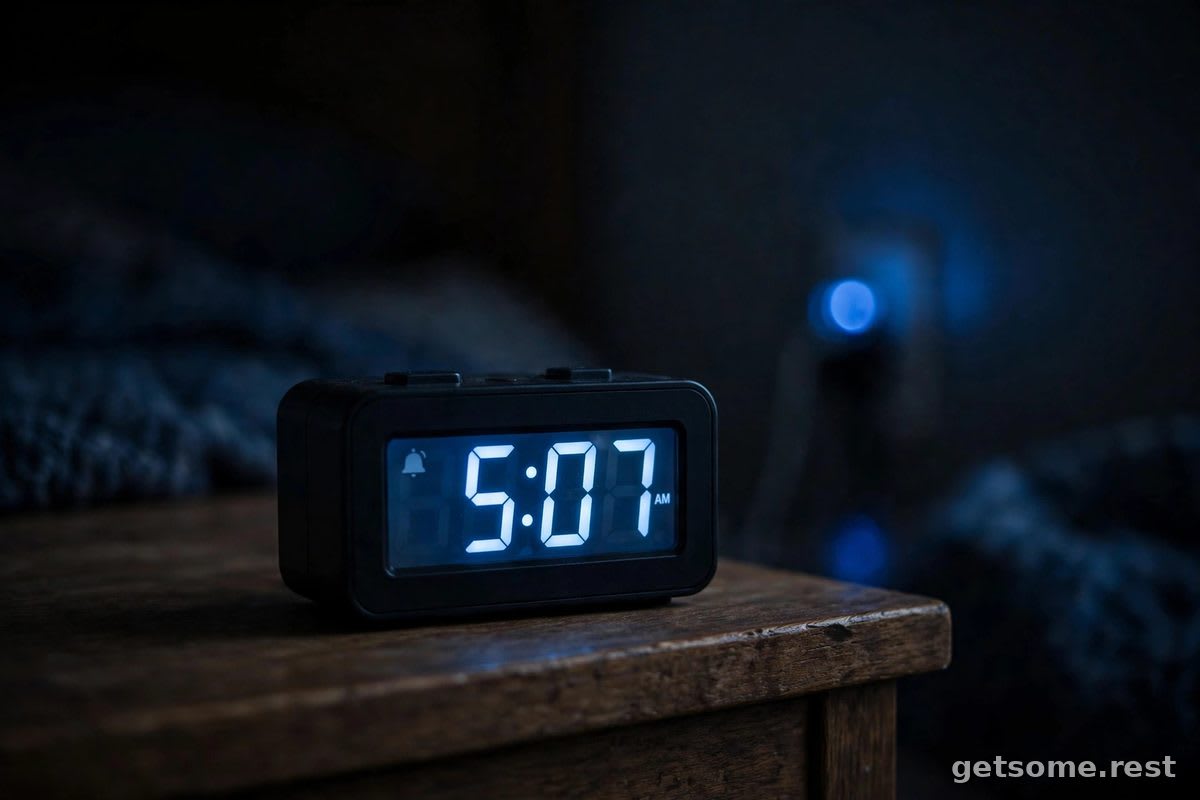
And stop checking the time. A glowing clock face is both light exposure and an anxiety trigger: seeing "3:04" starts the mental math of remaining sleep, which is the opposite of drifting back off. Turn the clock face away or switch to a dim, non-glowing display.
Evening alcohol wears off around 3am
This is the classic 3am pattern and one of the most common we hear about. Alcohol is a sedative, so a drink or two in the evening genuinely helps you fall asleep faster — that part is real. The problem arrives a few hours later: as your body metabolizes the alcohol, sleep architecture fragments. Sleep gets lighter, dreaming gets more intense, and wake-ups cluster in the second half of the night. Drink at 9 or 10pm, and the rebound lands squarely around 3am.
Alcohol also relaxes the muscles of the airway, which can make snoring louder — another 3am wake-up trigger for both you and your partner — and it increases nighttime bathroom trips. None of this requires heavy drinking; even moderate evening drinking can fragment the second half of sleep in sensitive sleepers.
The fix is timing, not necessarily abstinence. Move drinks earlier in the evening, keep the amount moderate, and give your body several alcohol-free hours before bed — a cutoff three to four hours before lights-out is a reasonable experiment. Track a week with the earlier cutoff against a week without, and judge by one metric: how many nights you woke at 3am.
Alcohol helps you fall asleep faster — then fragments the second half of the night, which is why the wake-up lands at 3am.
Source: GetSome Rest editorial analysis
Caffeine is still in your system
Caffeine's half-life — the time it takes your body to clear half of it — is roughly five to six hours in most adults, and longer in some. A coffee at 3pm means a quarter of it is still circulating at 3am. You may fall asleep fine, because caffeine's biggest effect is on sleep depth and continuity rather than on falling asleep at all. It keeps the brain in a slightly more alert state through the night, which again matters most when sleep is lightest.
The sneaky part is that caffeine hides in more than coffee: strong tea, energy drinks, pre-workout powders, chocolate, and some headache and cold medicines all count. If you are a regular 3am waker, audit the whole afternoon, not just the coffee cup. The standard experiment is a noon caffeine cutoff for a week — no coffee, tea, energy drinks or pre-workout after 12pm — and comparing your wake-up pattern. Many people are surprised how far back they have to move the line.
Stress and the racing mind
Sometimes the 3am wake-up is not the room at all — it is the mind using the lightest sleep of the night as an opening. Unfinished business, an awkward conversation, tomorrow's presentation: the brain loves to resume open loops at the exact moment sleep gets shallow. Once you are awake and thinking, the stress response does the rest — a little adrenaline, a faster heartbeat — and falling back asleep becomes genuinely difficult.
The fix works better before bed than at 3am. A short wind-down routine signals to your brain that the day is closed: dim the lights, put the phone in another room, and do a "brain dump" — write tomorrow's tasks and worries on paper so your mind stops rehearsing them. Our 30-minute evening routine is built around exactly this. If you do wake at 3am with a racing mind, our guide on how to fall asleep fast when your mind won't stop covers in-the-moment techniques; the short version is: don't lie there rehearsing the day. Get up, sit somewhere dim and boring for 15 minutes, then return to bed.
Your sleep schedule keeps drifting
An inconsistent schedule — late weekends, shifting bedtimes, catching up on Sunday — confuses the body's internal clock, and a confused clock produces fragmented sleep. When bedtime and wake time move around, the brain is never quite sure when deep sleep should happen, and the light-sleep portion of the night gets longer and more fragile. The 3am wake-up thrives in that fragility.
The fix is boring and effective: anchor your wake time. Going to bed at the same time matters, but waking at the same time matters more — it sets the clock for the whole 24-hour cycle, including when you get sleepy the next night. Keep the wake time within about 30 minutes even on weekends. Naps count too: a long late-afternoon nap steals sleep pressure from the night, making the second half of sleep lighter and more wake-prone. If you nap, keep it short and before mid-afternoon.
The 3am bathroom trip
The most mechanical cause of all: you wake because your bladder is full. Evening fluid timing is the lever — large glasses of water, herbal tea, or any drink in the last hour or two before bed will reliably produce a 3am wake-up in many people. Alcohol makes this worse, since it increases urine production on top of fragmenting sleep.
The fix is a fluid taper, not dehydration: stay well hydrated through the day and early evening, then taper fluids in the last two hours before bed, with a bathroom trip as the final step of your bedtime routine. If you exercise in the evening, rehydrate right after the workout rather than sipping heavily until bedtime. And keep the path to the bathroom dim — a bright bathroom light at 3am is a full wake signal that makes returning to sleep much harder.
Every cause and its fix, at a glance
Seven causes, seven experiments. Try them one at a time for a few nights each so you can tell what actually moved the needle.
| Likely cause | The giveaway | Tonight's fix |
|---|---|---|
| Room too warm | You wake hot, throw off covers, or the heating cycled on | Thermostat steady at 65–68°F; layered bedding you can shed |
| Light leaks | Streetlight, sunrise, or glowing LEDs visible from bed | Blackout curtains, cover LEDs, turn the clock face away |
| Evening alcohol | Drinks within a few hours of bed; wake-up around 3–4am | Alcohol cutoff 3–4 hours before lights-out |
| Late caffeine | Coffee, tea, energy drinks or pre-workout after midday | Noon caffeine cutoff for one week as an experiment |
| Racing mind | You wake thinking — tasks, worries, conversations | Brain-dump journal before bed; dim wind-down routine |
| Drifting schedule | Weekend bedtimes shift by an hour or more | Fixed wake time within 30 minutes, seven days a week |
| Full bladder | The wake-up is always a bathroom trip | Taper fluids 2 hours before bed; bathroom as last routine step |
Change one variable at a time for three to four nights each. If 3am wake-ups persist after working through the list, it is worth discussing with a doctor rather than assuming it is just a bedroom problem.
Frequently asked questions
Why do I keep waking up at 3am every night?
The hours around 3 to 4am are when sleep is naturally lightest, so small disruptions that slide by at midnight — a warm room, light leaking in, alcohol wearing off, a full bladder — are enough to wake you then. Look first at bedroom temperature, light, evening alcohol and caffeine, stress, and schedule consistency. If wake-ups persist despite fixing these, it is worth discussing with a doctor.
Can alcohol cause 3am wake-ups even if it helps me fall asleep?
Yes — this is one of the most common patterns. Alcohol can make you drowsy at bedtime, but as it is metabolized a few hours later, sleep becomes lighter and more fragmented, which is why the wake-up so often lands around 3am. Moving any drinks earlier in the evening and cutting off well before bed usually reduces the effect.
How warm is too warm for a bedroom at night?
Most sleep guidance points to roughly 65 to 68°F (18 to 20°C) as the sweet spot, but the bigger issue is swings: a room that feels fine at bedtime can heat up under blankets by the early morning hours. Lightweight, breathable bedding you can shed, and ventilation that runs all night, keep temperature steadier through 3am.
Will a white noise machine stop 3am wake-ups?
It can help if noise is the trigger — a steady masking sound smooths out the sudden changes (a passing car, a partner's cough) that pull you out of light sleep. It will not fix temperature, light, alcohol timing, or a racing mind on its own. Treat noise as one layer of the bedroom, not the whole fix.
When should I see a doctor about waking up at 3am?
We cover environment and routine factors in this guide, not medical conditions. If you have adjusted temperature, light, alcohol, caffeine, and schedule and still wake most nights — or if you notice loud snoring, gasping, pain, or severe daytime sleepiness — it is worth discussing with a doctor rather than treating it as just a bedroom problem.
Key takeaways
- 3am is when sleep is naturally lightest, so minor disruptions — heat, light, noise — wake you then even when midnight passes quietly.
- The most fixable causes are a warming room, light leaks, evening alcohol, afternoon caffeine, a racing mind, a drifting schedule, and late fluids.
- Change one variable at a time for three to four nights so you can tell what actually worked.
- If 3am wake-ups persist after fixing the environment and routine, it is worth discussing with a doctor.