Brown noise vs white noise for sleep: which is better?
Brown noise is having a moment, but white noise has decades of fans. We break down what each sound actually is, what the research says, and which one belongs on your nightstand.
Spend five minutes on sleep forums and you will find brown noise evangelists who swear the deep rumble changed their nights. White noise loyalists are equally convinced their hissy fan sound is the only thing that works. Both camps are describing something real — but the honest answer is less dramatic than either side claims.
Contents
What white, pink and brown noise actually are
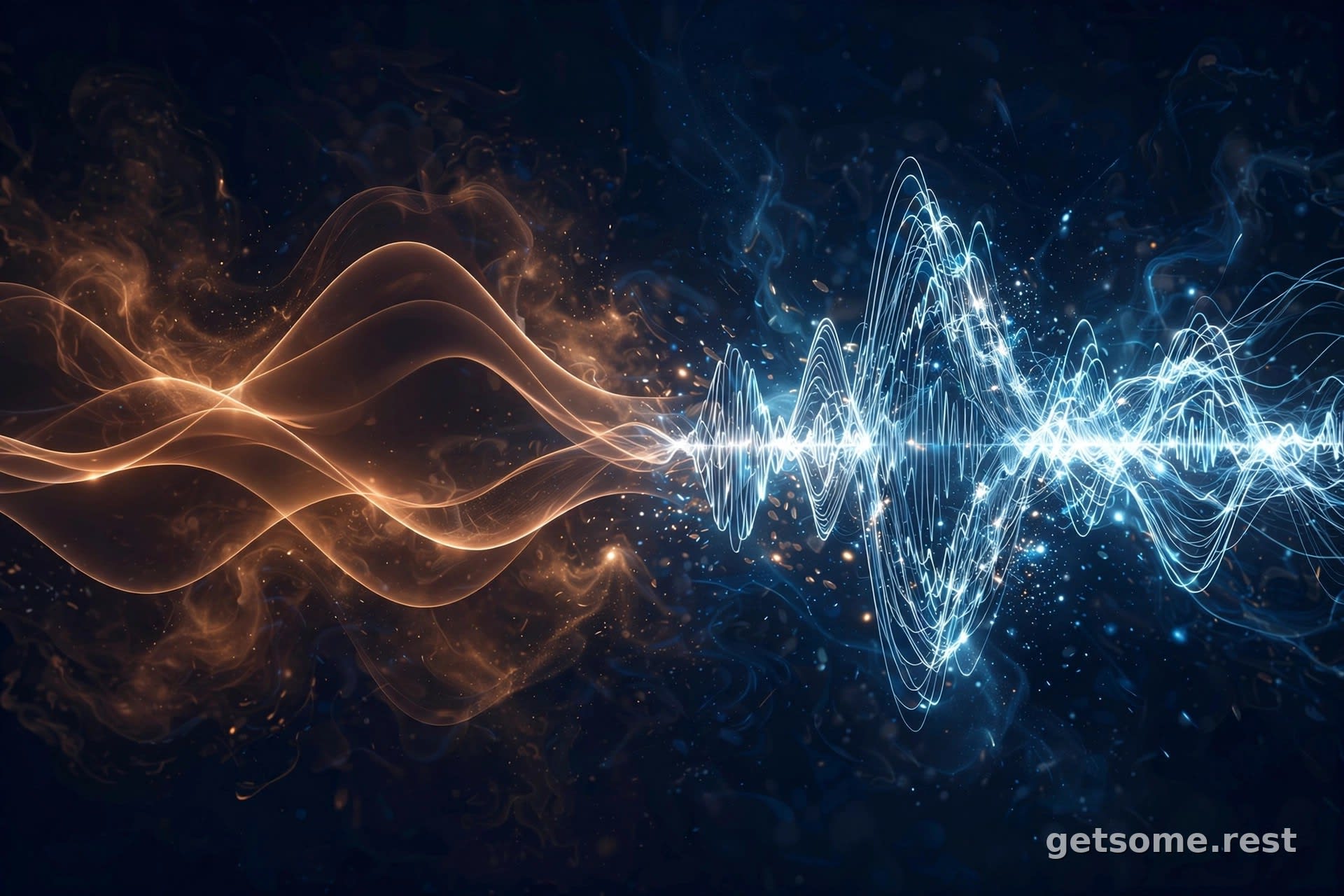
The "colors" of noise are just physics shorthand for how sound energy is spread across frequencies. White noise distributes energy evenly across the audible spectrum, which your ear hears as a bright, hissy "shhh" — like untuned TV static or a shower running. Because every frequency is equally present, it is the most aggressive masker: it covers up everything from bass thumps to high-pitched whines. It is also, for many people, the most fatiguing to listen to for hours.
Pink noise tilts the balance toward lower frequencies, so it sounds like steady rainfall or wind through trees — softer and more natural than white noise. Brown noise (named after Brownian motion, not the color) pushes even more energy into the low end, producing a deep rumble like distant thunder, a waterfall heard from far away, or the inside of an airplane cabin. In practice, most people experience the progression white → pink → brown as going from harsh to soothing, but also from "masks everything" to "masks mostly the low and mid stuff."
This matters because the real job of any sleep sound is masking: raising the room's baseline sound level so that sudden noises — a door slamming, a partner's cough, a car alarm — no longer stand out enough to pull you out of sleep. A sudden noise wakes you because of contrast, not absolute volume. A steady 45-decibel rumble makes a 55-decibel door slam far less startling than the same slam in a silent 30-decibel room. Any of the three colors does this; they just do it with different textures, and your brain's tolerance for that texture over eight hours is the whole game.
Sudden noises wake you because of contrast, not absolute volume — steady sound shrinks the contrast.
Source: GetSome Rest editorial analysis
Why pink noise keeps coming up
Pink noise sits in the middle and has attracted the most interesting sleep research: small studies have linked it during deep sleep with improved slow-wave activity and next-day memory. The caveat is that these were small, lab-based studies — they do not mean an app will make you smarter. What they suggest is that sound during sleep is not neutral, which is one more reason to pick a sound you find genuinely comfortable. If you are choosing a machine, get one that offers multiple colors; our guide to the best white noise machine for light sleepers favors models with exactly that flexibility.
Our top picks at a glance
All three machines below play brown and white noise (among other sounds). Here is how they compare on the things that matter for nightly use.
| Product | Best for | Price | Rating |
|---|---|---|---|
| LectroFan Classic | Non-looping white, pink and brown noise | $54.95 | 4.6 out of 5 |
| Yogasleep Dohm Classic | Real mechanical fan sound | $49.99 | 4.5 out of 5 |
| Dreamegg D11 | Portable, rechargeable, budget pick | $32.99 | 4.2 out of 5 |
Prices last checked October 13, 2026 and may change. Ratings reflect our own testing and research. The Dreamegg is frequently discounted below its list price.
Which is better for sleep?
Here is the uncomfortable truth for both camps: there is no large, high-quality body of research proving brown noise beats white noise for sleep, or vice versa. White noise has the longer research history — small trials going back decades suggest steady white noise can help some people fall asleep faster and wake less often in noisy environments. Brown noise's popularity is newer and mostly anecdotal, driven by streaming playlists and social media rather than clinical trials. Anecdotes are not nothing — millions of people reporting the same preference is a signal — but it is not the same as evidence.
What the evidence does support is the masking principle itself: a steady sound that smooths out sudden noise changes improves sleep continuity for light sleepers. Beyond that, the deciding factor is almost always subjective. If white noise's hiss irritates you after twenty minutes, no study will make it work. Heavy maskers — thin walls, a snoring partner, city traffic — usually do better with white noise's broader coverage, while brown noise suits quieter rooms and people whose tinnitus blends better into a low rumble.
Our practical advice: test both for at least three nights each. Your first-night reaction is unreliable — the brain needs a couple of nights to stop noticing a new sound. Run each at the same low volume, in the same room position, and judge by one metric: how fast you fell asleep and how many times you remember waking. The winner is your answer, and it is the only answer that matters. If your main problem is a racing mind rather than noise, a sound machine is only half the fix — read our guide on how to fall asleep fast when your mind won't stop for the other half.
White noise: who it is for
White noise is the maximum-masking option. If your sleep is broken by unpredictable, varied sounds — a partner's snoring, hallway conversations, traffic, a neighbor's TV — white noise's full-spectrum hiss covers more of them than brown noise can. That is why hospitals have used white noise in neonatal units for decades, and why it remains the default recommendation for light sleepers in genuinely noisy environments.
The tradeoff is comfort: white noise's high-frequency energy is what human hearing is most sensitive to, so it can feel sharp at higher volumes. The fix is almost always volume — most people who hate white noise are playing it too loud. Try it low enough to talk over, and give it a full week. If you also use sound to focus during the day, see our best white noise machine for office focus guide, where masking needs are different.
Brown noise: who it is for
Brown noise is the comfort option. Its deep rumble is far easier on the ears over eight hours, and many people describe it as actively calming — closer to a purring engine than to static. If you fall asleep in a reasonably quiet room and just want a soothing texture, or if white noise's hiss has always grated on you, brown noise is the obvious thing to try. It is also the sound many tinnitus sufferers prefer at bedtime: a low rumble can make high-pitched ringing less noticeable without adding another irritating high-frequency layer. That is personal coping, not treatment — if tinnitus regularly ruins your sleep, talk to a healthcare professional.
The tradeoff is masking power: sharp, high-frequency interruptions — a phone ping, a dog's bark — punch through brown noise more easily than white noise. If you try brown noise and still wake to the same sounds, the answer is probably more masking, a better-sealed room, or earplugs plus sound. One honest note: much free "brown noise" on streaming services is low quality; test the color seriously with a dedicated machine like the LectroFan Classic below, which generates its sounds dynamically with no repeating loop.
Volume and safety basics
Whichever color you choose, volume is where sleep sound goes wrong. The rule of thumb: keep it at or below about 50 decibels — roughly the level of a quiet conversation — and place the machine across the room rather than on your pillow. If you can hear the machine clearly but could still hold a conversation over it, you are in the right zone. Blasting any steady sound at high volume all night is not better masking; it is just noise exposure your ears have to process for eight hours.
For babies the guidance is stricter: use the lowest effective volume and keep the machine as far from the crib as practical, never inside it. For adults, all-night use at low volume is generally fine — but ringing ears or a morning headache mean turn it down. A machine with a timer, like the Dreamegg D11, is a good compromise if you only need sound to fall asleep: set it for 60 to 90 minutes.
Our picks in detail
Each pick below includes a one-line verdict, the current price, and the main pros and cons from our testing and research.
 Best overall
LectroFan Classic
Twenty dynamically generated, non-looping sounds including white, pink and brown noise variants — the best way to compare colors head to head.
$54.95 at time of writing
Pros
- 20 unique sounds with no repeating loop, including pink and brown noise — ideal for testing which color suits you
- Precise volume control and a sleep timer; compact and USB-powered for travel
- Backed by a 1,000-day satisfaction guarantee from the manufacturer
Cons
- Digital sound, not mechanical — purists prefer a real fan's texture
- No app or Bluetooth; controls are all on the unit
Best mechanical
Yogasleep Dohm Classic
A real fan inside the housing creates genuine, non-looping white noise — the classic for people who hate digital sound.
$49.99 at time of writing
Pros
- Physically generated fan sound — no digital seam to notice, ever
- Two speeds plus an adjustable tone dial; simple enough to use in the dark
- A design sold for decades with a 30-night trial and 1-year warranty
Cons
- White-noise-only — no brown or pink options for comparison
- Plug-in only, so it needs a wall outlet; modest maximum volume
Best budget
Dreamegg D11
Twenty-one sounds including white, pink and brown noise in a rechargeable, travel-friendly body for about thirty dollars.
$32.99 list; often discounted, at time of writing
Pros
- Includes white, pink and brown noise plus nature sounds — great for experimenting cheaply
- Rechargeable battery, night light, child lock and timers; genuinely portable
- Frequently on sale well under list price
Cons
- Small speaker has less depth than larger machines at higher volumes
- Build quality is budget-tier; it is not a buy-it-for-life device
How we test
We never accept payment for rankings. Every product is judged against the same five checks:
- Price
- We record the real price at checkout, note regular discounts, and recheck prices when we update the guide.
- Materials
- We read the fabric, fill and build details, and note anything the brand doesn’t make clear.
- Sleep trials
- We check how long you can try the product at home and whether the trial has conditions.
- Warranty
- We compare warranty length and what it actually covers, in plain language.
- Return policy
- We look at how returns work, who pays for shipping, and how refunds are handled.
Frequently asked questions
Is brown noise or white noise better for sleep?
Neither is proven better for everyone. White noise masks a wider range of sounds and has the most research behind it, while brown noise's deeper rumble feels less harsh to many ears and is often preferred for falling asleep. Choose whichever steady sound you find most comfortable at a low volume — consistency and preference matter more than the color.
What is the actual difference between white, pink and brown noise?
The colors describe how sound energy is distributed across frequencies. White noise spreads energy evenly, sounding bright and hissy like TV static. Pink noise emphasizes lower frequencies, sounding like steady rainfall. Brown noise emphasizes low frequencies even more, sounding like a deep rumble or distant thunder. All three mask background noise; they differ in how harsh or deep they feel.
Is it safe to play brown or white noise all night?
For adults, playing steady noise all night at a low volume is generally considered safe. Keep it around or below 50 decibels — a level you could talk over — with the machine across the room, not by your pillow. For babies, pediatric guidance is stricter: use the lowest effective volume and keep the machine as far from the crib as practical.
Can brown noise help with tinnitus or anxiety at bedtime?
Many people with tinnitus find that a deep, steady sound like brown noise makes ringing less noticeable at bedtime, and some find the rumble calming when the mind is racing. This is personal coping, not a treatment — we are not making medical claims. If tinnitus or anxiety regularly ruins your sleep, it is worth discussing with a healthcare professional.
Do I need a dedicated machine, or is a phone app enough?
A phone app works fine for trying out brown or white noise, and many people sleep well with one. A dedicated machine is worth it if phone notifications wake you, if the speaker distorts at higher volumes, or if you want non-looping sound without your phone in the bedroom. The LectroFan Classic generates its sounds dynamically with no repeating loop, which some light sleepers strongly prefer.
Key takeaways
- White noise masks the widest range of sounds; brown noise is deeper and easier on the ears — neither is proven better for everyone.
- The best sleep sound is the one you find comfortable at a low volume, played consistently; test each color for at least three nights.
- Keep volume around or below 50 decibels and the machine across the room; use the lowest effective volume for babies.
- The LectroFan Classic ($54.95) is the best way to compare all three colors head to head, with non-looping white, pink and brown noise.