Kardian Somily Explained (2026): $299 Wall Radar
Kardian Somily is a $299 wall radar that tracks breathing, heart rate and sleep through bedding — no wearable, camera or mic. Price, pre-order and limits.

On November 5, 2026, Xandar Kardian announced Somily, its first consumer product: a small disc that mounts on the bedroom wall above the bed and tracks your breathing, heart rate and sleep with radar, through the air and through bedding. Nothing to wear, nothing under the mattress, no camera, no microphone. A morning summary lands in the company's XKare app. It costs $299, including two years of the Kardian Max membership, and it is on pre-order in the US now. The idea is simple and appealing — sleep tracking for people who hate wearing things to bed. The details matter, though, especially the line between the FDA-cleared hospital radar this is built on and the general-wellness product Somily actually is.
Contents
What Somily Is
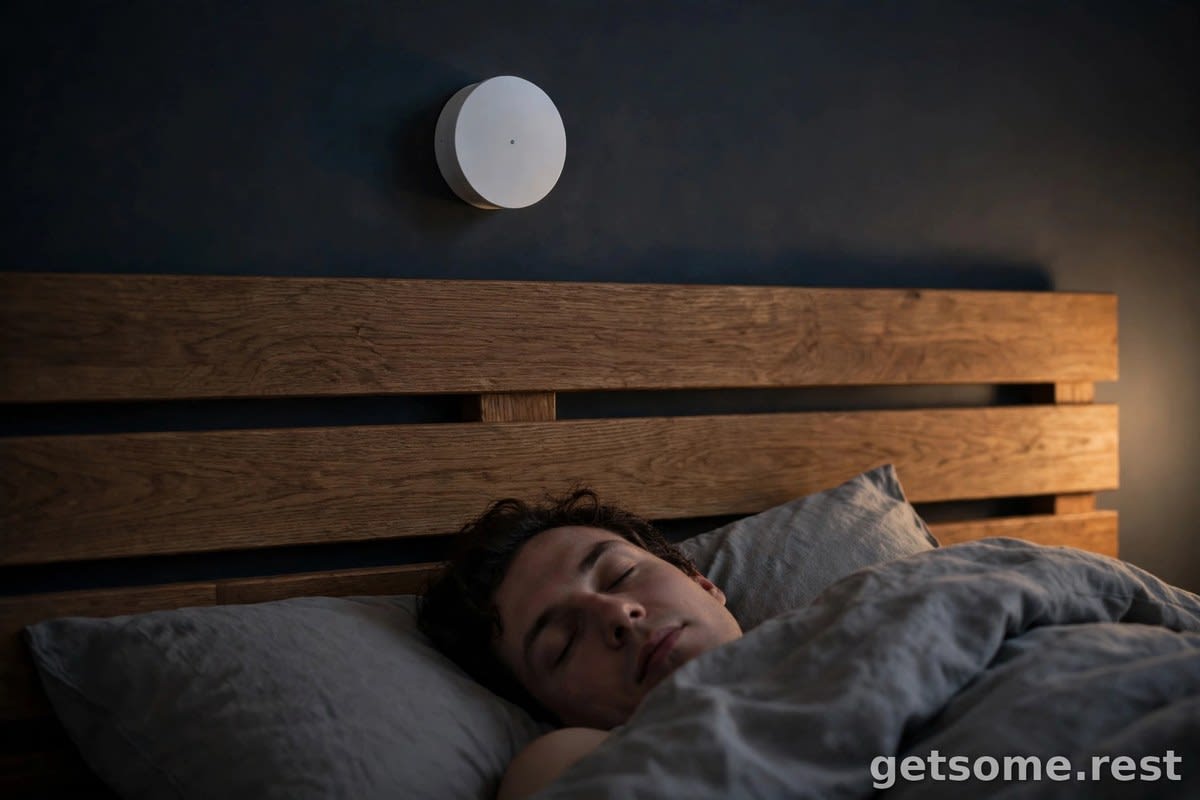
Somily is a wall-mounted disc from Xandar Kardian, a health technology company that has spent years putting contactless radar into hospitals. It is the company's first consumer product, and it brings the same sensing idea home: mount the disc on the bedroom wall above the bed, and it reads the rise and fall of your chest while you sleep — your breathing, your heart rate and your sleep patterns — without anything touching your body.
The pitch is the absence of things. No wearable to charge or remember, no ring squeezing your finger, no watch on your wrist, no mat under the mattress, no camera pointed at the bed, no microphone listening to the room. You go to bed, and the sensor does the work. In the morning, the XKare app shows a summary of the night. For people who have tried a ring or a watch and given up because they hate sleeping with something on, that pitch lands.
What it measures, in the company's words, is sleep, heart rate and breathing. It does not claim to label sleep stages, and third-party tracker roundups that checked the product page note the same: heart rate and breathing, not sleep-stage labels. That is an honest scope for radar — breathing and heart rate are movements a radar can read directly; sleep stages are inferred from them, and Somily does not promise that inference. If staged sleep data is what you want, a ring or a watch is still the better tool.
Somily is sold in the US only, and it is HSA- and FSA-eligible for qualified US customers. It is a general wellness product, not a medical device — the company says so plainly in the announcement, and the distinction matters for what you should expect from its numbers.
How Wall Radar Tracks Sleep
Radar measures distance and movement: it sends out a signal and reads what comes back. The announcement explains it with a familiar comparison — the same sensing that lets an aircraft or a self-parking car judge how far away something is and how it is moving. Pointed at a sleeping person, radar reads the small, regular movement of the chest as it rises and falls with every breath, and the smaller movement of each heartbeat. From those two rhythms it builds a picture of the night: when breathing is steady, when it changes, when the heart rate rises or falls, and when movement suggests you are awake.
The key detail is that it reads through the air and through bedding. A radar sensor does not need a line of sight to skin the way a camera does, and it does not need contact the way a wrist sensor does. That is why it can sit on the wall above the bed rather than on your body or under your mattress. It also means the sensor does not care whether you sleep on your back, your side or your stomach, as long as your chest is in its field of view.
The platform behind it is the XK300, Xandar Kardian's FDA-cleared medical device, which has monitored more than 49,000 people in hospitals, skilled-nursing facilities and other care settings for over five years. Somily is built on the same radar. That pedigree is real, and it is also the source of the most common misunderstanding about this product: the FDA clearance applies to the XK300 as a medical device in care settings. Somily is a separate consumer wellness product built on the same sensing, and it carries no FDA clearance of its own. Do not mix the two lanes — the hospital track record tells you the sensing works, not that Somily's consumer app is a medical instrument.
Privacy is the other half of the story. A sensor on the bedroom wall invites an obvious question, and Somily's answer is that there is no camera and no microphone — radar only. It cannot see you and it cannot hear you; it measures movement. The company says all data is stored on US servers, and the XKare app is where you see your morning summary. If a bedroom camera would be a non-starter for you, radar is the most private form of sleep tracking on the market.
Price, Membership and Pre-Order Dates
Somily costs $299, and the price includes two years of Kardian Max membership with no monthly fee during that period. Kardian Max is the membership that carries the app's fuller reporting; the announcement does not spell out exactly which features sit behind it and which are free, so check the product page for the current split before you buy.
After the included two years, the announcement states no renewal price. Third-party tracker roundups that checked the vendor page report $6 a month thereafter, or a free tier. That figure is reported, not confirmed by Kardian, and it could change before the first renewal comes due in late 2028. The honest way to think about the cost is $299 for the device plus two years of membership, with the long-term price still open.
Availability is pre-order, not shipping now. Orders are open at kardian.com, and the vendor page lists a shipping window of November 15 to December 15, 2026. That is a pre-order window, so the date you order is not the date it arrives. Somily is US-only at launch, and it is HSA- and FSA-eligible for qualified US customers, which may matter if you are buying with pre-tax health funds.
One more practical point: Somily mounts on the wall above the bed. That means a screw or adhesive mount, a power source, and a wall you are allowed to put a hole in. Renters should check the mounting method on the product page before ordering — a wall disc is only truly contactless if you can actually mount it.
Somily vs Wearables and Under-Mattress Trackers
Somily's competition is not other wall radars — it is every other way of tracking sleep without a lab. The trade is always the same: comfort and convenience against detail and proof.
| Tracker | Price | What you wear | Subscription | Sleep stages |
|---|---|---|---|---|
| Kardian Somily | $299, 2 years Max included | Nothing (wall radar) | 2 years included; renewal price unconfirmed | Not promised |
| Withings Sleep Analyzer | $129–$199.95 | Nothing (under-mattress mat) | None for core features | Yes |
| Oura Ring 4 | $349 | Ring, 24/7 | $5.99/month | Yes |
| Whoop MG | $239 (Peak) | Band, 24/7 | Membership included in price | Yes |
| Azume One | €109 Kickstarter | Nothing (watch puck) | None announced | Via watch data |
The closest rival is the Withings Sleep Analyzer, an under-mattress mat that also tracks with nothing on your body. It is cheaper, it is shipping now, and it does label sleep stages — but it lives under the mattress, which means it moves when you change beds and it shares the bed with a partner too. Our Withings vs Eight Sleep Pod tracking comparison covers how mat tracking differs from cover tracking.
Rings and bands give you more: staged sleep, daytime recovery, workouts, naps. They also ask more of you — a thing on your body all day and night, a subscription, and a charger. Somily asks nothing after mounting. The question is whether the thing you give up — sleep-stage labels and daytime data — is worth the comfort of tracking nothing at all. For a person who only wants to know how they breathed and how their heart behaved overnight, Somily's scope is enough. For a person who wants a full sleep score with stages, it is not.
The other new contactless option is the Azume One, a small sensor puck that turns a watch into a sleep tracker and ships in December 2026 from a €109 Kickstarter. It still needs a watch on your wrist. Somily is the only one of the new devices that asks for nothing on your body at all.
Who It Suits — and Who Should Skip It
It suits you if: you hate wearing anything to bed and have given up on rings or watches, you want passive tracking with no charging routine, you sleep alone or the shared-bed question does not apply to you, and you are comfortable with a pre-order wait. It also suits you if the privacy angle matters — no camera, no microphone, radar only — and you would rather have a wall sensor than a bedroom camera.
Skip it if: you need sleep-stage data, you share a bed and need per-person tracking (the announcement does not address this), you want a medical-grade device or data you can show a clinician, you live outside the US, or you need it now rather than in a mid-November to mid-December shipping window. The Withings Sleep Analyzer is the safer buy in every one of those cases: cheaper, shipping, staged, and under the mattress rather than on the wall.
Where to buy: orders are open now at kardian.com in the US. You can also search for the Kardian Somily on Amazon, though as a new pre-order product it is primarily sold direct, and the Withings Sleep Analyzer on Amazon is the in-stock alternative if you do not want to wait. Check the vendor page for the current shipping window before you order — pre-order dates move.
How We Reported This Story
We have not tested Somily, and no independent reviewer had as of November 12, 2026 — it was announced on November 5 and is still in pre-order. Everything in this article comes from Xandar Kardian's announcement, carried by BusinessWire and republished by Morningstar and others, plus an independent tracker roundup that checked the vendor page for pricing, membership and shipping dates.
- Price and membership: $299 including two years of Kardian Max, from the BusinessWire release of November 5, 2026. The post-two-year price is not stated in the announcement; the $6-a-month figure is reported by a third-party roundup, not confirmed by Kardian.
- Shipping window: November 15 to December 15, 2026, per the vendor page as checked by the roundup. Pre-order, US only.
- FDA status: the XK300 is FDA-cleared; Somily is a general wellness product and is not a medical device. The announcement states this directly, and we repeat it because the two are easy to confuse.
- Sleep stages: the announcement says Somily tracks sleep, heart rate and breathing; third-party roundups note it does not promise sleep-stage labels. We report both.
Frequently asked questions
Is the Kardian Somily FDA-cleared?
No. Somily itself is a general wellness product, not a medical device, and it is not intended to diagnose, treat, cure or prevent any disease. The confusion is understandable: it is built on the same radar as Xandar Kardian's XK300, which is an FDA-cleared medical device that has monitored more than 49,000 people in hospitals and skilled-nursing facilities for over five years. The clearance belongs to the XK300, not to Somily.
Does Somily work if two people share the bed?
The announcement does not say. Radar reads the chest in front of it, and a partner in the same bed is the obvious open question — whether it tracks one sleeper, gets confused by two, or needs a particular mounting position. If you share a bed, check Kardian's product page or ask support before ordering; do not assume it separates two sleepers.
Does Somily need a subscription?
The $299 price includes two years of Kardian Max membership with no monthly fee. After that, the announcement states no renewal price; third-party tracker roundups report $6 a month thereafter, or a free tier. Treat the $6 figure as reported, not confirmed, and check kardian.com for the current terms before you buy.
Does Somily have a camera or microphone?
No. Somily uses radar only — no camera and no microphone. That is the privacy case for a wall-mounted bedroom sensor: it measures the movement of your chest, not images or sound. The company says all data is stored on US servers.
When will Somily ship?
Orders are open now at kardian.com in the US only. The vendor page lists a pre-order window with shipping from November 15 to December 15, 2026, so it is not shipping the day you order. If you are buying it as a gift or for a specific date, allow for that window slipping.
Key Takeaways
- What it is: a $299 wall-mounted radar disc from Xandar Kardian that tracks breathing, heart rate and sleep through bedding, with nothing to wear and no camera or microphone.
- Built on hospital radar: the same sensing as the FDA-cleared XK300, which has monitored 49,000+ people in care settings — but Somily itself is a general wellness product, not a medical device and not FDA-cleared.
- Price: $299 including two years of Kardian Max membership. The renewal price after two years is not announced; third-party roundups report $6 a month.
- Availability: pre-order now at kardian.com, US only, shipping expected November 15 to December 15, 2026. HSA- and FSA-eligible for qualified US customers.
- The open questions: how it handles two people in one bed, and whether it labels sleep stages — the announcement promises neither.
- The rival to beat: the Withings Sleep Analyzer is cheaper, shipping now and stages sleep, with nothing on your body either.