Withings Sleep Analyzer Review (2026): The Tracker You Never Wear
Withings Sleep Analyzer review (2026): the under-mattress sleep tracker at ~$129-$200. Sleep cycles, snore signals, no subscription, and who should buy it.
Some people will never sleep in a ring or a watch — and the Withings Sleep Analyzer ($129–$199.95 depending on retailer) is the best tracker built for exactly that person. A thin pneumatic mat slides under the mattress at chest level and measures your heart rate, breathing, movement, and snoring through the mattress itself: no charging, no wearing, and no subscription for any core feature. Here is what it tracks well, what it can't do, and how it compares to the wearables it replaces.
Contents
At a glance: Withings Sleep Analyzer
Sleep-tracking adoption has a graveyard: the drawer of abandoned wearables. The Sleep Analyzer's bet is that convenience beats precision — and there is a serious point underneath: an estimated 20.2% of adults are highly likely to have obstructive sleep apnea while only ~3.5% are being treated (ERJ Open Research), so awareness tools that people actually keep using have real value. Here is the honest summary before the details.
| Fact | Withings Sleep Analyzer |
|---|---|
| What it is | Under-mattress pneumatic sleep-tracking mat |
| Price | $129–$199.95 (~$129–$150 on sale) |
| Tracks | Duration, cycles, heart rate, snoring, disturbances, Sleep Score |
| Subscription | None — all core features free |
| Charging / wearing | Never — stays plugged in, nothing worn |
| Mattress fit | 4–15"; most types except waterbeds/airbeds |
| Main limit | Single-user; stillness mislabeled as sleep; 2.4 GHz only |
| Best for | People who won't wear trackers |
When an under-mattress tracker beats a wearable
The Sleep Analyzer's pitch is not better sensors — it is zero friction. Think about the failure modes of wearables: the ring you forgot to charge, the watch that dies at 11 p.m., the band that irritates your wrist. The mat has none of them: it slides under the mattress once (a ~10-minute setup with calibration), stays plugged in forever, and measures every night without you thinking about it.
What you gain: adherence. A tracker you never touch is a tracker you never abandon, and sleep data only matters in trends across weeks. The mat tracks duration, sleep onset and wake time, cycles (deep, light, REM), continuous and average heart rate, snoring duration, interruptions, regularity, and a nightly Sleep Score — a full dashboard, synced automatically over 2.4 GHz Wi-Fi (which switches off while you are in bed and syncs on waking).
What you lose: precision. Measuring through the mattress is inherently less direct than measuring at the skin, so stage-level accuracy trails a good wearable. It assumes stillness means sleep — reading in bed can register as light sleep — and it is single-user: a partner's movements can confuse the readings. One mat, one sleeper, one bed.
Who it's for: anyone who has bought a wearable and stopped wearing it; couples where one partner hates gadgets in bed; and data-curious sleepers who want trends, snore tracking, and breathing-disturbance awareness signals without a nightly charging ritual or a subscription.
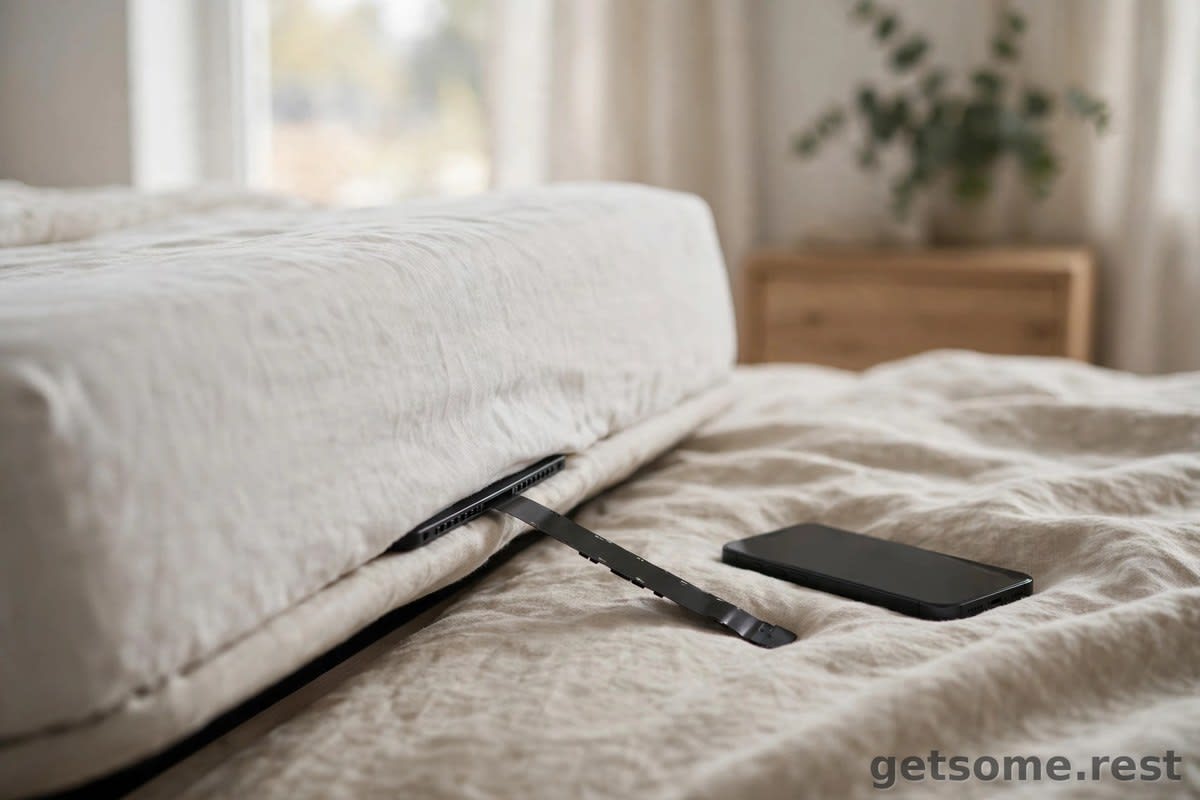
Sleep Analyzer specs
| Specification | Withings Sleep Analyzer |
|---|---|
| Sensor | Under-mattress pneumatic sensor (ballistography) + sound sensor |
| Tracks | Sleep duration, onset/wake, cycles (deep/light/REM), continuous + average heart rate, snoring duration, interruptions, regularity, Sleep Score |
| Breathing signals | Snore + breathing-disturbance screening signals (awareness, not diagnosis) |
| Subscription | None required — all core features free; Withings+ optional |
| Mattress fit | 4–15" (10–40 cm); spring, latex, foam, memory foam. Not waterbeds/airbeds; slats need a rigid board |
| Connectivity | 2.4 GHz Wi-Fi auto-sync (off while in bed); Bluetooth 4.0 setup only |
| Integrations | Apple Health, Google Health Connect, Google Fit, web dashboard |
| Physical | 25" × 7.5" × 0.2" (637 × 190 × 5 mm), 350 g; USB-powered; ~10-minute setup |
| Price | $129–$199.95 (~$129–$150 on sale) |
| Best for | People who won't wear trackers; zero-friction nightly data |
Our verdict: who should buy the Sleep Analyzer
Buy it if you want sleep data with zero nightly effort. Nothing to wear, nothing to charge, no subscription for any core feature, free unlimited data storage, and Apple Health / Google Health Connect integration make it the lowest-friction tracker you can buy. At ~$129–$150 on sale, it costs less than a year of most wearable subscriptions — and it works every night, forever.
Skip it if you want lab-grade stage accuracy or share the bed. The through-the-mattress measurement trades precision for convenience, stillness gets mislabeled as light sleep, and a partner's movements can confuse it. Wearables (rings, watches) track stages better if you will actually wear them nightly — our subscription-free tracker roundup compares those.
The honest summary: the Sleep Analyzer's competition is not the Oura Ring — it is the drawer where abandoned wearables go. If that drawer sounds familiar, the mat wins.
The Sleep Analyzer, reviewed
The unit's strengths and limits, and how it stacks up against the wearable alternative. Prices are October 2026 US pricing at the time of writing.
Best no-wearable trackerWithings Sleep Analyzer
The tracker for people who won't wear anything: full sleep dashboard, snore signals, zero subscription.
~$129–$199.95 ~$129–$150 on sale; $199.95 full retail
Pros
- Zero-wearable tracking — nothing to wear or charge
- All core features free; no subscription required
- Sleep cycles, Sleep Score, snore + breathing-disturbance signals
- Apple Health, Google Health Connect, Google Fit integrations
- Free unlimited online data storage
Cons
- Needs a bedside power outlet; 2.4 GHz Wi-Fi only
- Stillness can be mislabeled as light sleep
- Single-user per mat — partner movement confuses it
- Pricier than budget trackers; no advertised sleep trial
- Breathing-detection regulatory status varies by region
How we reviewed it
We did not sleep on the mat for a month — this is a research synthesis, and it is not medical advice. Here is exactly what went in.
- Pricing
- $129–$199.95 range from October 2026 retailer listings (saveonsleep ~$129; Amazon $199.95). Expect ~$129–$150 on sale; treat $199.95 as the ceiling.
- Specs
- Sensor technology, tracked metrics, mattress compatibility (4–15"; no waterbeds/airbeds), Wi-Fi behavior, and integrations come from withings.com and support pages. The 2-year warranty and no-trial terms were not confirmed on official pages in our check — we don't claim them.
- The breathing-signal framing
- We report screening signals as screening signals, never as diagnosis. Regulatory status (including older US FDA-pending notes) is unverified current — we say so explicitly rather than repeating dated claims.
- The OSA stat
- 20.2% of adults highly likely to have OSA vs ~3.5% treated (ERJ Open Research, 20,151 French adults, via SciTechDaily); the Wisconsin Sleep Cohort (NEJM) estimated 24% of men / 9% of women aged 30–60 with undiagnosed sleep-disordered breathing. Reported as awareness context, never a diagnosis prompt.
Frequently asked questions
How does the Withings Sleep Analyzer work without wearing anything?
It is a thin pneumatic sensor that slides under your mattress at chest level and measures your body's movement through the mattress via ballistography: heart rate, respiratory rate, and movement patterns from which it derives sleep duration, sleep cycles (deep, light, REM), a nightly Sleep Score, snoring duration, and breathing-disturbance signals. A built-in sound sensor listens for snoring. It stays plugged in and syncs over Wi-Fi — you never charge it and never wear it.
Does the Withings Sleep Analyzer need a subscription?
No — and that is one of its strongest selling points. All core sleep-tracking features are free in the Withings Health Mate app (iOS/Android) with a free Withings account, which also includes unlimited online data storage. Withings+ is an optional paid add-on for extra guidance and insights, but the tracker works fully without it.
Can the Withings Sleep Analyzer detect sleep apnea?
Careful framing needed here. The device flags signs of sleep-disordered breathing (breathing disturbances and snoring) as awareness signals — reviewers describe it as clinically validated for moderate-to-severe OSA screening — but it is not a diagnosis and does not replace a professional sleep study. Its regulatory status varies by region (older listings noted US FDA status as pending). If you have concerns about your breathing at night, talk to a clinician.
What mattresses work with the Withings Sleep Analyzer?
Withings tested it on mattresses 4–15 inches (10–40 cm) thick — spring, latex, foam, and memory foam all work. It is not recommended for waterbeds or airbeds, and slatted frames need a flat rigid board under the sensor. One mat tracks one sleeper; a partner's movements can confuse the readings, so it is a single-user device.
Withings Sleep Analyzer vs a smart ring or watch: which tracks sleep better?
Wearables generally track sleep stages more precisely because they measure pulse directly from your skin; the Sleep Analyzer measures through the mattress, which trades some precision for zero-effort adherence — Withings cites high long-term use because there is nothing to charge or wear. If you will actually wear a ring or watch every night, a wearable wins on detail. If you won't, the mat's data beats the wearable you left on the nightstand.
Key takeaways
- The Withings Sleep Analyzer (~$129–$150 on sale) is the best tracker for people who won't wear anything: sleep cycles, Sleep Score, snore and breathing-disturbance signals with no subscription.
- Zero friction is the feature: no wearing, no charging, automatic Wi-Fi sync — trends every morning without effort.
- Trade-offs: 2.4 GHz Wi-Fi only, needs a bedside outlet, single-user per mat, and through-the-mattress precision trails wearables.
- Breathing signals are awareness tools, not diagnosis — concerns about nighttime breathing belong with a clinician.
- Fits most mattresses 4–15"; not for waterbeds or airbeds, and slatted frames need a rigid board under the sensor.