Samsung Galaxy Ring Energy Score Explained: What $399 Buys With No Subscription
Samsung Galaxy Ring ($399.99, no subscription): how the AI Energy Score works, sleep tracking features, 6-7 day battery, and who should buy it.
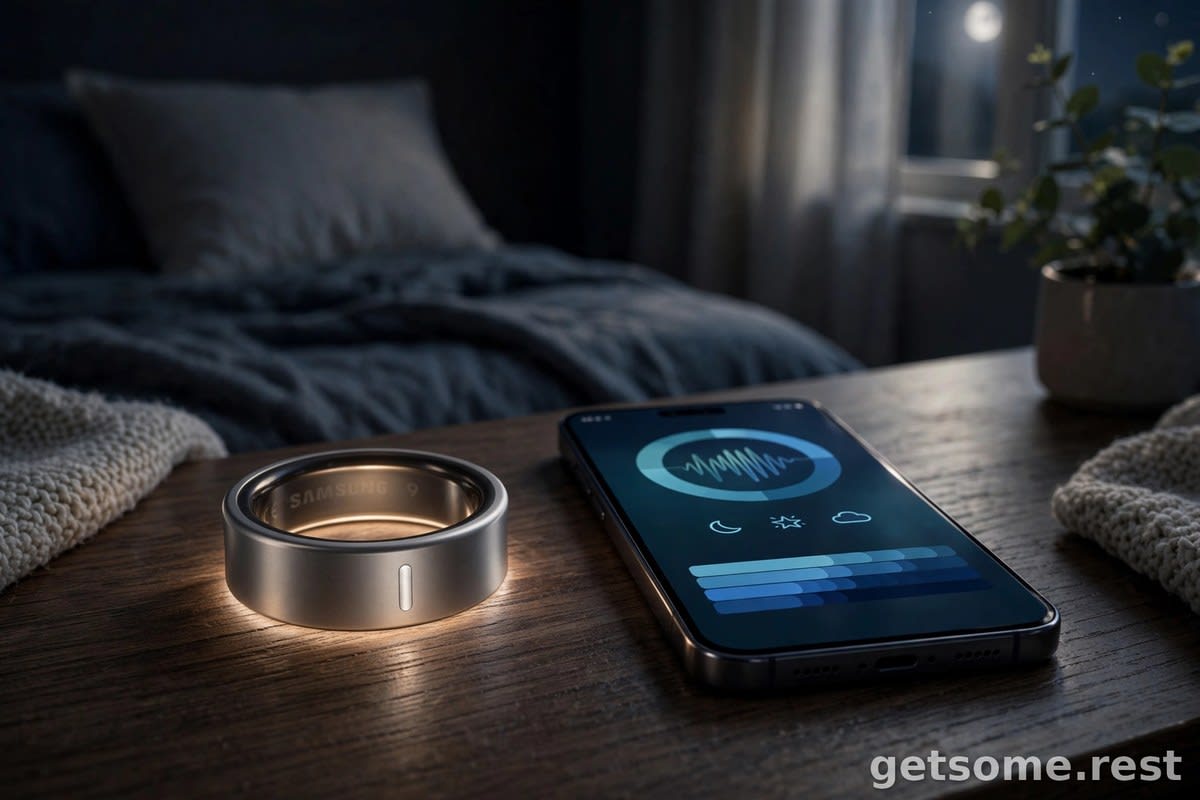
The Samsung Galaxy Ring costs $399.99 — more than any subscription-free smart ring except Oura's premium finishes — and asks for nothing monthly. Its headline feature is the Energy Score: a single AI-generated number, out of 100, that claims to tell you how ready you are for the day based on yesterday's sleep, heart rate, and activity. This guide explains what the Energy Score actually measures, what the ring tracks while you sleep, and whether $399 is worth it.
Contents
At a glance: the Samsung Galaxy Ring
Samsung's first smart ring launched at $399.99 with a pitch aimed squarely at Oura owners tired of memberships: premium titanium hardware, serious sleep tracking, an AI-powered Energy Score — and no subscription, ever. It is the most expensive subscription-free smart ring in this guide's orbit, so the question is fair: what does $399 actually buy you? Here is the short version.
| Fact | Samsung Galaxy Ring |
|---|---|
| Price | $399.99 (one-time) |
| Subscription | None — all features in Samsung Health |
| Energy Score | Galaxy AI daily score out of 100 from sleep + heart rate + activity |
| Sleep tracking | Stages, sleep score, snoring analysis, movement, latency, HR & respiratory rate |
| Battery | Up to 6–7 days; ~80-min charge via wireless charging case |
| Build | Titanium Grade 4, 2.3–3.0g, sizes 5–13, 10ATM water resistance |
| Best for | Samsung Galaxy phone owners who want premium, subscription-free sleep tracking |
Price is Samsung's US list price, checked October 2026. The ring discounts during major sales — it has been seen well under $399 — so patience can pay.
What the Energy Score is — and what it isn't
Every major wearable now gives you a morning number: Oura has Readiness, Garmin has Body Battery and Training Readiness, Whoop has Recovery. Samsung's entry is the Energy Score, and understanding it is understanding what the Galaxy Ring is for.
Here is how Samsung describes the computation:
- Yesterday's sleep — duration, consistency, and quality as measured overnight (stages, interruptions, timing).
- Resting heart rate trends — how your overnight and resting heart rate compares to your personal baseline.
- Previous-day activity — step counts and movement from the day before.
Galaxy AI blends those three streams into a single score out of 100, delivered each morning with plain-language guidance: push hard, keep a steady day, or prioritize rest. The score personalizes over time — the first week or two establishes your baselines, and the guidance gets more “you” from there.
An Energy Score is a wellness estimate, not a medical measurement. Treat it like a weather forecast for your body: useful for planning the day, not a diagnosis of anything.
Source: our wearables realism checklist
How it compares to Oura's Readiness and Garmin's Body Battery
Conceptually, all three answer the same question — “how recovered am I?” — from slightly different data. Oura's Readiness leans hardest on HRV trends and long-term baselines and is widely considered the most nuanced; Garmin's Body Battery is a real-time energy gauge that drains and recharges through the day. Samsung's Energy Score is the simplest of the three: three inputs, one morning number, minimal digging required. Reviewers note it is less granular than Oura's score but genuinely useful for day-to-day training decisions — and unlike Oura, it costs nothing monthly. If readiness-style scoring is what you want without a subscription, also see our subscription-free sleep tracker roundup for how the alternatives frame recovery.
The ecosystem catch: it's a Samsung product
The Galaxy Ring's secret weapon is Samsung Health integration. Paired with a Galaxy phone — and especially alongside a Galaxy Watch — the ring and watch split duties: the watch handles GPS workouts and daytime activity while the ring owns passive overnight metrics, producing a remarkably complete picture. On a non-Samsung Android phone you keep the core features but lose some deeper integrations. On an iPhone, the experience is notably thinner. At $399, this is a ring that rewards staying inside Samsung's world — buy it for the ecosystem as much as the hardware. Curious how AI coaching layers onto this kind of data? Our AI sleep coach tests show what software alone can and can't do with your nights.
Galaxy Ring specs, up close
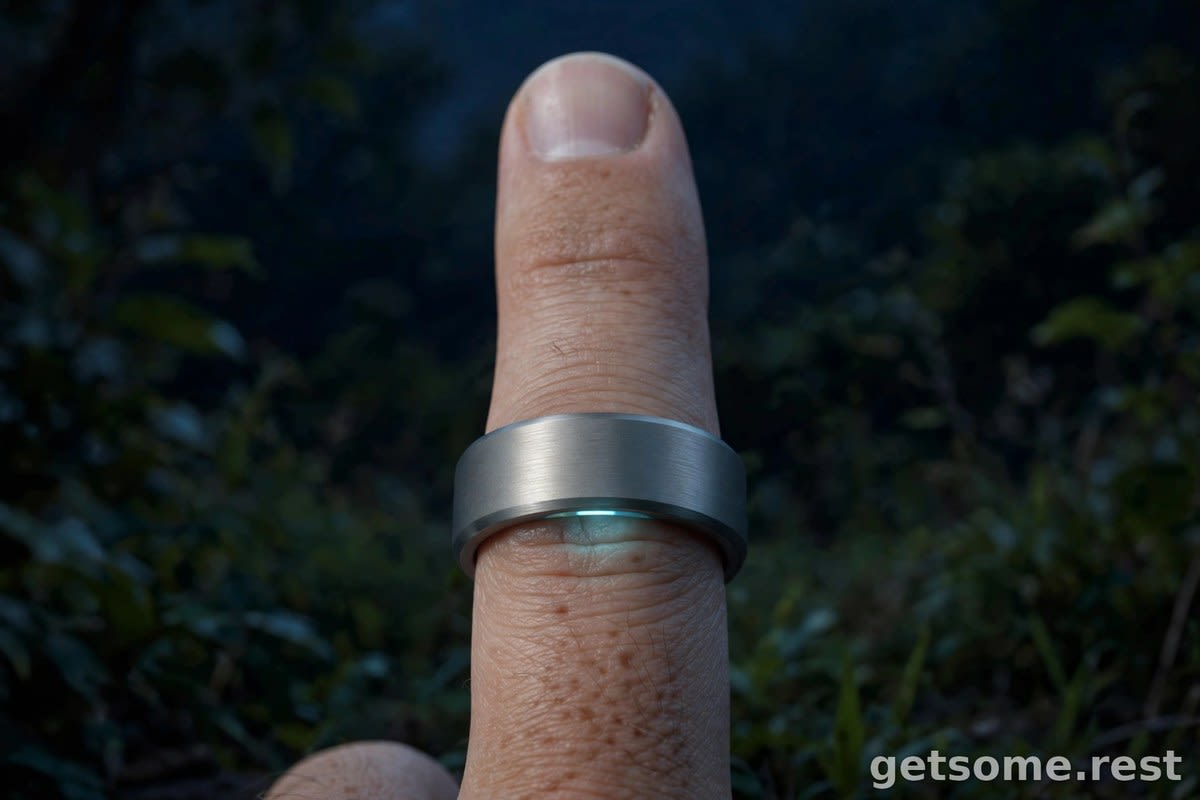
$399.99 buys premium materials and a polished experience, but the spec sheet tells a more nuanced story — battery life trails cheaper rivals, and the best features assume you own a Galaxy phone. How it stacks up against the subscription-free competition:
| Feature | Samsung Galaxy Ring | RingConn Gen 2 | Oura Ring 4 |
|---|---|---|---|
| Price | $399.99 | $299 | ~$349+ |
| Subscription | None | None | ~$5.99/mo for full analytics |
| Battery life | Up to 6–7 days | Up to 12 days | Up to 8 days |
| Charging | Wireless charging case (~80 min) | Charging case (~150 days total use) | Charging dock |
| Weight | 2.3–3.0g | 2–3g | ~3.3–5g (by size/finish) |
| Sizes | US 5–13 | US 6–14 | US 6–13 |
| Water resistance | 10ATM / 100m | 100m / IP68 | 100m / 10ATM |
| Readiness score | Energy Score (Galaxy AI) | Recovery score | Readiness Score (most nuanced) |
| Phone compatibility | Android (best with Galaxy phones) | iOS & Android | iOS & Android |
| Best for | Galaxy owners, premium no-subscription pick | Battery life and value | Deepest sleep analytics (with membership) |
Specs from manufacturer pages, checked October 2026. Oura pricing varies by finish; its membership is ~$5.99/month or ~$69.99/year after the trial.
Our verdict: is the Galaxy Ring worth $399?
Buy the Samsung Galaxy Ring if you own a Galaxy phone and want the most polished subscription-free ring experience. The hardware is genuinely premium — feather-light titanium you forget you are wearing — the sleep tracking is competitive with anything short of Oura, the Energy Score is a useful morning ritual, and the Samsung Health integration (especially with a Galaxy Watch in the mix) is the best ecosystem story in smart rings. No subscription means the $399 is the whole cost, and it undercuts two years of Oura-plus-membership.
Skip it if you use an iPhone, or if battery life is your priority. At 6–7 days, the Galaxy Ring needs charging roughly twice as often as the $299 RingConn Gen 2, which is also thinner, lighter, cheaper, and platform-neutral. And $399 is a lot for a ring whose best tricks assume Samsung hardware. The Galaxy Ring is the best ring for Samsung loyalists — it is simply not the best ring for everyone else, and Samsung's pricing knows it.
The Galaxy Ring and its closest rival, in detail
One ring to explain, one rival to frame it. Prices below are typical prices at the time of writing and shift often — check the live listing for the current number. Links are plain — no affiliate tags attached yet.
Best for Galaxy ownersSamsung Galaxy Ring
The premium subscription-free ring: titanium build, AI Energy Score, strong sleep tracking, and deep Samsung Health integration.
$399.99 at time of writing
Pros
- No subscription — Energy Score and all insights free in Samsung Health
- Feather-light titanium (2.3–3.0g), comfortable for all-night wear
- Sleep stages, snoring analysis, skin temperature, HR & respiratory rate
- Wireless charging case; up to 6–7 day battery
- Excellent pairing with Galaxy phones and Galaxy Watch
Cons
- $399.99 — priciest subscription-free ring here
- Battery trails the $299 RingConn Gen 2 (6–7 vs 12 days)
- Thinner experience on iPhone and non-Samsung Android
The subscription rivalOura Ring 4
The accuracy benchmark for consumer sleep tracking — but full analytics need a ~$5.99/month membership.
~$349+ plus ~$5.99/mo membership at time of writing
Pros
- Best-in-class sleep staging accuracy among consumer rings
- Most nuanced Readiness Score in the category
- Up to 8-day battery; works with iOS and Android
Cons
- Membership (~$5.99/mo) required for full analytics
- Two-year cost exceeds the Galaxy Ring's one-time $399.99
- Heavier than the Galaxy Ring
How we researched this explainer
We don't run a sleep lab — and this article isn't medical advice. Our goal is narrower: explain what the Energy Score actually measures, document what $399.99 buys, and compare the total cost of ownership against subscription and subscription-free rivals. Here is exactly what went into it.
- Spec sources
- Core specifications (price, battery ratings, cell sizes, materials, weight, sizes, water resistance, sensors) come from Samsung's published Galaxy Ring pages and retailer listings, cross-checked against hands-on reviews.
- Energy Score documentation
- How the score is computed — sleep, resting heart rate, previous-day activity via Galaxy AI — comes from Samsung's own feature documentation and Best Buy/Samsung listing copy.
- Subscription audit
- We verified the Galaxy Ring has no membership tier and quantified the savings versus Oura's ~$5.99/month membership over one- and two-year horizons.
- Price checks
- Samsung's $399.99 US list price checked October 2026, alongside typical sale pricing and competitor list prices ($299 RingConn Gen 2, ~$349+ Oura Ring 4).
- Independence — no affiliate tags
- Every Amazon link in this article is a plain search URL with no affiliate tag attached, so our verdicts aren't influenced by commission. That policy applies to every review we publish.
Frequently asked questions
How is the Samsung Galaxy Ring Energy Score calculated?
Samsung says the Energy Score is computed by Galaxy AI from three inputs: yesterday's sleep (duration and quality), resting heart rate trends, and previous-day activity (steps). It produces a daily score out of 100 with guidance on whether to push, maintain, or rest. It is a wellness estimate — not a medical measurement — and it gets more personalized as the ring learns your baselines over the first weeks.
Does the Galaxy Ring require a subscription?
No. All health data and insights, including the Energy Score, sleep tracking, and sleep coaching, are available in the Samsung Health app at no additional cost. This is a deliberate contrast with the Oura Ring, which requires a ~$5.99/month membership for full analytics — over two years, the Galaxy Ring's $399.99 price saves roughly $145 in fees versus Oura.
How long does the Galaxy Ring battery last?
Samsung rates battery life at up to 6–7 days depending on ring size (larger sizes hold larger cells: 17mAh on sizes 5–7, 18mAh on 8–11, 22.5mAh on 12–13). It charges in about 80 minutes via a wireless charging case — similar to an earbuds case — whose own 361mAh cell provides many additional recharges away from an outlet.
Does the Galaxy Ring work with iPhone?
Technically the ring pairs with Android phones via Samsung Health, and core tracking works on non-Samsung Android devices — but the experience is designed around Galaxy phones. iPhone users get a reduced feature set, and some integrations (like combined watch-plus-ring tracking) need Samsung hardware. If you use an iPhone, a platform-neutral ring like the RingConn Gen 2 is the safer buy.
Is the Galaxy Ring accurate for sleep tracking?
Reviewer consensus rates it genuinely good — competitive with the Ultrahuman Ring Air and a step below Oura's best-in-class staging — with a sleep algorithm Samsung updated in late 2025. It tracks sleep stages, sleep score, snoring analysis, movement, sleep latency, and heart and respiratory rate overnight. As with all consumer wearables, treat it as a trend tracker for your own patterns, not a clinical instrument.
Key takeaways
- The Samsung Galaxy Ring costs $399.99 with no subscription: the Energy Score, sleep tracking, and coaching are all free in Samsung Health.
- The Energy Score is a Galaxy AI number out of 100 built from yesterday's sleep, resting heart rate, and activity — a wellness estimate for planning your day, not a medical measurement.
- Battery lasts up to 6–7 days with a wireless charging case; the titanium ring weighs just 2.3–3.0g and comes in sizes 5–13.
- It shines brightest with a Galaxy phone (and even more with a Galaxy Watch); iPhone users get a thinner experience and should consider platform-neutral rings.
- On value alone, the $299 RingConn Gen 2 beats it on battery and price — the Galaxy Ring wins on polish and ecosystem.