Somnee Smart Sleep Headband Explained: What It Does and What It Costs
Somnee's $489 smart sleep headband uses EEG sensors and gentle neurostimulation to build a 15-minute pre-bed ritual. Price, membership, and who it suits.

The Somnee Smart Sleep Headband is one of the oddest and most interesting sleep gadgets of 2026: a soft fabric headband that reads your brain waves and delivers a gentle 15-minute electrical stimulation session before bed. Backed by neuroscientist Dr. Matthew Walker and a 2026 Red Dot design award, it costs $489 with a required membership. Here is what it actually does, what the price covers, and whether it fits your bedtime routine.
Contents
At a glance: the Somnee Smart Sleep Headband
Somnee's pitch is simple and unusual: instead of tracking your sleep and telling you about it in the morning, the Smart Sleep Headband does something before bed. It reads your brain activity through soft hydrogel electrodes, then delivers a roughly 15-minute session of gentle, personalized electrical stimulation (tACS — transcranial alternating current stimulation) designed to cue your brain toward its wind-down state. When the session ends, you take the headband off and go to sleep.
| Fact | Somnee Smart Sleep Headband |
|---|---|
| What it is | Fabric headband with EEG+ brainwave sensors and personalized tACS neurostimulation |
| Core routine | ~15-minute stimulation session before bed; remove the headband, then sleep normally |
| Price | $489 bundle (headband + 6-month Smart Sleep Membership) |
| Ongoing cost | $100 per 6 months or $160/year membership (electrodes + app + AI personalization) |
| Personalization | Nights 1–7 build your EEG baseline map; sessions refine over nights 8–21 via SmartSleep AI |
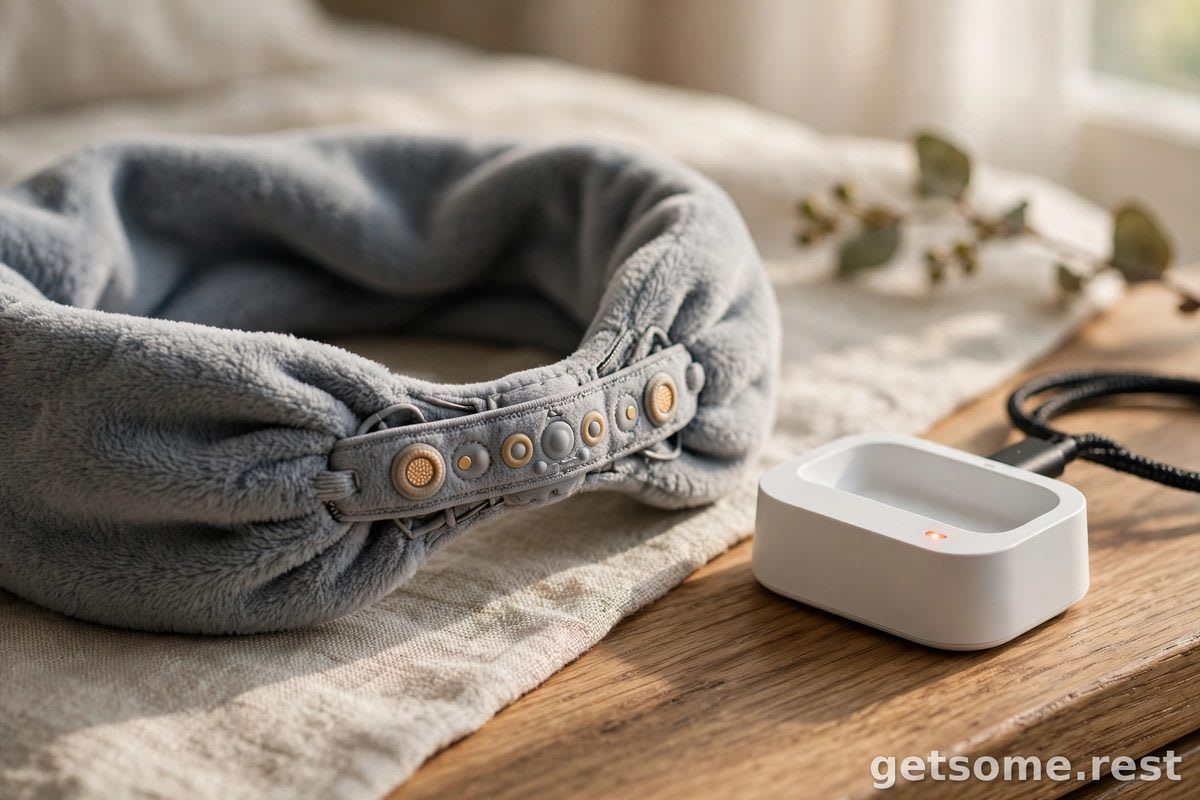
| Battery | Lasts one night; charges overnight in its dock |
| Trial & returns | 45-day guarantee with free return shipping in the US |
| Awards | 2026 Red Dot Product Design Award |
Somnee is a consumer wellness device, not medical equipment. It supports a bedtime routine with brainwave insights and gentle stimulation — it does not diagnose or treat sleep conditions. Prices last checked October 2026.
How Somnee claims to work: EEG, tACS, and SmartSleep AI
Most sleep gadgets are passive: a ring or wristband watches your heart rate and movement, then guesses at your sleep stages. Somnee inverts the formula. Its headband reads your brain waves directly with EEG sensors — the same kind of signal sleep labs use — and then actively delivers tiny alternating currents (tACS) tuned to nudge your brain's rhythms toward the patterns associated with winding down. The whole thing is handled by the companion app and a “SmartSleep AI” layer that adjusts the session to your history.
Here is the night-by-night picture the company describes:
- Nights 1–7: baseline mapping. The headband builds an EEG map of your brain activity so it can personalize stimulation rather than using one fixed program.
- Nights 8–21: refinement. The stimulation protocol adapts as the AI learns which session shape lines up with faster sleep onset for you.
- After day 21: ongoing adaptation. The system keeps tuning. Somnee also ships a sleep journal in the app, modeled on the journals used in sleep studies, so you can log how you feel before bed and after waking.
The honest lens on Somnee: it is an expensive anchor for a wind-down ritual. Even if the stimulation effect is modest, committing to a 15-minute pre-bed session forces the screen-free routine most of us know we should keep.
Source: reviewer consensus from 2026 wearables coverage
The stimulation: what 15 minutes feels like
Reviewers describe the tACS session as a faint tingling or nothing at all. With Somnee 2.0 you don't even need your phone: press the button on top of the headband, hold it for 3 seconds, and the session runs. If you wake mid-night, you can run another session the same way. Somnee says about 14–21 sessions are needed to fully personalize stimulation, so don't judge it on night one.
The tracking: EEG beats heart-rate guessing
If you wear the headband overnight, its EEG+ sensors track sleep phases and sleep efficiency (time in bed vs. time asleep) directly from brainwaves rather than inferring them from heart rate. That is technically the most direct way to measure sleep outside a lab. The tradeoff: several reviewers never got comfortable sleeping in a headband, waking with it half-on or on the floor — which also gaps the overnight data. If you plan to use it for the 15-minute session only, that's fine, though the app's personalization leans on your tracked data.
The AI layer: SmartSleep and the sleep journal
The companion app processes what Somnee describes as 40x the brain-based data of typical trackers, produces sleep reports and a readiness-style score, and pairs it with Dr. Matthew Walker's sleep journal questions. If you like AI sleep coaches, this will feel familiar: a data-driven loop where nightly numbers nudge tomorrow's behavior. The difference is Somnee also changes the night itself, not just the morning report.
Somnee price, membership, and specs
Let's talk money, because Somnee's pricing model is where most buyers decide. The $489 bundle includes the headband and a six-month Smart Sleep Membership. That membership is required — the personalized stimulation and app analytics run through it, and it includes the medical-grade hydrogel electrodes that wear out after 3–4 uses each. After six months you pay $100 for another half-year or $160 for the year (about 20% off, ~44¢/day). Cancellation is anytime before renewal, and the device is HSA/FSA-eligible.
| Feature | Somnee Headband | Dreem 3 Headband | Oura Ring 4 (tracker only) |
|---|---|---|---|
| Upfront price | $489 (incl. 6-mo membership) | ~$499 | $349–$499 |
| Ongoing cost | $100/6 mo or $160/yr | No subscription reported | $5.99/mo or $69.99/yr |
| Primary trick | Personalized tACS neurostimulation | EEG tracking + bone-conduction audio | Passive sleep/heart-rate tracking |
| Wear time | ~15 min before bed (overnight optional) | Overnight | 24/7 on your finger |
| Battery | 1 night; dock charges daily | 1 night | ~8 days |
| Trial | 45-day guarantee, free US returns | Check current policy | 45-day returns via Oura |
| Best for | Experimenters wanting an active pre-bed ritual | EEG-curious sleepers wanting audio entrainment | Comfort-first passive trackers |
Prices last checked October 2026. Dreem's current-generation pricing and Oura's membership terms come from recent 2026 roundups; always confirm on the official site before buying. Links in this article are plain search links with no affiliate tags.
Somnee's two-year total: $489 + $160 (first renewal at the annual rate) = $649 if you renew annually after the bundle's 6 months. Compare that with our best sleep tracker without a subscription roundup if recurring fees are a dealbreaker — Somnee is one of the few sleep devices where the subscription is the product, not an add-on.
Our verdict: who should buy it, and who should skip
Consider Somnee if you are a gadget-curious experimenter with a wind-down problem. The honest mechanism of action may be half neurostimulation, half forced routine: a 15-minute session you must sit through, lights low, phone untouched, every night. If your current bedtime “routine” is scrolling until you fall over, the headband is a very expensive alarm clock that enforces the ritual. The Red Dot jury agreed on the design quality, and the 45-day guarantee with free returns makes the experiment low-risk financially.
Skip it if you want passive tracking. A headband is the wrong form factor for forgettable all-night wear — several reviewers couldn't keep it on. If you want to wear a tracker and forget it exists, a ring-style device or one of the best AI-powered sleep apps will serve you better at a fraction of the cost.
Skip it if subscriptions make you twitch. The $489 bundle is just the entry ticket; the ongoing $100/6-month or $160/year membership is structural, covering the consumable electrodes. Over two years you'll spend $649. If you already dislike paying monthly for features, this device will annoy you daily.
Do not buy it as a treatment. Somnee is a wellness gadget, not a medical device. If your sleep issues are persistent — snoring with gasping, suspected apnea, chronic insomnia — a clinician and, if needed, a proper sleep study is the move, not a headband. No consumer gadget replaces that.
What reviewers and early users found
Somnee sits in that interesting zone where the concept outruns the evidence. The company publishes results showing faster sleep onset and fewer night awakenings among its own users, which is exactly what you'd expect from the manufacturer — and exactly why independent evidence matters. Consumer neurostimulation is still young, and the gap between a clinical lab protocol and a living-room headband is real.
The headband itselfSomnee Smart Sleep Headband
The only consumer headband pairing EEG tracking with personalized pre-bed tACS stimulation — intriguing, pricey, and best treated as a 45-day experiment.
$489 bundle with 6-month membership, at time of writing
Pros
- EEG sensors measure sleep directly instead of inferring it from heart rate
- 15-minute session forces a genuine wind-down ritual
- 45-day guarantee with free US return shipping
- Red Dot 2026 design award; comfortable, adjustable Velcro band
- HSA/FSA-eligible
Cons
- Membership is required — $100/6 mo or $160/yr after the bundle period
- Electrode pads wear out after 3–4 uses (consumable by design)
- Most reviewers couldn't comfortably sleep in it overnight
- Battery lasts one night; it must be docked daily
- Evidence for the stimulation effect is company-reported, not independent
The main alternativeDreem 3 Headband
EEG headband with bone-conduction audio entrainment — the closest rival if you want brain-based sleep tech without stimulation.
$499 at time of writing
Pros
- EEG-based sleep staging like a lab-lite approach
- Audio entrainment instead of electrical stimulation (less odd to many users)
- No reported mandatory subscription
Cons
- Still a headband — overnight comfort is the same question mark
- Similar price without the active-stimulation pitch
- Smaller 2026 review footprint than Somnee
Men's Journal's 2026 reviewer wore Somnee for several weeks and reported that it forced him into the wind-down routine he'd been avoiding for years — no late meals, no late screens, fixed bedtimes — while noting he never got comfortable sleeping in it. Wareable's 2026 roundup flagged the paid membership as the main downside. The company's own data claims most users fall asleep faster within the first weeks and that 14–21 sessions fully personalize stimulation, but treat those as marketing figures until independent studies appear. It won a 2026 Red Dot for translating neuroscience into an all-night-wearable design, which speaks to build quality, not clinical proof.
How we researched this explainer
We don't run a neuroscience lab — and this article isn't medical advice. Somnee is a new, expensive, and genuinely novel device, so our job was to separate the documented facts (price, membership terms, how the tech is described, award wins) from the claims (efficacy, personalization speed) and present both with their sources. Here is exactly what went into it.
- Price and membership terms
- Pricing ($489 bundle, $100/6 months, $160/year, 45-day guarantee, HSA/FSA eligibility) comes from Somnee's product pages, its official help center, and the Groupon merchant FAQ page mirroring those terms, cross-checked against 2026 review coverage that quoted the same numbers.
- How the tech works
- The EEG + tACS + SmartSleep AI description, the 15-minute session length, the 1–7 night baseline mapping, and the 8–21 night refinement window come from Somnee's own materials as quoted across 2026 reviews and roundups.
- Reviewer findings
- Hands-on findings (comfort issues overnight, routine-forcing effect, membership criticism) come from Men's Journal's 2026 multi-week review and Wareable's 2026 sleep-tech roundup. The Red Dot 2026 win is from Sleep Review's awards coverage.
- Claim framing
- Company-reported outcomes (faster sleep onset, fewer awakenings) are presented as company claims, not independent facts — independent validation studies of the consumer tACS protocol don't exist yet.
- Independence — no affiliate tags
- Every product link in this article is a plain search URL with no affiliate tag attached, so our verdict isn't influenced by commission. That policy applies to every article we publish.
Frequently asked questions
How much does the Somnee sleep headband cost?
The bundle retails for $489, which includes the headband and a six-month Smart Sleep Membership covering app access and replacement electrodes. After that, membership costs $100 for six months or $160 for a year (about 20% off). Members cancel any time before their renewal date.
Do you wear the Somnee headband all night?
No — that is the point. The core routine is a ~15-minute stimulation session before bed, after which you remove the headband and sleep normally. You can wear it overnight for sleep tracking via its EEG+ sensors, but several reviewers found sleeping in it uncomfortable.
Is the Somnee headband a medical device?
No. Somnee positions it as a consumer wellness device that supports a bedtime routine with brainwave-based insights and gentle electrical stimulation. It does not diagnose or treat any sleep condition. If you have persistent sleep problems, see a clinician.
How often do the Somnee electrodes need replacing?
The medical-grade hydrogel electrodes last roughly 3-4 uses, and membership includes regular replacements shipped to you. This is the main practical reason the subscription exists — without fresh electrodes, stimulation quality drops.
How long before Somnee's stimulation adapts to you?
Somnee says the first 1-7 nights build an EEG baseline map of your brain activity, and personalization deepens over nights 8-21. After that, its SmartSleep AI keeps refining the session as you use it, similar to how AI sleep coaches tune their guidance over time.
Key takeaways
- Somnee's Smart Sleep Headband costs $489 with a 6-month membership, then $100/6 months or $160/year — the membership (with its consumable electrodes) is structural, not optional.
- The core routine is a ~15-minute pre-bed stimulation session based on your EEG; you don't have to wear it all night, and most reviewers couldn't comfortably do so.
- SmartSleep AI personalizes the stimulation over nights 1–21, and the app adds a sleep journal and nightly reports.
- It won a 2026 Red Dot design award and carries Dr. Matthew Walker's neuroscience halo, but efficacy claims are company-reported — independent evidence is thin.
- It suits gadget-curious experimenters who want an enforced wind-down ritual; it does not suit passive-tracker fans, subscription haters, or anyone looking for a medical treatment.
- If persistent sleep problems are the issue, see a clinician — not a headband. And if you just want brain-wave-free tracking, see our subscription-free sleep tracker picks.