ZenoWell Luna Plus Explained (2026)
ZenoWell's Luna Plus is a $439 ear-worn taVNS gadget for 20-minute pre-bed sessions. What it does, what it costs, and what the evidence actually says.
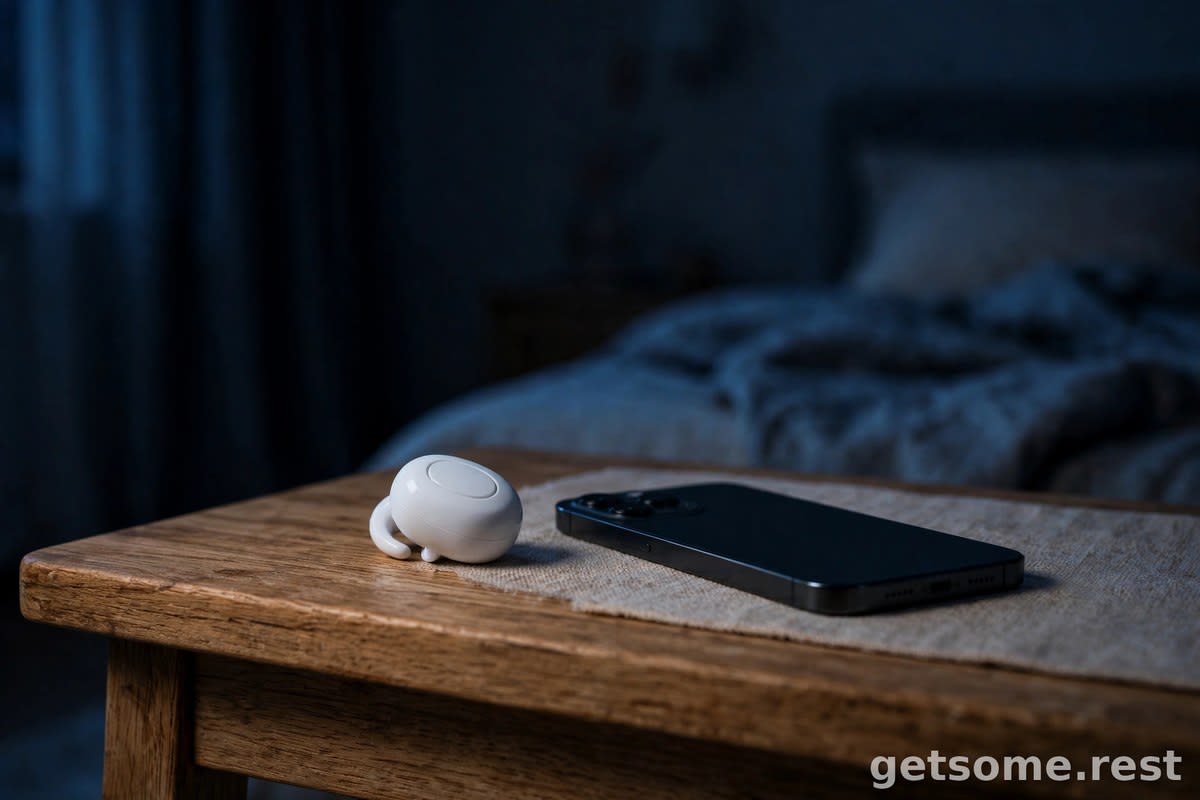
The newest gadget in the sleep aisle does not go on your wrist, under your mattress or on your nightstand. It goes in your ear. The ZenoWell Luna Plus, presented at Sleep Europe 2026 in Maastricht in October, is a small ear-worn device that delivers mild electrical pulses to the vagus nerve — a technique called transcutaneous auricular vagus nerve stimulation, or taVNS — for 20 minutes before bed. The promise is a drug-free wind-down: calmer nerves, an easier slide into sleep, and a better morning. The price is $439 on sale from a $758 list, the wristband is currently free, and the evidence is — as with most of the vagus-nerve market — a mix of one good small trial, a lot of extrapolation, and marketing numbers with no study attached. This article explains what the Luna Plus is, how it works, what it costs, and what the evidence actually says.
Contents
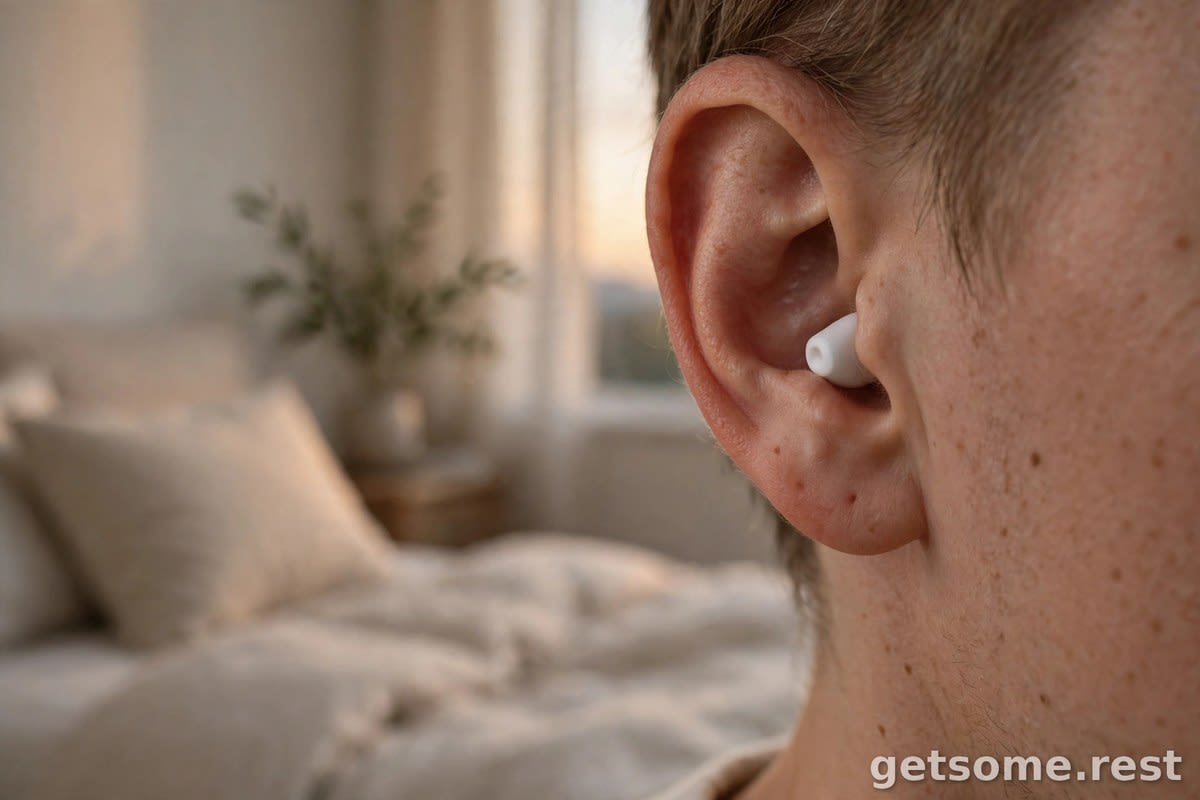
The ZenoWell Luna Plus is a non-invasive, ear-worn nerve stimulator. It delivers mild electrical pulses to the auricular branch of the vagus nerve — the branch that runs through the ear — through an earpiece that targets the cymba conchae, the hollow of the outer ear. The idea is to nudge the parasympathetic nervous system, the 'rest and digest' side, and help the body settle before sleep. It is a drug-free, 20-minute, pre-bed routine, not a pill and not a treatment. That framing is the company's own, and it matters for everything that follows.
ZenoWell is a Berlin company incubated at Heidelberg University Medical School, founded by Dr. Jane Xiao, its chief scientist. The Luna Plus opened for global pre-orders on August 6, 2026, was shown at IFA Berlin in September, and was presented at Sleep Europe 2026 — the European Sleep Research Society congress in Maastricht, October 20 to 23, at Booth A75, with Dr. Xiao presenting. It is past the pre-order stage and is in stock and shipping now from zenowell.ai, with a US storefront at zenowell.us and an Amazon channel under the ZenoFit sub-brand. It carries CE, FCC, RoHS and UKCA certifications, needs no prescription, and has no FDA clearance as a sleep treatment — it is sold as a general-wellness device.
The 'Set' is three parts, and that is part of the pitch. There is the Luna Plus ear stimulator itself, the Zenoband Mobi wristband that tracks heart rate, heart-rate variability, sleep score and sleep time, and the AI Coach in the ZenoWell app, built around a 'Track, Understand, and Improve' loop. The wristband is currently free with purchase, which softens the $439 price — a little. The company is also expanding into 100 specialty clinics and therapy centres, announced in June 2026. What sets the Luna Plus apart in its category is the combination of a 20-minute pre-bed session, six modes, and a bundled tracker — and a price that sits in the middle of the category.
Using the Luna Plus is simple, and deliberately so. You moisten the earpiece with gel or water — a gel tube and a spray bottle come in the box — place it in your left ear only, and run a session. Sleep Mode, the pre-bed routine, lasts 20 minutes. You pick a mode on the controller and turn the intensity up until you feel a comfortable tingling, then leave it there. The stimulation itself, in Sleep Mode, alternates between 4 Hz and 20 Hz with a nominal pulse width of 200 microseconds, parameters the company cites from the Zhang et al. 2024 trial discussed below.
The modes are where the sources disagree, so here is the resolved version. The official product page lists Sleep, Relaxation, Recovery, Focus, Meditation and Digestion; the press releases list Relax, Sleep, Relief, Meditation, Focus and Digestion. The official FAQ is the most specific: four modes — Sleep, Relax, Relief and Meditation — work on the device itself, and Focus and Digest are unlocked through the app. If a review you read names a 'Recovery' mode, it is almost certainly the same thing as Relief under a different label.
The app is the second half of the product. The ZenoWell app adds session history, AI-guided suggestions, a Face Scan check-in, and the two app-only modes. Behind it sits an AI Coach built on a retrieval-augmented-generation system over a vagus-nerve research database — a chatbot that answers from a library of vagus-nerve papers. The core modes work without the app, which matters: a gadget that stops working when the app changes is a different purchase. One third-party review claims the AI Coach runs on a credit system after a 7-day trial, but the official page says 'no subscription' without detail, so do not buy on either claim. The Zenoband Mobi also works with third-party wearables — WHOOP, Oura, Garmin, COROS, Fitbit, Apple Watch and Health Connect.
What the box does not tell you is battery life. The official Luna Plus product page publishes no battery figure, and the FAQ only says battery 'varies by model'. Do not believe any review that quotes a number for the Luna Plus: the 8-hour, 20-plus-session figure that circulates belongs to the non-Plus Luna, a different device. The box itself contains the Luna Plus device, the earpiece, a gel tube, a spray water bottle, a charging cable, a warranty card, a pouch, the user manual, and the Zenoband Mobi with its own charging cable and manual.
The Luna Plus is not the only vagus-nerve gadget on the market, and the category has split into distinct form factors. The comparison below uses prices verified in November 2026 by independent device guides. None of these devices is cleared as a sleep treatment; all are sold as wellness products, and the evidence for each is the same thin taVNS literature discussed above.
The closest rival in form is the Neuvana Xen, another ear-based device at $449 list and about $299 on sale, with 15-to-30-minute sessions synced to music and HSA/FSA eligibility. The Pulsetto is the most popular neck device and the cheapest way into the category at roughly $242 to $269, with sessions of about four minutes — far shorter than the Luna Plus's 20. The Truvaga is a handheld wand you hold against your neck for about two minutes, and its stimulation parameters match its prescription sibling gammaCore, which is FDA-cleared for headache — not for sleep or stress. The Nurosym has the strongest published evidence base of the group per reviewers, but at roughly €699 it is the most expensive, it is a CE-certified medical device in the EU, and it is not sold in the US.
Where does that leave the Luna Plus? At $439 it sits in the middle of the pack on price, with the longest pre-bed session of the ear-based devices, the most modes, and the only bundled sleep-tracking wristband. Whether any of that matters depends on whether 20 minutes of ear stimulation before bed actually helps you wind down — and on that question, the honest answer is that nobody has tested this device. The category is young, the trials are small, and the differences between these products are mostly about form factor and habit, not proven effect. If you buy one, buy the form you will actually use every night.
The Luna Plus costs $439 on the official ZenoWell site, marked down from a $758 list price, and the Zenoband Mobi wristband is currently bundled free. That is the checkout price on the product page, confirmed by the page's own price metadata and checked on November 16, 2026. The $758 is the crossed-out list price on the same page — the anchor that makes $439 look like a deal. Whether $758 was ever the real selling price is unknowable from the page alone; treat it as the list price, not a price anyone paid.
There is a wrinkle. The same site's Better Sleep landing page still shows $499 for the Luna Plus — the kind of thing that happens when a landing page is not updated after a sale starts. Either way, $439 is the price you will actually pay at checkout, and $499 is the figure to expect if the sale ends. There is also a WELCOME8 code for 8% off, mentioned on the Vita page, which may or may not apply to the Luna Plus.
Three other figures circulate and should not be trusted. The €505 price that appears in some coverage could not be traced to any source in three targeted searches. The $659 figure comes from a third-party aggregator's metadata with no date or basis. And the £415 paid / £340 RRP figures come from a Trustpilot review and a review site, not from ZenoWell. For context, the siblings cost less: the non-Plus Luna is $409 and the Vita is $239 on sale from $479.
Buying is straightforward. The device is in stock and shipping — past the pre-order stage that opened on August 6, 2026 — direct from zenowell.ai globally and zenowell.us in the US. In the US it is also sold through Amazon under ZenoWell's official marketplace sub-brand ZenoFit, with Prime one-to-two-day delivery, though we did not verify the Amazon listing price in this pass. Shipping is free over $100; orders are processed within seven business days and standard delivery typically takes seven to 14 business days. You can find the ZenoWell Luna Plus on Amazon through the ZenoFit storefront, and the official product page lists the current $439 price. The warranty is one year on the device and one month on the earpiece, with an extra year if you register the warranty card, and there is a 30-day trial and return on the device and earpiece only — the free Zenoband Mobi is excluded.
This is the section that matters most, because the Luna Plus sits at the exact point where a real technique meets marketing that runs ahead of it. The technique is taVNS: mild electrical stimulation of the auricular branch of the vagus nerve, delivered through the ear. The vagus nerve is the main highway of the parasympathetic nervous system — the 'rest and digest' side — and the theory is that stimulating it helps the body shift out of the alert, wound-up state that keeps people awake. It is a plausible mechanism with a real, if thin, evidence base. What does not exist is a trial of this device.
The best trial of the technique is Zhang et al. 2024, published in JAMA Network Open, and it is the study ZenoWell cites. It was a sham-controlled randomised trial in 72 patients with chronic insomnia in Beijing: bilateral tragus taVNS for 30 minutes twice a day for eight weeks, against a sham device. Sleep quality on the Pittsburgh Sleep Quality Index improved 4.2 points more than sham — a clinically meaningful difference — and the benefit held to 20 weeks, with no serious adverse events. That is a genuinely encouraging result. It is also a different protocol from the Luna Plus in every way that matters: 30 minutes twice daily versus 20 minutes once before bed, tragus versus concha placement, a clinical population versus a consumer gadget, and a different device entirely.
The rest of the evidence is weaker. A 2025 meta-analysis of six trials with 336 patients found sleep-quality scores favoured taVNS, but rated the evidence low to very low — small samples and probable unblinding. A July 2026 opinion review in Frontiers in Pain Research rated the Zhang insomnia evidence 'moderate' and stressed the methodological limits. Dealroom, covering the launch, put it bluntly: 'recent trials point to possible sleep benefits… But those studies are small and heterogeneous, and ZenoWell's multi-purpose health claims remain unproven.' No tVNS device is cleared specifically as a sleep treatment, and the guidelines still recommend CBT-I as first-line for chronic insomnia.
Against that background, the company's own numbers deserve a sceptical read. The product page carries a 'Study-Referenced Insight' claiming 59% PSQI improvement, 66% ISI improvement and 73% deep-sleep improvement — but it does not name or link the study behind those percentages, so they cannot be checked. The same page claims 'over 2 million patient sessions and no serious adverse events' in one section and '4M+ happy user sessions' in another, and says the device was 'evaluated in randomized, placebo-controlled clinical trials' — all of which refer to taVNS or ZenoWell generally, not to a trial of the Luna Plus. Medical Daily quoted the company's own position that the Luna Plus is 'an adjunctive wellness tool, not a replacement for established care such as CBT-I or professional clinical judgment.' That is the honest framing, and it is the one this article uses.
One more data point: user sentiment is mixed. The official page shows 4.1 out of 5 from 30 reviews, while Trustpilot includes a November 2026 one-star complaint about no benefit alongside positive reports of better sleep and relaxation. Thirty reviews is a small base — but it is a reminder that a $439 gadget with a 30-day return window is a purchase to test, not to commit to on faith.
How We Reported This Story
We have not tested the Luna Plus, and no honest guide can review a nerve-stimulation device from a product page. This article is built from the official sources, the launch coverage, and the published evidence for the technique — and it keeps those three things separate.
- The product: ZenoWell's official Luna Plus product page and FAQ (zenowell.ai), read November 16, 2026; PR Newswire launch release (August 6, 2026) and Sleep Europe release (October 20, 2026, corrected November 12, 2026). Mode names follow the official FAQ.
- The price: $439 sale / $758 list from the official product page, confirmed by its price metadata, checked November 16, 2026. The $499 figure on the Better Sleep landing page and the €505 figure are flagged in the article because they could not be reconciled — €505 has no source at all.
- The evidence: Zhang et al. 2024 (JAMA Network Open, DOI 10.1001/jamanetworkopen.2024.51217); the 2025 meta-analysis of six taVNS trials; the Frontiers in Pain Research July 2026 opinion review; Medical Daily and Dealroom coverage from November 2026. None of these tested the Luna Plus itself.
- What we did not verify: Luna Plus battery life (not published); the exact Amazon price through the ZenoFit storefront; the AI Coach credit model (third-party claim only); the source of the company's PSQI/ISI/deep-sleep percentages (unattributed). None appear as facts in this article.
- What this article is not: medical advice. It describes a wind-down gadget. It does not diagnose, treat or recommend treatment for insomnia, anxiety or any condition, and it does not suggest the Luna Plus replaces care. The do-not-use list comes from ZenoWell's own page.
Frequently asked questions
How much does the ZenoWell Luna Plus cost?
$439 on the official ZenoWell site, on sale from a $758 list price, checked November 16, 2026 — and the Zenoband Mobi wristband is currently bundled free. The same site's Better Sleep landing page still shows $499, so the price varies by page and promotion; $439 is the checkout price on the product page. The €505 figure in some coverage could not be traced to any source. There is also an 8%-off WELCOME8 code mentioned on the Vita page.
Does the Luna Plus treat insomnia?
No — and that distinction is the whole point. The Luna Plus is sold as a general-wellness device with no FDA clearance as a sleep treatment. The company itself describes it as an adjunctive wellness tool, not a replacement for established care such as CBT-I. The sleep evidence that exists is for the taVNS technique in small trials, not for this device — no peer-reviewed trial of the Luna Plus has been published.
How do you use the Luna Plus?
Place the earpiece in your left ear only, moistened with gel or water first, and run a 20-minute session before bed — Sleep Mode is the pre-bed routine. Pick a mode on the controller and adjust the intensity until you feel a comfortable tingling. The core modes work on the device itself; the app adds session history, AI-guided suggestions and two extra modes, Focus and Digest.
Do I need the app or a subscription?
No subscription is needed for the core device: four modes (Sleep, Relax, Relief and Meditation) work on-device, and the official page says 'no subscription'. The ZenoWell app adds session history, a Face Scan check-in and the AI Coach, plus the Focus and Digest modes. One third-party review claims the AI Coach runs on credits after a 7-day trial, but that is not confirmed on the official page — treat it as unverified.
Who should not use the Luna Plus?
The official page lists: anyone with an implanted pacemaker or ICD or another life-sustaining implant, anyone with epilepsy or a seizure history, anyone pregnant without medical approval, anyone under 18, and anyone with severe heart disease or a high arrhythmia risk. If you are unsure, or cannot communicate discomfort, the page says to consult a healthcare professional first.
Key Takeaways
- What it is: a $439 ear-worn taVNS device that stimulates the vagus nerve through the left ear for 20 minutes before bed, made by ZenoWell of Berlin and shown at Sleep Europe 2026.
- What it costs: $439 on sale from a $758 list on zenowell.ai, checked November 16, 2026, with the Zenoband Mobi wristband currently free. The same site's Better Sleep page still shows $499, and the €505 figure has no source.
- What it does: six modes (Sleep, Relax, Relief and Meditation on-device; Focus and Digest in the app), 30 intensity levels, an AI Coach in the app, and a wristband that tracks heart rate, HRV and sleep score.
- What the evidence is: one good small trial of the technique — Zhang et al. 2024, 72 patients, PSQI 4.2 points better than sham — using a different protocol and a different device. No trial of the Luna Plus exists.
- What the company claims: 59% PSQI, 66% ISI and 73% deep-sleep improvements, unattributed on its own page, and session counts that read 2 million in one place and 4M+ in another. Treat them as marketing, not results.
- Who should skip it: anyone with a pacemaker or ICD, epilepsy, pregnancy without medical approval, anyone under 18, or anyone with severe heart disease. And anyone expecting a treatment for insomnia — this is a wind-down gadget, and CBT-I remains first-line.