How much sleep do you really need by age (chart)
From 14–17 hours for newborns to 7–8 for older adults: the expert-backed sleep chart for every age, how to read it, and what to do when your nights fall short.
Everyone has heard "get eight hours," but eight hours is only the right answer for some of us. A newborn and a retiree live in completely different sleep worlds, and even teenagers and adults differ by more than most people realize. Here is the chart sleep experts actually use.
Contents
The sleep-by-age chart
The ranges below come from the National Sleep Foundation's expert panel recommendations, the most widely cited guidelines in sleep science. Find your age group, aim for the range, and read the section below the chart for what changes at each stage of life.
| Age group | Recommended sleep | May be appropriate |
|---|---|---|
| Newborns (0–3 months) | 14–17 hours | 11–13 or 18–19 hours |
| Infants (4–11 months) | 12–15 hours | 10–11 or 16–18 hours |
| Toddlers (1–2 years) | 11–14 hours | 9–10 or 15–16 hours |
| Preschoolers (3–5 years) | 10–13 hours | 8–9 or 14 hours |
| School-age children (6–13 years) | 9–11 hours | 7–8 or 12 hours |
| Teenagers (14–17 years) | 8–10 hours | 7 or 11 hours |
| Young adults (18–25 years) | 7–9 hours | 6 or 10–11 hours |
| Adults (26–64 years) | 7–9 hours | 6 or 10 hours |
| Older adults (65+ years) | 7–8 hours | 5–6 or 9 hours |
Recommended ranges per the National Sleep Foundation expert consensus; "may be appropriate" covers the wider range some healthy individuals fall into. Hours include naps for children.
How to read the chart
The most important thing about this chart is that every entry is a range, not a target. Sleep need varies between individuals the way height does: most people cluster in the middle, some healthy people sit at the edges, and a few sit outside entirely. If you consistently wake up feeling rested on 6 hours 45 minutes and you are not mainlining caffeine, you probably do not need to force yourself to 8. If you sleep 8 and still feel wrecked, the problem is more likely sleep quality — fragmentation, apnea, an uncomfortable bed — than the number.
What the chart does not measure is consistency and timing. Someone sleeping midnight to 8am nightly will almost always feel better than someone averaging the same hours with a chaotic schedule. Regularity — the same bedtime and wake time — is one of the strongest predictors of feeling rested, and it costs nothing. If you take one action from this article, make it a fixed wake time.
Finally, treat the "may be appropriate" column as permission, not pressure. A teenager who thrives on 7.5 hours is fine. An adult who genuinely needs 9.5 is fine too. The chart is a starting point for a conversation with yourself — or with a healthcare professional if something feels off — not a report card. With that framing, here is what changes at each stage of life, and what each stage most often gets wrong.
Roughly one in three U.S. adults regularly sleeps less than the recommended seven hours a night.
Source: Centers for Disease Control and Prevention (CDC)

Babies and children
For the under-six crowd, total hours include naps — and the numbers surprise most new parents. Newborns need 14 to 17 hours, but they take it in short stretches around the clock, which is why the first months feel like controlled chaos. Infant sleep cycles run about 50 minutes versus an adult's 90, so babies surface between cycles and often need help settling back down. This is developmentally normal, not a problem to fix, and night waking typically consolidates over the first year. If you are worried about your baby's sleep patterns or your own exhaustion is becoming unmanageable, talk to your pediatrician or healthcare provider.
For toddlers and preschoolers the lever is the routine, not the clock: the same sequence — bath, books, lights out — at the same time nightly becomes a sleep cue. The common mistake is the drifting bedtime: 8pm becomes 9, and mornings become a war zone. A consistent wake time anchors the day, including naps — if afternoon naps push bedtime past 9pm, the nap is too long or too late. For school-age children, the enemy is the screen in the bedroom.
Teenagers
Teenagers are the most sleep-deprived group in the chart relative to their needs. They need 8 to 10 hours, but biology works against them: during puberty, the evening release of melatonin shifts later, so a teenager's body genuinely is not ready for sleep at 10pm. Combine that with early school start times, homework, and phones, and the average teen gets far less than they need — then tries to repay the debt with 12-hour weekend lie-ins that wreck the body clock further.
Weekend catch-up helps with immediate grogginess but does not fully repay a week of short nights, and the shifting schedule worsens Monday mornings by misaligning the body clock. The realistic fix is protecting the morning: consistent wake time, bright light soon after waking, and screens genuinely off 30 to 60 minutes before bed. For teens who struggle to wake, a sunrise alarm clock eases the transition with dawn simulation — one of the few gadgets with a real mechanism behind it.
Adults
Adults 18 to 64 need 7 to 9 hours, and this is where the gap between the chart and reality is widest. Roughly one in three U.S. adults regularly sleeps less than seven hours, per the CDC. The usual suspects are work schedules, caregiving, and the great modern thief: the phone in bed. What makes adult short sleep insidious is adaptation — after a few weeks of six-hour nights, you stop feeling tired but your performance stays impaired. People routinely rate themselves as fine while their reaction times say otherwise.
The adult playbook: fix the wake time first, including weekends — sleeping in more than an hour past it creates the Monday crash. Cut caffeine after midday (a 3pm coffee is still half-present at 9pm). Make the bedroom dark, cool and quiet, since fragmented sleep steals deep stages even when total hours look fine. If your schedule cannot deliver seven hours, protect what you get and nap strategically: our power nap guide covers the 20-minute sweet spot, and night shift workers get a dedicated schedule.
Older adults
Here is the surprise in the chart: adults 65 and older still need 7 to 8 hours — only slightly less than younger adults. The myth that older people need much less sleep causes real harm, because it normalizes the 5-hour nights that leave people groggy and then gets blamed on age. What actually changes with age is sleep architecture: deep slow-wave sleep shrinks, sleep becomes lighter and more fragmented, and the circadian clock shifts earlier, so waking at 5am feeling done is common even after a reasonable bedtime.
Work with the new architecture: an earlier bedtime matching the shifted clock beats lying awake holding a 30-year-old schedule. Morning light exposure anchors the rhythm, and naps should stay under 30 minutes and before mid-afternoon. Frequent waking for bathroom trips, pain, or loud snoring deserves a healthcare conversation — treatable causes are common, and "I'm just old" is not a diagnosis.
Closing the gap: practical steps
If your nights fall short, do not fix everything at once — pick one lever and run it for two weeks. The highest-yield lever is a fixed wake time, seven days a week: it sets the circadian anchor, and sleep pressure builds toward an earlier bedtime on its own. The first few days are rough; it stabilizes.
The second lever is the bedroom itself. Light is the strongest time cue your brain receives, so the room should be genuinely dark: blackout curtains or a good sleep mask, no standby LEDs, no glowing chargers. Cool beats warm — around 65°F (18°C) suits most sleepers. And noise should be steady or absent, not intermittent: a consistent evening routine plus steady background sound does more for light sleepers than any gadget. Track what you actually do, not what you think you do — a simple two-week sleep diary (bedtime, wake time, how you felt at noon) reveals patterns that memory hides. If the diary shows you are doing everything right and still sleeping far less than your range, or you snore loudly, gasp, or feel exhausted despite time in bed, that is the point to talk to a healthcare professional rather than trying harder.
Sleep aids that help at any age
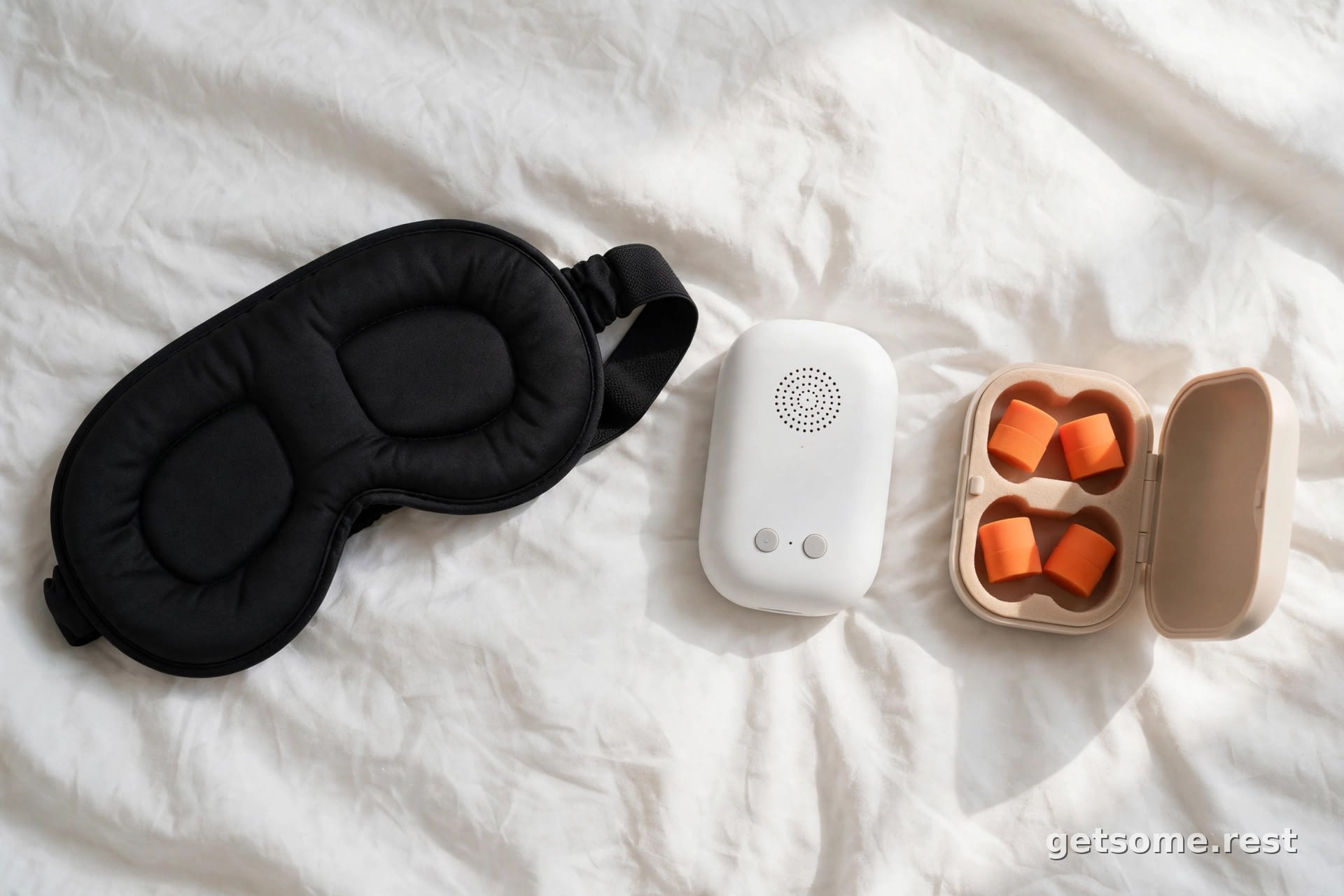
The chart tells you how much to aim for; the bedroom decides whether you get it. These three aids address the most common reasons people fall short of their range — light, noise, and restless environments — at every age from teen to older adult.
 Best for light
Manta Sleep Mask
A contoured 100%-blackout mask with zero eye pressure — the fastest way to make any bedroom dark at any age.
$39 at time of writing
Pros
- True blackout with deep eye cups — no pressure on eyes or lashes, comfortable for side sleepers
- Infinitely adjustable strap; modular design with swappable parts
- Works for teens with bright rooms, adults with early sunrises, and shift workers alike
Cons
- Premium price for a sleep mask; cheaper masks block almost as much light
- Velcro-style adjustment can catch long hair
Best for noise
Dreamegg D11
Twenty-one sounds including white, pink and brown noise in a rechargeable portable body — steady masking for light sleepers.
$32.99 list; often discounted, at time of writing
Pros
- Smooths out sudden noises that fragment sleep — the main reason totals fall short of the chart
- Rechargeable, portable, with night light and timers for kids' rooms and travel
- Budget-friendly and frequently on sale
Cons
- Small speaker lacks depth at higher volumes
- Keep volume low and the machine away from the bed, especially for children
Best classic
Yogasleep Dohm Classic
A real fan creates non-looping white noise — the decades-old favorite for masking household sounds all night.
$49.99 at time of writing
Pros
- Mechanical, non-looping sound many sleepers prefer for all-night use
- Simple two-speed and tone controls — no app needed
- 30-night trial and 1-year warranty
Cons
- Plug-in only; no brown or pink noise options
- Modest maximum volume for very loud environments
How we test
We never accept payment for rankings. Every product is judged against the same five checks:
- Price
- We record the real price at checkout, note regular discounts, and recheck prices when we update the guide.
- Materials
- We read the fabric, fill and build details, and note anything the brand doesn’t make clear.
- Sleep trials
- We check how long you can try the product at home and whether the trial has conditions.
- Warranty
- We compare warranty length and what it actually covers, in plain language.
- Return policy
- We look at how returns work, who pays for shipping, and how refunds are handled.
Frequently asked questions
How many hours of sleep do adults really need?
Most adults need 7 to 9 hours of sleep per night, according to the National Sleep Foundation's expert recommendations. Consistently sleeping under 7 hours is associated with worse daytime functioning, and roughly one in three U.S. adults reports doing exactly that. Some people genuinely function on slightly less or need slightly more, but the 7-to-9 range is the target for the vast majority.
Do sleep needs really decrease as you get older?
Yes, but less than people think. Teenagers need 8 to 10 hours, adults need 7 to 9, and adults over 65 still need 7 to 8 hours — the drop from young adulthood to old age is small. What changes more with age is sleep architecture: older adults tend to spend less time in deep sleep, wake more easily, and shift toward earlier bedtimes, even when total sleep time stays similar.
Can teenagers catch up on sleep on weekends?
Weekend catch-up sleep helps with immediate grogginess, but it does not fully undo a week of short nights, and the shifting schedule — late nights, late mornings — can make Monday mornings worse by misaligning the body clock. A consistent bedtime that delivers 8 to 10 hours on school nights beats a 12-hour weekend lie-in for steady daytime alertness.
Is it normal for babies to wake up several times a night?
Yes, frequent night waking is developmentally normal for babies, especially in the first six months. Newborns sleep 14 to 17 hours total but in short stretches, and their sleep cycles are much shorter than an adult's. Night waking usually consolidates gradually over the first year. If you are worried about your baby's sleep or your own exhaustion, talk to your pediatrician or healthcare provider.
What should I do if I consistently sleep less than my age group needs?
Start with the boring basics: a consistent wake time (even on weekends), a dark cool bedroom, limited caffeine after midday, and screens off well before bed. Track your sleep for two weeks to see the real pattern rather than guessing. If you are doing all of that and still sleeping far less than recommended — or you snore loudly, gasp, or feel exhausted despite time in bed — talk to a healthcare professional.
Key takeaways
- Newborns need 14–17 hours, teens 8–10, adults 7–9, and older adults still need 7–8 — the ranges matter more than any single number.
- A fixed wake time beats a fixed bedtime as the single highest-yield habit for closing the gap.
- Consistency and timing matter as much as total hours; weekend catch-up sleep does not fully repay weekday debt.
- If good habits do not close the gap — or you snore, gasp, or feel exhausted despite time in bed — talk to a healthcare professional.