Loftie Clock vs Philips SmartSleep: Waking Up Without Your Phone
Loftie Clock vs Philips SmartSleep: a two-phase phone-free alarm vs a colored dawn simulation. Price, features, and which phone-free morning wins (2026).
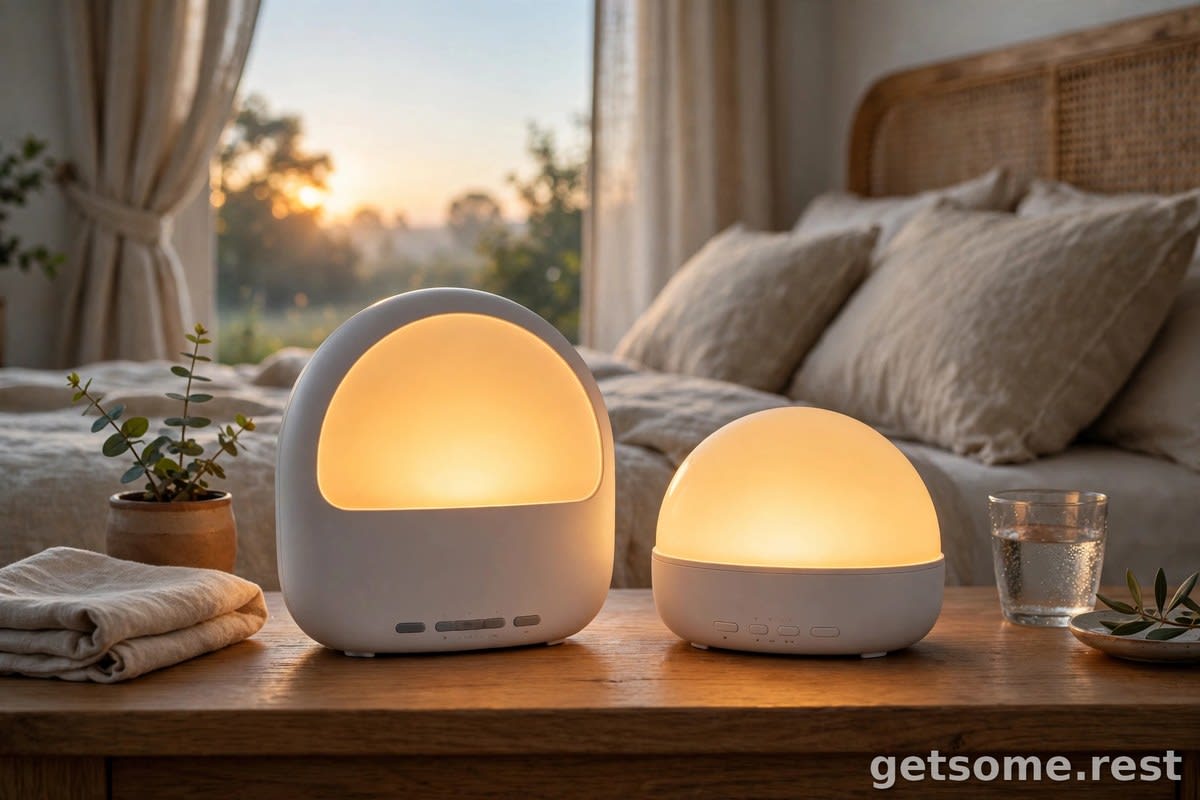
If your phone is your alarm, your phone owns your morning. The Loftie Clock ($169.99) and the Philips SmartSleep Wake-Up Light HF3520 (~$110–$150) take two different routes to the same goal — a phone-free bedroom: Loftie stages your wake-up with a two-phase sound alarm, while Philips slowly fills the room with colored dawn light.
Contents
Loftie vs Philips SmartSleep at a glance
Both of these clocks want the same thing: your phone, out of the bedroom. The Loftie Clock ($169.99 on sale) gets there with alarm design — a two-phase sound wake-up and 100+ sleep sounds. The Philips SmartSleep Wake-Up Light HF3520/60 (roughly $110–$150 street) gets there with light — the colored dawn simulation Philips has refined for decades. Short on time? The table says it all.
| Feature | Loftie Clock | Philips SmartSleep HF3520 |
|---|---|---|
| Price | $169.99 on sale (lists $199.99 at loftie.com) | ~$110–$150 street; seen as low as ~$76 on deep sale |
| Wake-up method | Two-phase sound alarm: a gentle tone that fades after ~30 seconds, then a second get-up alarm 9 minutes later | Colored sunrise simulation over ~30 minutes — dawn reds through warm orange to bright yellow |
| Sounds | 100+ sleep sounds included; doubles as a Bluetooth speaker | 5 natural wake-up sounds plus FM radio |
| Extra features | Bedtime reminders, sleep timer, adjustable amber night light plus red and blackout modes, no-WiFi mode | Sunset fading simulation for wind-down, 20 brightness settings, reading lamp, auto-dimming display, tap snooze |
| Subscription | None required | None required |
| Phone required | No — designed from the start as a phone-free alarm | No — works fully standalone |
| Backup power | 5-hour backup battery keeps the alarm running in an outage | Backup battery keeps the clock and settings through short outages |
Prices move around, especially the Philips' — check current street pricing. For the reasoning, see how to pick.
Alarm design vs dawn simulation: how to pick
The choice comes down to how you wake up. Sound-woken people need a tone plus a second stage to actually get up; light-woken people wake to a brightening room with sound as backup. Loftie is built for the first group, Philips for the second — and knowing your group matters more than any spec row.
- You smash snooze for 40 minutes: the Loftie's two-phase design is the point — a gentle tone that fades after ~30 seconds, then a firm get-up alarm nine minutes later.
- You wake to light: Philips' colored sunrise (reds to orange to bright yellow over ~30 minutes) is the more gradual, natural-feeling route, with decades of refinement behind it.
- You want the phone gone, full stop: both work without a phone, but Loftie's no-WiFi mode and 5-hour backup battery make it the more deliberate phone-free design.
- You fall asleep to sound: Loftie's 100+ sleep sounds and sleep timer beat Philips' five wake-up sounds — and the timer doubles as a nap timer if you keep naps to the recommended power nap length.
- You want wind-down light, too: Philips' sunset simulation dims the room toward bedtime; Loftie answers with an amber night light, red mode, and full blackout mode.
The single biggest upgrade a dedicated alarm clock offers is not the alarm — it is removing the phone, with its feeds, alerts, and late-night glow, from the first and last hour of the day.
Source: American Academy of Sleep Medicine sleep hygiene guidance
Sound-first vs light-first wake-ups
A sound-first alarm asks nothing of your environment: blackout curtains, a bright summer morning, a partner who sleeps in — none of it changes the alarm's behavior. That is Loftie's lane, and the two-phase design answers the snooze problem directly: a gentle nudge that fades, then a real wake-up call nine minutes later, instead of one blast you learn to silence in your sleep. Light-first wake-ups work the opposite way: the Philips slowly floods the room with dawn-colored light over ~30 minutes, so you are already in lighter sleep before any sound plays. Genuinely heavy sleepers need a different tool, though — see our guide to sunrise alarm clocks for heavy sleepers.
The phone-free bedroom argument
Both clocks are fully standalone — no app, no pairing, no phone on the nightstand — and that is the point of this category. The night the phone's charger moves to the hallway, bedtime stops drifting later and the morning stops starting with a feed. Loftie takes the philosophy further with a no-WiFi mode and a 5-hour backup battery; Philips keeps it simple with a backup battery that holds time and settings. For the full ritual, pair either clock with our phone-free bedroom challenge, a 7-day plan for the transition.
Price and value over the years
Loftie lists at $199.99 and typically sells around $169.99 — a premium price carried by the sound library, Bluetooth speaker, and staged alarm. The Philips lives at ~$110–$150 street and has dipped near ~$76 on deep sale, the clear value route to a gentler wake-up. Neither has a subscription, so the purchase price is the whole cost.
Full specs and price comparison
Everything side by side — from loftie.com and Philips' SmartSleep listings, cross-checked against current retailer listings. Approximate numbers are labeled as such.
| Spec | Loftie Clock | Philips SmartSleep HF3520/60 |
|---|---|---|
| Current price | $169.99 on sale | ~$110–$150 street; seen as low as ~$76 on sale |
| List price / MSRP | $199.99 at loftie.com | MSRP territory ~$150–$190 |
| Wake-up style | Two-phase: gentle tone fades after ~30 s; second get-up alarm 9 min later | Colored sunrise simulation over ~30 minutes |
| Sunrise light | No — night light only | Yes — dawn reds → warm orange → bright yellow |
| Sunset wind-down | No (sleep timer + sleep sounds instead) | Yes — fading sunset simulation |
| Night light | Adjustable amber; red mode; full blackout mode | Reading lamp; auto-dimming display |
| Alarm sounds | 100+ sleep sounds; Bluetooth speaker | 5 natural wake-up sounds; FM radio |
| Snooze | Built into the two-phase design (9-minute second alarm) | Tap snooze |
| Sleep timer | Yes | No dedicated timer (sunset simulation covers wind-down) |
| Bedtime reminders | Yes | No |
| Backup power | 5-hour backup battery | Backup battery for clock and settings |
| Connectivity | Optional Wi-Fi; no-WiFi mode available | None — fully standalone |
| Dimensions | 6.5 × 2.75 × 2.75 in | — |
| Weight | 1.8 lb | — |
| Warranty | Limited warranty (check current terms at loftie.com) | 2-year warranty |
| Owner rating | ~4.3/5 (aggregated owner reviews) | ~4.2–4.5/5 across thousands of reviews |
Prices last checked October 2026; specs from manufacturer pages.
Our verdict: which phone-free morning wins
Narrow winner: the Loftie Clock. If the goal is a genuinely phone-free bedroom — not just a clock without an app — Loftie is the more complete system. The two-phase alarm is the standout feature here: a gentle tone that fades after ~30 seconds, then a firm get-up alarm nine minutes later, attacking the real failure mode of phone-free mornings — the snooze loop. Add 100+ sleep sounds, a sleep timer, bedtime reminders, a no-WiFi mode, and a 5-hour backup battery, and you get a bedside device designed to replace the phone — at $169.99 on sale against a $199.99 list.
But light sleepers who wake to light should buy the Philips. Its colored 30-minute sunrise simulation — dawn reds through warm orange to bright yellow — is a decades-refined, gradual wake-up that sound-first alarms cannot replicate, and it usually costs $20–$60 less than the Loftie's sale price (far less on deep sale, where it has dipped near ~$76). The sunset wind-down, 20 brightness settings, reading lamp, and 2-year warranty round out a package holding roughly 4.2–4.5 stars across thousands of reviews.
Bottom line: snooze-button addicts who need a staged alarm → Loftie. Light sleepers who wake to light → Philips. Either one gets the phone out of the bedroom, which is where most of the benefit comes from anyway.
The two clocks in detail
What each clock does well, where it falls short, and who it is actually for. Note: the check-price links below are plain Amazon search links. Links are plain — no affiliate tags attached yet.
Two-phase phone-free alarmLoftie Clock
Loftie is the modern answer to the phone-as-alarm problem: a small bedside clock (6.5 × 2.75 × 2.75 in, 1.8 lb) built around a two-phase alarm — a gentle tone that fades after ~30 seconds, then a firmer get-up alarm nine minutes later. No sunrise simulation here; instead you get an adjustable amber night light, a red mode, and a full blackout mode. The 100+ sleep sounds, Bluetooth speaker, sleep timer, and bedtime reminders cover wind-down, while a 5-hour backup battery and no-WiFi mode keep mornings outage-proof and fully offline. Owner reviews sit around 4.3/5, praising the staged alarm.
$169.99 at time of writing
Pros
- Two-phase alarm is purpose-built for snooze-button addicts
- 100+ sleep sounds plus Bluetooth speaker
- No-WiFi mode and 5-hour backup battery for a fully offline, outage-proof morning
- Amber night light, red mode, and blackout mode
- No phone, app, or subscription required
Cons
- No sunrise simulation — light-first wakers should look at the Philips
- Premium price next to the Philips' street price
- No FM radio
Colored sunrise simulationPhilips SmartSleep Wake-Up Light HF3520/60
Philips invented this category, and the HF3520/60 is the refined mainstream version: a colored sunrise simulation moving from dawn reds through warm orange to bright yellow over ~30 minutes, easing you out of sleep before any sound plays. Five natural wake-up sounds and an FM radio cover audio; a fading sunset simulation handles wind-down; 20 brightness settings plus a reading lamp make it a genuine bedside lamp. Tap snooze, an auto-dimming display, and a settings backup battery round out a simple, fully standalone device — no phone, no app, no Wi-Fi. Typically ~$110–$150 street (seen as low as ~$76 on deep sale), with a 2-year warranty and roughly 4.2–4.5 stars across thousands of reviews.
~$110–$150 street price at time of writing
Pros
- Colored 30-minute sunrise simulation — the most gradual wake-up here
- Sunset fading wind-down plus reading lamp
- 5 natural wake-up sounds and FM radio
- Usually cheaper than the Loftie; deep-sale prices go much lower
- 2-year warranty and thousands of reviews
Cons
- No staged alarm — snooze-button addicts get less help than with Loftie
- No Bluetooth speaker, no sleep timer, no bedtime reminders
- Street price swings a lot; worth waiting for a sale
How we compared them
We did not lab-test these clocks overnight — this is a spec-and-ownership comparison built from manufacturer data, owner reviews, and current pricing, judged against what makes a phone-free morning work.
- Specs sources
- Features and dimensions come from loftie.com and Philips' SmartSleep product pages, cross-checked against current Amazon listings for the HF3520/60.
- Owner ratings
- Approximate aggregates across major retailers — ~4.3/5 for the Loftie, ~4.2–4.5/5 across thousands of reviews for the Philips.
- Price checks
- Prices last checked October 2026: Loftie $169.99 on sale ($199.99 list); Philips ~$110–$150 street, as low as ~$76 on deep sale.
- Alarm and light design criteria
- We judged the wake-up design (staged sound vs dawn simulation), wind-down features, night-light behavior, snooze mechanics, and how completely each clock removes the phone from the bedroom.
- Independence and plain links
- No brand paid for placement. Check-price buttons are plain Amazon search links — no affiliate tags attached yet.
Frequently asked questions
Are heated mattress pads safe to leave on all night?
Yes, with a modern pad that has an auto shut-off timer and overheat protection, such as the ETL- or UL-certified models we compare here. Set the auto-off timer for the time you actually need — most sleepers use one or two hours after falling asleep rather than the full 12-hour window — and never use a pad that is damp or folded over itself.
Heated mattress pad vs electric blanket: which is better for sleep?
A heated mattress pad usually wins for sleep. It warms the bed from underneath so heat rises around you, it never slides off, and it can preheat the bed before you get in. Electric blankets trap heat on top and often make sleepers overheat; a pad plus your normal blanket lets you fine-tune warmth on each side.
How much does it cost to run a heated mattress pad?
Very little. A pad like the Bwarm HeatSync draws about 65 watts per side — roughly the same as an incandescent light bulb. Running one side for eight hours costs only a few cents of electricity, far less than running a 1,500-watt space heater to warm the whole bedroom.
Will a heated mattress pad fit my mattress?
Most fit mattresses up to 18 inches deep, which covers the majority of pillow-top and hybrid mattresses. If your mattress is thicker than 18 inches, pick a deep-pocket model — the Beautyrest Cotton pad here fits up to 21 inches, and all three pads use all-around elastic skirts so they stay put.
Can I wash a heated mattress pad?
Yes — all three pads we compare are machine washable. Detach the controller and cords first, wash on a gentle cycle, and make sure the pad is completely dry before plugging it back in. Never dry clean or bleach it, and never operate a pad that is still damp.
Key takeaways
- Loftie is sound-first: a two-phase alarm (gentle tone fading after ~30 seconds, then a get-up alarm 9 minutes later). Philips is light-first: a colored 30-minute dawn simulation.
- Loftie costs $169.99 on sale (lists $199.99); the Philips runs ~$110–$150 street, dipping near ~$76 on sale — the budget route to a gentler wake-up.
- Neither needs a phone, but Loftie's no-WiFi mode and 5-hour backup battery make it the most deliberately phone-free design here.
- Snooze-button addicts → Loftie. Light sleepers who wake to light → Philips. Heavy sleepers want dedicated sunrise alarm clocks for heavy sleepers instead.
- Narrow winner: the Loftie Clock, for the most complete phone-free morning system — with Philips winning on light quality, price, and value.