The Phone-Free Bedroom Challenge: A 7-Day Plan
Seven nights, one rule: the phone sleeps in another room. Here is the night-by-night plan that makes it stick — what to use as an alarm, what to do instead of scrolling, and what most people notice by day 7.
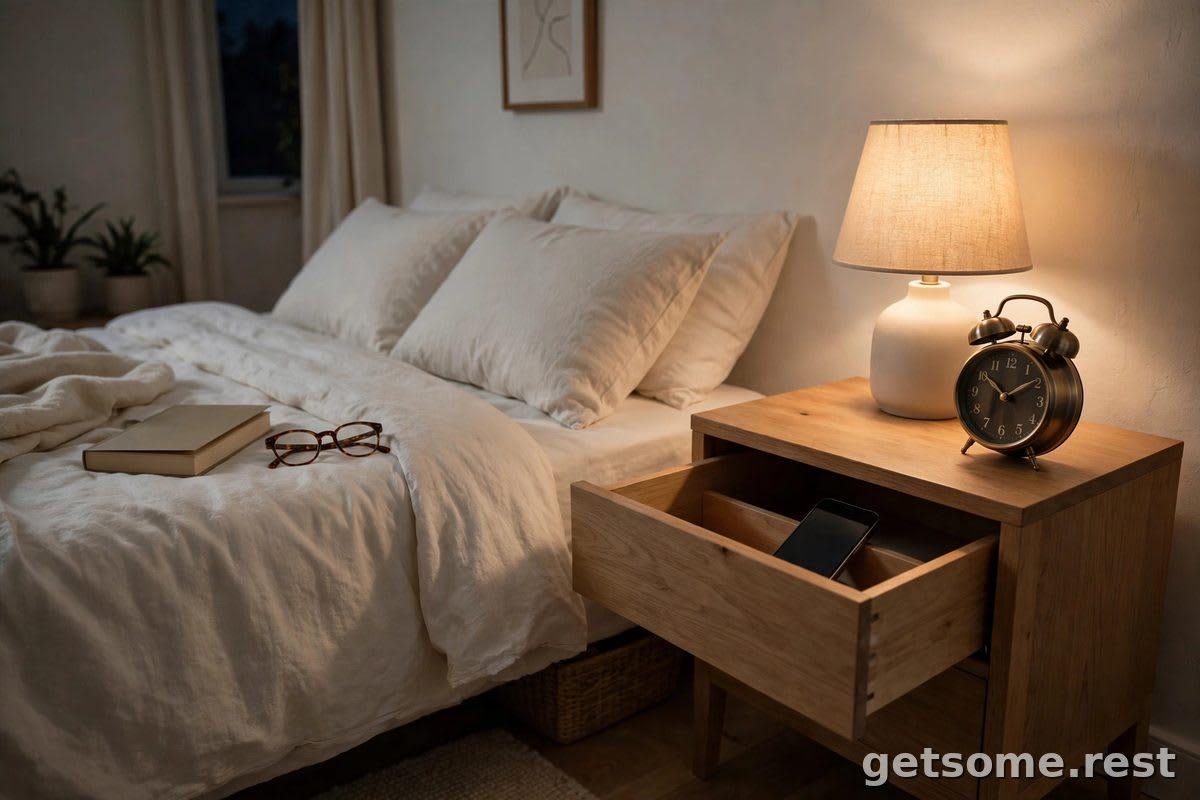
The average American now checks their phone 186 times a day — and around half of us sleep with it next to our heads. This 7-day challenge removes the phone from the bedroom entirely, one gentle step per night, and replaces the scrolling with things that actually help you sleep.
Contents
Why the bedroom is the right battleground
Willpower loses to a phone on the nightstand every time. The bedroom is where the phone does the most damage and where it is easiest to remove — you do not need to quit your phone, you just need to change where it sleeps.
Americans check their phones 186 times a day, 85% check within 10 minutes of waking, and around half sleep with their phone at night.
Source: Reviews.org cell phone usage survey of ~1,000 U.S. adults, Q4 2025
Three things happen when the phone is in bed with you. First, bedtime slides later: research consistently links leisure screen time to delayed bedtimes — not because the light is magic, but because every “five more minutes” subtracts minutes from sleep. Second, sleep gets fragmented: notifications, vibrations and the temptation to check a buzzing phone break the continuous sleep your brain needs. Third, mornings start wrong: reaching for the phone within minutes of waking hands your first conscious thoughts to email, news and social feeds.
The fix is structural, not motivational. A phone in another room cannot buzz on your nightstand no matter how many notifications arrive — pediatric and sleep-medicine experts point to exactly this, noting that some families’ most effective solution was simply keeping the phone out of the room at night. You are not fighting an addiction with discipline; you are removing the battlefield. If a racing mind rather than a phone is your main problem, pair this challenge with our guide on how to fall asleep fast when your mind won’t stop racing.
Before day 1: the 15-minute setup
Do this on a weekend afternoon. The whole challenge depends on these four moves:
- Move the charger: plug your charger in the kitchen or living room — somewhere you will not wander past at midnight. This is the single most important step. A phone with a dead battery in the bedroom is a phone you cannot scroll on.
- Get an alarm: the phone-as-alarm is the excuse that keeps the phone in the bedroom. Any alarm clock works — a $10 basic one, or a sunrise alarm like the Hatch Restore 3 that also replaces your bedside light and sound machine. Our roundup of the best sunrise alarm clocks for heavy sleepers covers options at every price.
- Tell two people: let your partner, a family member or a close friend know you are unreachable in bed for a week. Knowing someone expects your silence removes the “what if someone needs me” anxiety that sends people back to the phone.
- Stage the replacement: put a paperback book, a journal or a magazine on the nightstand — and a box or drawer where the phone used to sit. An empty nightstand is an invitation; a nightstand with a book on it is a plan.

The 7-day plan, night by night
Each night adds one small change. None of them require willpower — they change the environment so the default choice is the good one.
| Night | Mission | The swap | What success looks like |
|---|---|---|---|
| 1 — Evict | Phone charges outside the bedroom | Alarm clock takes over the nightstand | You reach for the phone once, find it gone, and laugh |
| 2 — Replace | Fill the pre-bed 30 minutes | Book, magazine or journal instead of scrolling | Lights out at your planned time, not 40 minutes late |
| 3 — Wind down | Build the shutdown sequence | Dim lights, stretch or a warm shower, then bed | You feel sleepy before your head hits the pillow |
| 4 — Morning 1 | No phone for the first 30 minutes awake | Water, daylight, get dressed before any screen | You notice how quiet the morning feels |
| 5 — Morning 2 | Protect the morning all week | Keep the phone on its charger until you leave | Two calm mornings in a row |
| 6 — Stress-test | Handle the hard cases | Emergency plan, travel version, partner rules | You can explain the system to someone else |
| 7 — Decide | Choose what stays permanent | Keep what worked, adjust what didn’t | A bedroom rule you actually want to keep |
Night 1 — Evict the phone
Tonight the phone sleeps in the kitchen. Set your alarm clock, plug the phone in outside the bedroom, and go to bed. You will reach for the phone out of habit — everyone does. Notice the urge, name it (“that’s the habit, not a need”), and roll over. The first night is the only hard one.
Night 2 — Replace the scroll
The pre-bed scroll is a ritual, and rituals need replacements, not willpower. Pick one: a paperback (not an e-reader with notifications), a journal with three lines about the day, or a magazine you would never read on a phone. Our readers report that reading before bed works best when the book is physical and slightly boring — thrillers at midnight are their own problem.
Night 3 — Build the shutdown sequence
Tonight, start 30 minutes before bed: dim the lights, do five minutes of gentle stretching or take a warm shower, then read until sleepy. This is the skeleton of a real 30-minute evening routine — night 3 is just the first draft. The sequence matters more than any single step: your body starts associating the order of events with sleep.
Nights 4–5 — Fix the morning
Evenings are only half the challenge. For these two mornings, the phone stays on its charger until you are dressed and have had water and daylight. Mornings without a phone feel strangely spacious — most people use the time better than they expected, and the calm carries into the day. If you need a gentle wake-up without a phone alarm, a sunrise clock’s gradual light beats any buzzer.
Night 6 — Stress-test the system
Tonight you handle the objections. Emergencies: enable Do Not Disturb exceptions for family, or keep a basic alarm-capable device — the real safety net is people knowing where you are, not a phone under your pillow. Travel: a portable alarm or a hotel wake-up call covers it. Partner: if they keep their phone, ask them to charge it on their side and silence it — most partners join in by night 3.
Night 7 — Decide what stays
Review the week. Almost nobody goes back to the phone on the nightstand — but the honest version of this challenge is deciding your own permanent rule. Common keepers: phone charges in the kitchen forever; phone allowed in the bedroom but never in bed; weekends exempt. Write your rule on a sticky note and put it where the phone used to charge.
Morning rules for the week
The challenge is called phone-free bedroom, but mornings 4 and 5 are where people feel the biggest shift. Three rules carry those mornings:
- No screens for 30 minutes: not news, not email, not the weather. Your brain’s first half hour sets the day’s baseline for reactivity.
- Light before pixels: open the curtains or step outside. Morning light is the strongest signal your body clock gets — stronger than any app’s “circadian” feature.
- One analog task: make the bed, stretch, write three lines in a journal. A completed physical task before any screen builds a small sense of control that scrolling never provides.
After day 7: what to keep
Seven days proves the concept; the permanent version can be looser. Most people who finish this challenge keep two things: the charger stays outside the bedroom, and mornings stay phone-free until they are dressed. Those two rules deliver most of the benefit with none of the rigidity.
If the quiet bedroom worked for you, the next upgrades stack naturally: a sleep mask for light, a sound machine for noise, and blackout-level darkness. Each one is another sense you have taken back from the glowing rectangle.
How this plan was built
We don’t give medical advice. This plan was assembled from behavioral research and tested against real-world constraints:
- Research
- We drew on screen-time surveys (Reviews.org, Q4 2025), pediatric sleep guidance on keeping devices out of bedrooms, and the behavioral-bedtime-delay literature linking leisure screen time to later bedtimes.
- Structural design
- Every step changes the environment rather than demanding willpower — moving the charger, staging a replacement activity, setting an alarm clock — because habit research favors friction over discipline.
- Realism check
- We pressure-tested the plan against the five most common failure points: emergencies, partners, travel, shift work and boredom. Each has an answer in the night-by-night guide.
- Safety
- The plan never asks you to be unreachable: Do Not Disturb exceptions, telling key people, and keeping a basic phone or landline option cover genuine emergencies.
- No medical claims
- We describe what people commonly report (falling asleep faster, calmer mornings) without promising clinical outcomes. If you have a sleep disorder, talk to a clinician — a phone habit is not the whole story.
Frequently asked questions
Will I actually sleep better without my phone in the bedroom?
Most people fall asleep faster within the first few nights, mainly because scrolling stops pushing bedtime later — research consistently ties leisure screen time to delayed bedtimes. Sleep also gets less fragmented without notifications and the temptation to check a buzzing phone. The effect is behavioral rather than medical: you remove the thing that was stealing sleep time.
What should I use as an alarm if my phone is out of the room?
Any standalone alarm clock works — a basic $10 digital one is fine. If you want an upgrade, a sunrise alarm clock wakes you with gradually brightening light instead of a buzzer, and some models like the Hatch Restore 3 also play sleep sounds and work as a bedside light. The key feature is simply that it is not a phone.
How do I stop the urge to scroll before bed?
Do not fight the urge — replace the ritual. The scroll is a habit loop (trigger: getting into bed, routine: scrolling, reward: novelty), so give it a new routine: a paperback, a journal, or a magazine kept on the nightstand. Moving the charger out of the bedroom adds friction that makes the old loop hard to run. Most people report the urge fades after three or four nights.
What if I need my phone for emergencies or my kids?
Tell key people you are unreachable in bed for the week, and set your phone's Do Not Disturb to allow calls from family members — you will hear them if it is in the next room. For genuine safety concerns, a basic alarm-capable phone or a landline by the bed covers emergencies without bringing the smartphone back. The goal is unreachable-by-scrolling, not unreachable-by-everyone.
Do I have to keep the bedroom phone-free forever?
No. The 7 days prove the concept; the permanent version can be looser. The two rules most people keep are charging the phone outside the bedroom and staying phone-free for the first 30 minutes of the morning — those deliver most of the benefit with none of the rigidity. Write down your own rule on night 7 and treat it as an experiment, not a vow.
Key takeaways
- The phone leaves the bedroom for 7 nights — charger moves to the kitchen on night 1, an alarm clock takes the nightstand.
- Replace the scroll, don’t just remove it: a book, journal or magazine fills the pre-bed 30 minutes.
- Nights 4–5 fix the morning: no phone for the first 30 minutes after waking.
- On night 7, write down the one rule you will keep permanently — most people keep the charger outside the bedroom.