Best Ambient Sounds for Deep Sleep: Brown Noise, Rain and Fan Sound (2026)
Brown noise, pink noise, white noise, real fan sound and steady rain — we compared what each actually masks at night, how loud to play it, and which machines and free apps deliver the best sound for the money in 2026.
The wrong sound at 2 a.m. is worse than silence. A harsh hiss keeps your brain half-alert; the right low rumble lets it stop listening for trouble. Here is how the main ambient sounds really differ for sleep, how loud to play them, and which machines and apps are worth your money.
Contents
The ambient sounds, at a glance
Every sound below works by the same trick: steady, predictable sound gives your brain nothing new to notice, so it stops scanning for sudden noises. The differences are texture, depth and how natural they feel at 3 a.m.
| Sound | What it sounds like | Best for | Try it first if |
|---|---|---|---|
| Brown noise | A deep, low rumble — like a waterfall heard from far away | Masking bass-heavy noise: traffic, airplanes, snoring | You find white noise too hissy or sharp |
| Pink noise | Balanced and even — softer highs than white noise, more body | A middle ground that suits most sleepers | You want one sound that works for most nights |
| White noise | An even hiss across all frequencies — like TV static | Strong masking of sharp sounds: doors, voices, barking | Your bedroom gets sudden, unpredictable noise |
| Real fan sound | The natural whoosh of moving air, with tiny organic variations | People who find digital sounds artificial | You already sleep with a fan running |
| Steady rain | Continuous rainfall, sometimes with distant thunder | Sleepers who need variety and a natural setting | You like rain and can tolerate loop seams |
| Ocean / nature | Waves, forest, crickets — rhythmic but variable | Wind-down before sleep rather than all-night masking | You want the evening to feel like a getaway |
There is no clinically proven “best” sound for deep sleep — preference predicts success. The sound you can listen to all night without noticing is the right one.
Brown vs pink vs white vs fan: the detailed comparison
Colored noises are named for how sound energy is distributed across frequencies. That distribution decides whether a sound feels deep, bright or harsh — and which kind of night noise it covers best.
| Feature | White noise | Pink noise | Brown noise | Real fan sound |
|---|---|---|---|---|
| Frequency emphasis | Equal energy everywhere — sounds bright | Energy falls as pitch rises — balanced | Strong low end — deep and rumbling | Mostly low-to-mid, with natural flutter |
| Feels like | Hiss, static, shower running | Rushing air, soft rainfall on leaves | Distant waterfall, airplane cabin | A fan in the room, but without the breeze |
| Masking strength | Strongest per decibel — covers sharp sounds | Strong, less aggressive | Strongest against low rumbles | Good, and feels the least “processed” |
| Comfort at sleep volume | Can feel harsh above 50 dB | Comfortable for most people | The most comfortable at higher volumes | Comfortable — the most familiar of all |
| Who usually likes it | City sleepers with thin walls | First-timers trying ambient sound | Sleepers who need depth; tinnitus sufferers | Anyone who already runs a fan at night |
| Weakness | Hissy at the volume needed to mask | Jack of all trades, master of none | Can sound muddy or muffled | One texture — no rain or nature options |
A note on rain: recorded rain is usually a short loop. On a cheap speaker the seam repeats every few seconds and your brain starts tracking it — which defeats the purpose. Non-looping digital rain (LectroFan’s tracks, for example) or a real rain app with long recordings avoids this.
The right ambient sound doesn’t knock you out — it stops small noises from knocking you awake. Think of it as a volume floor that sudden sounds can’t rise above.
How we describe masking to first-time white noise machine buyers
Why brown noise exploded in popularity
Brown noise went from a physics term to a sleep buzzword because it solves the most common complaint about white noise: harshness. White noise spreads energy evenly, so its high frequencies hiss; brown noise piles energy into the low end, which reads as a warm rumble at the same volume. There is no solid clinical evidence that brown noise produces deeper sleep than pink or white noise — but the sound people actually leave running all night matters more than lab data, and brown noise wins that vote. If you are choosing between colors, start with brown, then try pink if brown feels too muffled. Our deeper dive into brown noise vs white noise for sleep walks through the science and the listening tests.
Fan sound: the sleeper pick
Real fan-based machines like the Yogasleep Dohm have one advantage no digital track can copy: the sound never repeats, because it is made by an actual spinning fan. Listeners describe it as warmer and less fatiguing than digital noise, and if you already sleep with a fan on, the Dohm gives you the same whoosh without cold air on your face. The trade-off is variety — one sound family, tuned by rotating the cap. For a single-sound option for sensitive sleepers, our best white noise machines for light sleepers covers fan-based machines in more depth.
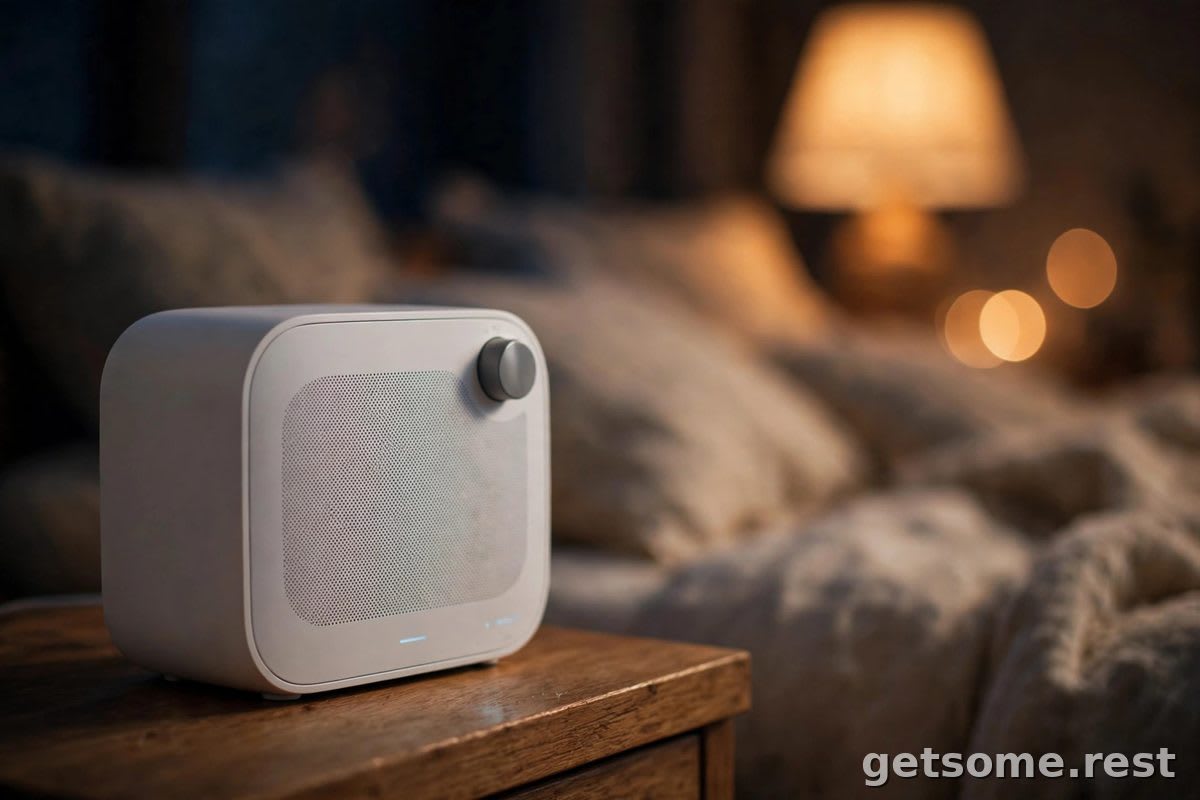
How loud to play ambient sound
More is not better. The goal is the lowest volume that still masks the noise around you — for most bedrooms that lands at or below 50 dB, roughly the level of a quiet conversation or moderate rainfall.
- Start low and raise slowly: set the machine to about half volume at bedtime, then nudge it up only until the sounds you want covered — traffic, a ticking clock, hallway voices — fade into the background. If you can clearly hear the masking sound itself over your pillow, it is too loud.
- Keep it under 70 dB: sleep experts recommend keeping sound machines below 70 decibels for adults, and lower is better for all-night use. A free phone decibel meter is accurate enough to check.
- Distance matters: put the machine across the room rather than on your nightstand, or at least several feet from your head. Every doubling of distance drops the volume noticeably, so a machine that masks street noise from the dresser can sit quieter than one screaming next to your ear.
- Measure once, then forget it: check the level once with a meter app, mark the volume position with a small sticker, and leave it there. Constant fiddling turns the sound into something your brain tracks.
When sound alone isn’t enough
Ambient sound masks steady noise beautifully, but it struggles with loud, irregular noise — a snoring partner, a barking dog, construction at 6 a.m. For those, pairing brown noise with earplugs works better than cranking the volume. Our guide to the best earplugs for sleeping next to a snoring partner covers reusable options that pair well with a low machine hum. And if a racing mind — not noise — is what keeps you up, sound helps less than a wind-down routine; see how to fall asleep fast when your mind won’t stop racing.
The best machines for sleep sounds in 2026
A dedicated machine beats a phone for one simple reason: no glowing screen, no notifications, no battery anxiety at 3 a.m. These four cover every budget and preference, with real, current prices.
Best real fan sound
Yogasleep Dohm Classic
The original since 1962: a real spinning fan makes natural, never-repeating white noise you tune by rotating the cap. No app, no timer, no fuss.
$49.99 at time of writing
Pros
- Real fan sound — the most natural texture, zero looping
- Two speeds plus adjustable tone and volume for a personalized whoosh
- Dead simple: plug in, flip the switch, done
Cons
- No brown/pink noise, no timer, no battery or app
- One sound family — what you hear is what you get
Best digital all-rounder
LectroFan Classic
Ten fan sounds plus ten non-looping white, pink and brown noise variations, a sleep timer and precise volume steps — the most sound per dollar.
$49.95 at time of writing
Pros
- 20 non-looping sounds: fan, white, pink, brown and ocean variations
- Sleep timer and 1 dB volume steps for exact tuning
- Runs on AC or USB — easy to take on trips
Cons
- Digital sound can’t match the Dohm’s organic feel
- No app or Bluetooth streaming
Best portable
LectroFan Micro2
A 2-inch cube with 11 non-looping sleep sounds and up to 40 hours of battery — plus Bluetooth for streaming your own tracks.
$34.95 at time of writing
Pros
- Tiny and rechargeable — hotel rooms and guest rooms solved
- 11 sounds including white, pink and brown noise variations
- Doubles as a Bluetooth speaker for daytime use
Cons
- Small speaker can’t fill a large bedroom like full-size machines
- No sleep timer on some listings — check before buying
Best premium combo
Hatch Restore 3
A sunrise alarm, bedside light and sound machine (white, pink, brown noise plus nature) in one screen-free device that gets your phone out of the bedroom.
$169.99 at time of writing
Pros
- White, pink and brown noise plus nature sounds with high-quality audio
- Sunrise alarm and dimmable light replace your phone alarm and lamp
- Phone-free on-device controls — no glowing screen at night
Cons
- Premium price — three times a basic machine
- Needs Wi-Fi and the app for setup; Hatch+ subscription for full content
Free apps for trying ambient sounds
Before spending a dollar, test-drive the sounds on your phone for a week. If you end up loving a particular sound, that is your signal to buy the machine that plays it best.
- BetterSleep (free tier): mixable rain, brown noise, fans and nature tracks you layer yourself. The free library is generous; the subscription unlocks the rest.
- myNoise (free): the tinkerer's pick — finely tunable noise generators and long, seamless soundscapes. Superb audio quality, dated interface.
- Built-in phone sounds: both iPhone (Background Sounds in Accessibility settings) and many Android phones ship with white, brown and pink noise. Basic, but free and offline.
- Long-play videos: 10- and 12-hour rain and brown noise videos work in a pinch — download them offline so a mid-roll ad doesn’t arrive at 4 a.m.
The catch with every app: your phone stays in the bedroom, glowing and buzzing. If that is what ruins your sleep, a machine pays for itself in the first week — or try our 7-day phone-free bedroom challenge, which pairs perfectly with a dedicated sound machine.
How to build a sound routine that sticks
The machine is only half the system. A small routine turns background noise into a sleep cue your body recognizes:
- Same sound, same time: start the sound when you begin your wind-down, not when you get into bed. Within a week, the first rumble becomes a “bedtime is near” signal.
- Keep the room cool and dark: sound covers your ears, not the rest of the environment. A cool room pairs well with warm sound — our research summary on the ideal bedroom temperature for sleep explains why.
- Give it two weeks: the first nights with a new sound can feel strange. Most people stop noticing the sound — which is the entire point — somewhere around night ten.
- Travel with it: hotel air conditioners and unfamiliar hallways are exactly where masking earns its keep. The Micro2 was made for this; the Dohm fits in a carry-on.
How we test
We never accept payment for rankings. Every sound machine is judged against the same five checks:
- Price
- We record the real price at checkout and recheck prices when we update the guide. Prices here were checked October 15, 2026.
- Sound quality
- We listen for looping seams, harsh high frequencies and speaker distortion at low volumes — the volumes people actually sleep with.
- Sound variety
- We count genuinely different, usable sounds — not 30 near-identical hiss presets — and note which noise colors are covered.
- Bedroom fit
- We check timers, night lights, phone-free controls and whether the device itself glows, buzzes or demands attention at night.
- Value
- We weigh the price against sound quality and features, including free-app alternatives, so a budget pick earns its place.
Frequently asked questions
Is brown noise better than white noise for sleep?
Neither is proven better for sleep depth — it comes down to comfort. Brown noise emphasizes low frequencies, so it sounds deeper and less harsh than white noise at the same volume, which makes it better at masking bass-heavy sounds like traffic and snoring. White noise masks sharp sounds slightly better per decibel but can feel hissy. Try brown noise first; if it sounds muddy, switch to pink noise.
Should I play ambient sound all night or use a sleep timer?
All-night playback gives more consistent coverage, because it masks the 3 a.m. noises that wake you after you have already fallen asleep — slamming doors, early traffic, a partner's alarm. A 45- or 90-minute timer is fine if your room is quiet and you only need help drifting off. If you use a timer, pick the longest setting your machine offers.
How loud should a white noise machine be?
Keep it at or below 50 decibels — about the level of a quiet conversation — and under 70 decibels at the absolute most. Place the machine several feet from your head, ideally across the room, and use the lowest volume that still masks the noise around you. Check once with a free decibel-meter app, then leave the setting alone.
Can ambient sound help with a snoring partner?
Yes, for steady snoring — brown noise or a low fan hum covers it well for most people. For loud or irregular snoring, sound alone is rarely enough; pairing low ambient sound with reusable earplugs works better than turning the volume up. If the snoring is new, very loud, or paired with gasping, the snorer should talk to a doctor, since that can signal a sleep breathing issue.
Are free apps as good as a dedicated sound machine?
Apps like BetterSleep and myNoise are excellent for finding which sound you like, and they cost nothing. But a dedicated machine wins for nightly use: no glowing screen, no notifications or calls interrupting the sound, no battery anxiety, and no phone in the bedroom tempting you to scroll. If you fall asleep to your phone every night, a $35 to $50 machine pays for itself quickly.
Key takeaways
- Brown noise and real fan sound are the best starting points for deep sleep — brown for bass-heavy noise, fan for the most natural texture.
- Keep ambient sound at or below 50 dB, placed across the room rather than next to your head — louder is not better.
- The Yogasleep Dohm Classic ($49.99) is the pick for real fan sound; the LectroFan Classic ($49.95) is the best digital all-rounder with brown, pink and white noise.
- A dedicated machine beats a phone: no glow, no notifications, no battery anxiety at 3 a.m.