SleepEngine POD Explained (2026): Under-Pillow Sound
SleepEngine POD: neuroacoustic sounds from under your pillow, no subscription, nothing to wear. Now on sale in Canada — price, studies, who it suits.

The newest sleep gadget of November 2026 does not go on your wrist, your head or your finger. The SleepEngine POD is a small device that sits under or behind your pillow and plays low-frequency neuroacoustic sounds while you fall asleep — no wearable, no subscription, nothing touching your body. Its maker, Cambridge Sleep Sciences, says the sounds retrain the brain's natural sleep patterns over about 30 days, and that 94% of people in its two small clinical studies slept better. On November 9, 2026, the POD went on sale in Canada through distributor Total Sleep Supply, joining sales already running in the UK, US, Europe and Benelux. The price, however, has not been published anywhere — and that is the first thing to know before you go looking for one.
Contents
What the SleepEngine POD Is
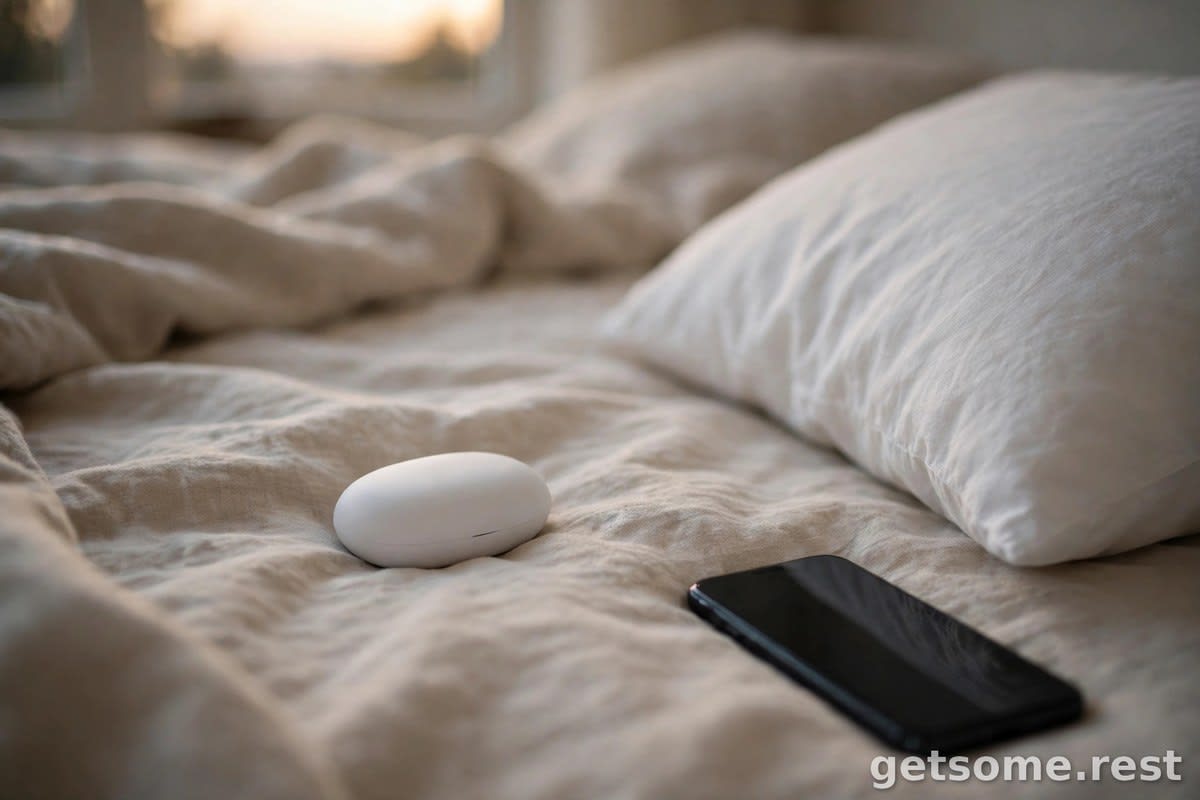
The SleepEngine POD is Cambridge Sleep Sciences' own product and, in the company's words, 'the way to experience SleepEngine today'. It is a compact device — small enough to go in a bag — that sits under your pillow, behind it, or on your bedside table, and plays SleepEngine Sounds as you fall asleep. A dedicated app for iOS and Android gives you control of sleep programs, volume and alarms, so you wake to an alarm rather than to the sound still playing.
Three things define it. First, the placement: under the pillow, not on the body. Second, the sound: patented neuroacoustic soundwaves at precisely calibrated low frequencies, developed over 15 years, which the company says help the brain relearn natural sleep patterns. Third, the business model: no subscription. The app is free with the device, which sets it apart from most sleep tech launched in the last two years.
- Nothing to wear: no headband, no earbuds, no ring, no watch. Nothing on your head, nothing in your ears.
- Four sleep modes: including a fall-asleep program for the start of the night, with volume and alarm control from the app.
- Works with any bed or pillow: the device does not care what you sleep on, and it travels with you.
- No subscription: the app costs nothing beyond the device itself — the price of which, as noted below, has not been published.
- Up to 30 days to work: the company's own timeframe, with results varying from person to person.
The Canadian context: a 2025 Leger survey of 1,553 adults found 54% of Canadians struggle to fall or stay asleep. Total Sleep Supply, backed by 80 years of expertise from Eden Textile, is pitching the POD to retailers with a four-minute in-store demo — Benelux retailers report around 6 in 10 demos end in a sale. Whether it works as well at home as in a demo is the question the rest of this article tries to answer.
How It Claims to Work
Cambridge Sleep Sciences describes SleepEngine as neuroacoustic sound: soundwaves played at precisely calibrated low frequencies, designed over 15 years to help the brain relearn natural sleep patterns. The idea is not to mask noise — that is what white noise does — and not to lull you with music. The sounds are meant to interact with the brain's own rhythms as you fall asleep, nudging them toward the patterns of a person who sleeps easily.
The mechanism is the brand's own account, and it is worth separating what is known from what is claimed. Low-frequency sound can influence brain activity — that much is established in neuroscience — but whether a specific set of tones, played from a small speaker under a pillow, reliably retrains sleep is exactly what the company's studies are trying to show. The evidence so far is two small studies, covered in detail below, and a larger randomised trial of a sleep-sound library published in the journal Sleep in 2026 — which tested a 60-track library over four weeks in 495 working adults, not the POD itself. That distinction matters: the library trial supports the general idea of sound at bedtime; the POD-specific evidence is the two small studies.
What the approach does offer, regardless of the evidence, is a genuinely different form factor. Nothing on your body at all — no headband, no earbuds, no ring, no watch. For people who cannot sleep with something in their ears — side sleepers especially — or who dislike wearing a tracker to bed, that is the POD's real selling point. It also travels: the device is small enough to go in a bag, and it works with any bed or pillow, so the routine survives a hotel room.
One honest note: if you already sleep well to rain, fan or brown noise, a white-noise machine does the same job for a fraction of the price — our ambient sounds guide and brown noise vs white noise comparison cover the free and cheap options. The POD is for people who have tried those and want something that claims to do more than mask the neighbours.
Price, Availability and What's in the Box
Price: not published. This is unusual for a product launch, and it is the single most important fact in this article. As of November 11, 2026, no price appears on Cambridge Sleep Sciences' site, in the Canada launch release, or in the distributor's materials — not in Canadian dollars, pounds or US dollars. The POD sells through retail in Canada, which may explain it: Total Sleep Supply is a distributor, and its retail partners may set their own prices. But for a buyer, the result is the same: you cannot comparison-shop a product with no price. We will update this article when a price is confirmed.
Availability. The POD ships in the UK, the US and Europe from Cambridge Sleep Sciences directly, and it already sells through retailers in Benelux. Canada is the newest market: Total Sleep Supply, backed by 80 years of expertise from Eden Textile, signed as the exclusive Canadian distributor, and the POD has been available in Canada from November 9, 2026 at totalsleepsupply.ca. The Canadian launch is aimed at retailers as much as consumers — the release talks about a four-minute in-store demo, and says Benelux retailers report that around 6 in 10 demos end in a sale.
What you get. The POD itself — a compact device that sits under your pillow, behind it, or on your bedside table — plus the SleepEngine app for iOS and Android, which controls sleep programs, volume and alarms. There are four sleep modes, including a fall-asleep program for the start of the night. There is no subscription: the app is free with the device. The device is small enough to travel with, and it works with any bed or pillow.
The wider family. Cambridge Sleep Sciences also licenses the same sound technology to bedding, wellness and smart-furniture brands, and sells a SleepEngine Smart Pillow — the first product to use the embedded approach. The same technology may eventually appear inside a mattress or pillow you were already buying.
A note on buying it. With no published price, buy from the distributor or the brand's own site, not a marketplace listing, and confirm the price and return terms before paying. For a cheaper sound-based option right now, the Yogasleep Dohm on Amazon is the classic alternative — a fan-based sound machine at a known price, with no app and no claims attached.
What the Studies Actually Show
The headline number on every SleepEngine page is 94%: '94% of people sleep better with SleepEngine.' It is a striking figure, and it needs its context, which the company does print — in the footnote.
The 94% is a combined result across two independently run UK clinical studies with 53 participants in total, and 'slept better' means self-reported improvement while using the device as instructed. Fifty-one of the 53 said they slept better. That is a real result on a very small group, and self-reported sleep is exactly the kind of measure that improves when people expect a product to work. It is promising, not proven.
| Study | What happened |
|---|---|
| First study, 2016 (CMR, independent research company) | 36 adults with insomnia symptoms, sleep diaries over 21 nights. They started at 4.2 hours of sleep a night; after three weeks they were sleeping 155 minutes more and waking 55% less often. |
| Second study, 2025 | 12 weeks of nightly use. More than two thirds saw a clinically meaningful improvement in sleep quality on the Pittsburgh Sleep Quality Index, the standard measure. At week 20 — eight weeks after participants stopped using it — the improvement still held, and 84% had a clinically meaningful improvement. People typically fell asleep in 20 minutes instead of 35. |
| Randomised trial, Sleep journal, 2026 | 495 working adults used a 60-track sleep-sound library at bedtime for four weeks. This tested the sound-library approach in general, not the POD hardware specifically. |
Two details deserve emphasis. First, the second study's most interesting result is durability: eight weeks after people stopped using the device, most were still sleeping better — which, if it holds up in peer review, supports the 'retraining' claim, unlike a white-noise machine whose effect stops the night you switch it off. Second, that study is still in peer review, presented at the World Sleep Congress 2025; until it passes, the result is preliminary.
The honest summary: the studies point the same way, the samples are small, the headline measure is self-reported, and the strongest claim — lasting improvement — still awaits independent scrutiny.
Who It Suits — and Who Should Skip It
It suits you if: you dislike sleeping with anything on or in your body — no earbuds, no headband, no ring — and you want a sound-based sleep routine without a monthly fee. The no-subscription app is the POD's clearest advantage over the headband and ring devices we have covered: the Somnee headband costs $349 plus a subscription for its full features, and the rings in our ISHO coverage and Azume One coverage all sit in a subscription ecosystem. The POD charges once — whenever the price is published — and the app is free.
It suits you if: you have tried white noise and want something different. The POD is not a white-noise machine with a new shape; it claims a different mechanism. If rain and fan sounds already work for you, save your money — our best white noise machine guide has options from $20.
Skip it if: you want data. The POD gives you no sleep tracking, no score, no nightly report — a tracker is the better buy if you want to know how you slept.
Skip it if: you want a treatment. The POD is a wellness device, not a medical device, and it is not a treatment for insomnia or any sleep disorder. If you have a diagnosed sleep condition, talk to your clinician — and do not stop any treatment you are already on because of a gadget.
Skip it if: you are impatient. The company says it can take up to 30 days to work, and the study results were measured over three to twelve weeks. A device that needs a month before you can judge it is a device you should only buy if you are willing to give it that month.
Wait if: the price matters to you — which it should, since it has not been published. Until Total Sleep Supply or Cambridge Sleep Sciences confirms a price, there is nothing to compare against the $20 white-noise machine or the $349 headband. Check totalsleepsupply.ca in Canada or cambridgesleepsciences.com elsewhere before deciding.
How We Reported This Story
We have not tested the SleepEngine POD, and neither has any independent reviewer we could find as of November 11, 2026. Everything in this article comes from the company's own materials and the launch release, and we flag where the company's numbers end and independent evidence would begin.
- Launch and availability: EINPresswire release, November 9, 2026 — Total Sleep Supply signed as exclusive Canadian distributor, POD available from November 9 at totalsleepsupply.ca. The release also supplies the Leger survey figure (54% of Canadians struggle to fall or stay asleep; 1,553 adults, March 2025, commissioned by Eisai Limited) and the Benelux demo figure (around 6 in 10 demos end in a sale).
- Product details: Cambridge Sleep Sciences' own product pages — under-pillow placement, four sleep modes, no-subscription app, portable, embedded licensing to bedding and furniture brands, Smart Pillow sibling product.
- Studies: the company's own study summaries. The first study was run in 2016 by CMR, an independent research company; the second was presented at the World Sleep Congress 2025 and is now in peer review — which means it has not yet passed independent scrutiny. The 94% figure is the brand's combined result across the two studies, self-reported, on 53 participants in total.
- Price: not published. We searched the company's site, the launch release and distributor materials on November 11, 2026 and found no price in any currency. If a retailer quotes you a price, ask them to confirm it against the distributor before buying.
As with every product in this series, we will update this article if independent testing or a confirmed price appears. Until then, treat it as an explainer of what the product is and what its maker claims — not a recommendation.
Frequently asked questions
How much does the SleepEngine POD cost?
No price has been published. Neither Cambridge Sleep Sciences' own site nor the November 9, 2026 Canada launch release states a price, and the Canadian distributor, Total Sleep Supply, lists the product through its retail channel rather than as a direct online price. Check totalsleepsupply.ca in Canada or cambridgesleepsciences.com in the UK, US and Europe — and treat any price quoted by a third-party listing with caution until the brand or distributor confirms it.
Does the SleepEngine POD need a subscription?
No. The POD runs from the SleepEngine app for iOS and Android with no subscription to pay — the app controls sleep programs, volume and alarms. That is a genuine difference from most sleep tech in 2026: the comparable headband and ring devices in our coverage mostly charge monthly for their full features.
How long does the SleepEngine POD take to work?
Up to 30 days, according to Cambridge Sleep Sciences, and results vary from person to person. The company's own framing is that the sounds retrain sleep patterns over weeks rather than knocking you out on night one — so anyone expecting a first-night result will be disappointed, and anyone buying it should judge it after a month of nightly use.
Is the SleepEngine POD a medical device?
No. It is a consumer wellness device, not a treatment for insomnia or any sleep disorder. The brand's studies were run on people with insomnia symptoms, but the product is positioned as a sleep aid, not a therapy. If you have a diagnosed sleep condition, talk to your clinician before spending money on a gadget — and do not stop any treatment you are already on because of it.
Where can I buy the SleepEngine POD?
In Canada from November 9, 2026, through Total Sleep Supply, the exclusive Canadian distributor, at totalsleepsupply.ca. In the UK, US and Europe it ships from Cambridge Sleep Sciences directly. It already sells through retailers in Benelux, where the company says around 6 in 10 in-store demos end in a sale.
Key Takeaways
- What it is: a small under-pillow device from Cambridge Sleep Sciences that plays low-frequency neuroacoustic sounds, controlled by a free app with no subscription. Nothing to wear, nothing on your body.
- Where to buy: on sale in Canada from Nov 9, 2026 via Total Sleep Supply (totalsleepsupply.ca); also shipping in the UK, US, Europe and Benelux.
- Price: not published. No price appears on the brand's site, the launch release or distributor materials as of Nov 11, 2026 — check with the seller before buying.
- The 94% claim: 51 of 53 people across two small UK studies said they slept better — self-reported, small samples, and the second study is still in peer review. Promising, not proven.
- What the studies found: the 2016 study saw sleep rise from 4.2 hours by 155 minutes over three weeks; the 2025 study saw improvements that still held eight weeks after people stopped using it.
- Who it suits: people who dislike wearables and want a sound-based routine with no monthly fee — and who are willing to give it the 30 days the company says it needs to work.
Disclosure: this article contains affiliate links. If you buy through them, we may earn a commission at no extra cost to you.